






Summary
- Climate volatility is increasing pressure on greenhouse systems and the businesses that depend on them
- Equipment failure in a controlled growing environment rarely produces one clean loss. It compounds across crop cycles, delivery schedules, and revenue
- In this blog, we cover how greenhouse climate control works, which systems fit different operations, and what growers need when those systems fail
A commercial greenhouse runs on tight margins and tighter schedules. The crop in the ground today is only worth what it is when it comes out on time, at the right quality, and in the right condition. Every step of that process depends on heating systems, ventilation equipment, humidity controls, and automated sensors holding their range around the clock.
For commercial growers, greenhouse climate control is not a background function. It is the system your production schedule, your contracts, and your revenue are all built on. Understanding how it works, and where it breaks down, is as important as any growing decision you make.
What Greenhouse Environmental Control Systems Actually Do
At the core of any greenhouse environmental control system is a continuous loop. Sensors monitor temperature, humidity, CO2, light, and airflow across the facility. A climate computer reads that data and decides what needs to change. Actuators carry out those changes through heating, cooling, ventilation, and irrigation equipment. The loop runs around the clock, adjusting in real time to keep growing conditions in range.
The reason greenhouse control systems are complex to manage is that no single variable operates in isolation. Change the temperature and humidity shifts. Adjust ventilation and CO2 levels respond. Each part of the system affects every other part. When the coordination holds, crops grow on schedule. When it breaks anywhere in the loop, the effects spread fast across the whole environment.
The Systems Behind Every Climate Control Greenhouse
Heating
Heating is the first line of defense in any greenhouse climate control setup. Boiler systems distribute heat through pipes and work well for larger commercial operations because they deliver consistent, scalable warmth. Unit heaters cost less upfront and suit smaller operations, but they create temperature variation if not distributed correctly across the facility. Root-zone heating targets the growing medium directly, which is more energy-efficient for certain crops and reduces the disease risk that comes from cold, damp air near the canopy.
Distribution matters as much as raw capacity. A facility with a single large heater at one end will have temperature variation across zones that no single thermostat reading can capture.
Ventilation and Cooling
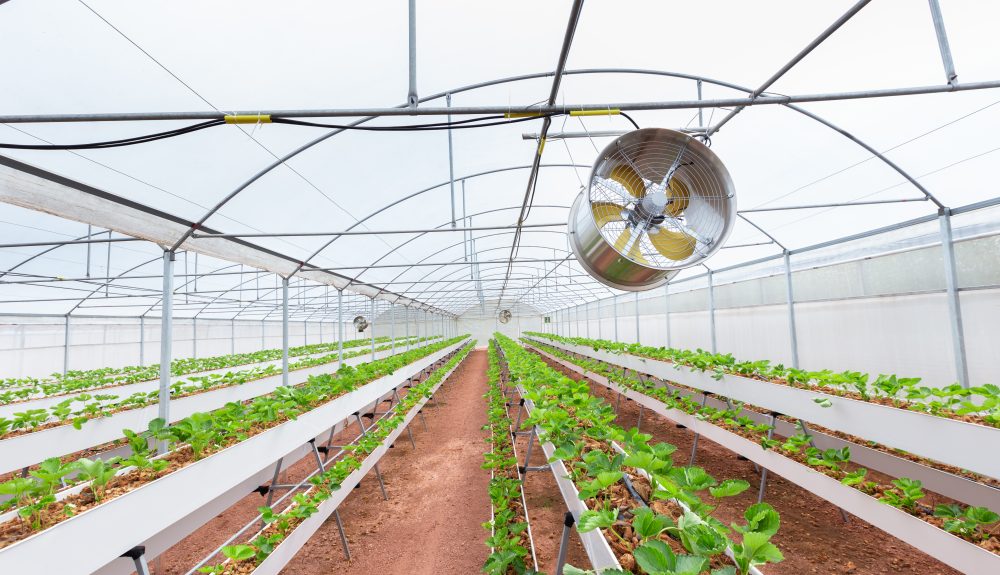
Ventilation manages more than heat. It controls humidity, supports CO2 exchange, and reduces disease pressure across the crop. Climate equipment research shows that in fan-and-pad systems, placing exhaust fans as high as possible removes the warmest air first, improving cooling efficiency and cutting evaporative water consumption by a meaningful margin.
Natural ventilation works through roof and sidewall openings, driven by wind and temperature difference. Mechanical ventilation uses exhaust fans to create negative pressure and pull fresh air through the facility consistently. Most commercial operations run both, shifting between them based on season and conditions. One coordination point worth noting: injecting CO2 while ventilation fans are running is largely wasted, as Ohio State’s greenhouse control guidance explains. CO2 enrichment needs to be scheduled around ventilation cycles, not run in parallel with them.
Humidity and VPD
Relative humidity gives you a basic moisture reading. Vapor pressure deficit, or VPD, tells you something more operationally useful: how much pulling force the air has on your crop’s moisture. High VPD means the air is dry and aggressive, causing plants to close their stomata and halt photosynthesis. Low VPD means the air is close to saturation, transpiration slows, nutrient movement drops, and conditions for fungal disease like botrytis become favorable.
Commercial growers who manage VPD alongside relative humidity get better yield consistency and fewer disease outbreaks. It is one of the more reliable indicators of whether your greenhouse environmental control is actually supporting crop performance or just maintaining a number on a screen.
Must read: 6 Benefits of Water-Based Agriculture with Hydroponics
Which Greenhouse Control System Works Best for Your Setup
No two growing operations have the same climate demands. What works for a small traditional greenhouse will not be enough for a commercial hydroponic facility, and what a vertical farm needs looks different again. The right greenhouse climate control setup comes down to your crop type, your production volume, and how quickly a system failure would affect your revenue.
A greenhouse with temperature control as the primary system generally does well with reliable heating, thermostat-driven ventilation, and basic circulation fans. It covers the essentials and works well for smaller operations with less complex crop requirements.
Commercial vegetable and floral operations need integrated climate computers, boiler-based heating, and coordinated CO2 and ventilation management to maintain the consistency that wholesale contracts require.
Hydroponic and indoor vertical farm operations run at the tightest tolerances of all. VPD management becomes more critical, dehumidification carries more weight, and backup power moves from optional to essential because the entire growing system runs on electricity. Hydroponic operations carry a specific risk profile that general coverage rarely addresses well.
The Real Cost of Greenhouse Climate System Failures
A climate failure in a commercial greenhouse rarely produces a single, contained loss. An HVAC breakdown overnight, a sensor that drifts out of calibration, or an irrigation pump that underperforms for several days can each trigger a sequence that looks like this:
- Crop stress or total loss across one or more growing houses
- Delayed production that pushes back the next harvest cycle
- Missed delivery windows and rejected orders from buyers
- Revenue loss that continues well past the date repairs are completed
Equipment failure in a climate control greenhouse can wipe out an entire crop cycle. NOAA recorded 27 billion-dollar weather and climate disasters in 2024 alone, and for controlled-environment growers, that exposure runs through every system the operation depends on. This is why specialty coverage built around how your facility actually runs matters far more than a standard property policy.
Greenhouse Grower Insurance That Covers Climate System Risk
Strong climate systems reduce how often things go wrong. The right insurance coverage handles the financial impact when they do. GrowPro is NIP Group’s specialty program for greenhouse growers, nurseries, hydroponic operations, and indoor vertical farms, backed by A+ rated carriers. An A+ rating means the carrier has the financial strength to pay a covered claim in full when it counts.
Coverage includes equipment breakdown, business interruption, crop and stock protection, general liability, and more. Contact us to learn more about coverage built for how your operation actually runs. Ask your broker to sign you up for GrowPro.
Frequently Asked Questions
What is VPD and why do commercial growers track it?
VPD, or vapor pressure deficit, measures the difference between the moisture in the air and how much more it can hold. For growers, it is a more accurate read on plant stress than relative humidity alone.
- High VPD: air is too dry, plants close their stomata, growth slows
- Low VPD: air is too saturated, transpiration stalls, fungal risk rises
Tracking VPD helps growers keep crops in the range where water and nutrient uptake actually work.
What is the difference between natural and mechanical ventilation in a greenhouse?
Natural ventilation uses roof and sidewall openings to move air through wind and temperature differences. Mechanical ventilation uses exhaust fans to pull air through consistently, regardless of outside conditions. In practice:
- Natural is lower cost but gives you less control in extreme or calm weather
- Mechanical is more precise and integrates better with automated climate systems
Most commercial operations use both.
What backup systems should a commercial greenhouse have in place?
At minimum:
- A generator sized for heaters, fans, and pumps running at the same time, with an automatic transfer switch
- A secondary heat source for primary system failures
- Alarms that notify multiple people when the temperature or humidity moves out of range
- Thermal curtains to hold heat during an outage
Test your generator under full load monthly, not just on a weekly idle cycle.
How does business interruption coverage work for greenhouse operations?
It replaces lost income and covers ongoing fixed expenses when a covered event forces a shutdown. For greenhouse growers, two things matter most:
- An extended indemnity period, because your revenue loss continues after repairs are done. The next crop cycle still has to grow
- Equipment breakdown is a covered trigger, since most greenhouse climate control losses start with a system failure, not a weather event