












Summary
- Winter heating eats into margins fast, and one failure can wipe out a season’s crop.
- Knowing how to keep greenhouse warm in winter starts with cutting heat loss first.
- This blog covers what lowers a greenhouse heating bill, how do greenhouses stay warm when equipment fails, and the coverage gap growers often miss.
Growers across the country watched the forecast turn ugly in late January. On January 23, USDA issued an advisory for Winter Storm Fern. It urged farmers and small businesses to brace for severe cold. The advisory pointed producers toward crop insurance and disaster assistance. That timing wasn’t a coincidence because heating a greenhouse in winter carries real financial weight.
U.S. horticulture operations sold $18.3 billion in specialty crops in 2024, according to USDA’s Census of Horticultural Specialties. Much of that revenue sits behind a thin layer of poly or glass. Add rising fuel costs to the mix, and the pressure only builds. The EIA expects electricity costs to run about 4% higher than last winter, while propane is trending roughly 9% lower. So heating costs this year look like moving targets, instead of fixed expenses.
That’s why knowing how to keep greenhouse warm in winter without overspending begins with a few smart choices. Yet, none of it means cranking the thermostat higher.
Must Read: Greenhouse Climate Control: What Systems Work Best and Why It Matters
What Drives a Greenhouse Heating Bill in Winter
A greenhouse loses heat because its covering favors light over insulation. Single-layer poly film carries an R-value of just 0.83. Add a second layer with an air gap, and that number rises to 1.43. That is a meaningful jump in resistance to heat flow.
Wind is another variable, and growers often underestimate it. A windy site can push heating needs up by 20% or more. Beyond wind, location also shapes your fuel choice and your costs. Nationally, the EIA counts nearly 29.7 million households in the West relying on these fuels. For the Midwest it’s about 28.2 million, and for the Northeast, 22.7 million. Natural gas and propane availability, therefore, shifts sharply by region. This is why a grower heating with propane in Minnesota faces different math than one using natural gas in Georgia.
So, costs for how to keep greenhouse warm in winter come down to two main drivers: structure and fuel choice. Apart from that, the regional climate decides how hard both have to work. Understanding these drivers helps you target the upgrades that matter most.
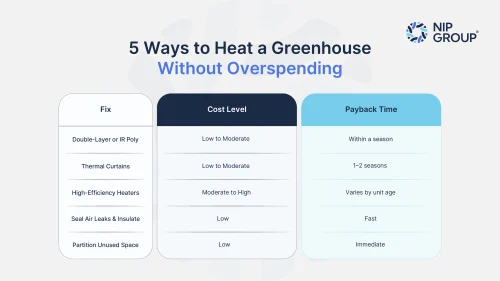
5 Ways to Heat a Greenhouse Without Overspending
Before spending a dime on more heat, stop the heat you’re already losing. These five fixes tend to pay for themselves the fastest.
Switch to Double-Layer or IR Poly
Double-layer poly outperforms a single layer by a wide margin. Two sheets of film trap a cushion of air between them, and a small blower keeps that pocket inflated at all times. An infrared inhibitor on the inner layer adds extra protection. Because it holds heat so well, payback on the upgrade often comes within a single season.
Install Thermal Curtains
Most heat escapes a greenhouse overnight, once the sun goes down. That’s when a thermal curtain pulled across the growing space traps that heat before it slips away. It’s a big part of how to keep greenhouse warm in winter. Installed cost typically runs a few dollars per square foot. From there, automated curtains open and close on a timer, keeping labor minimal. Manual curtains work just as well for smaller hoop houses on a budget. Either way, growers often see the investment pay for itself within two seasons.
Upgrade to High-Efficiency Heaters
Older heaters waste fuel that never reaches the plants. That’s why swapping in a modern condensing unit pays off, since it burns cleaner and holds heat longer. Check for a high thermal efficiency rating before you buy. Maintenance also matters just as much because a burner running out of tune burns fuel for nothing. Stay on top of it, and you also cut your odds of a midwinter breakdown.
Seal Air Leaks and Insulate the Foundation
Air leaks quietly drain the heat you paid for. Sealing them is central to how to keep greenhouse warm in winter. University of Georgia Extension also notes that older, poorly maintained glass houses can exchange air two to four times an hour. However, newer double-layer plastic houses exchange air far less often, sometimes under once per hour. Multiplied across a season, that difference lands on your fuel bill. So, weatherstripping doors and insulation seal that gap. Also, check fan louvers and vents each fall before the cold arrives.
Partition Unused Space
Part of how to keep greenhouse warm in winter is to not heat the space you don’t use. Close unused bays, and let a simple curtain wall or plastic barrier do the job. Keep burners tuned above 90% too. Small changes like these add up more than you’d think by season’s end.
How Do Greenhouses Stay Warm When the Heat Fails
A well-run greenhouse can also lose heat if equipment fails. That’s why a backup plan matters as much as your main heat source.
- Two smaller heaters offer more protection than one large unit. If one fails, the other still keeps plants above freezing.
- Pair that with a generator that starts automatically during a power outage.
- Add a temperature alarm as well that alerts you the moment things start dropping.
Knowing how to protect your greenhouse in winter starts with redundancy. If your main system runs on electricity, use a backup that does not. Test your backup system before the first hard freeze arrives. A dry run in October beats a surprise in January.
When a Good Heating Plan Still Isn’t Enough
Even the best setup can fail on the coldest night of the year. A boiler breakdown at 2 a.m. carries a cost beyond repairs. It includes the plants inside and the revenue they represented. Recovery can take days or weeks depending on the damage.
The best plan for how to keep greenhouse warm in winter has limits. USDA saw that risk and pointed producers toward crop insurance during Winter Storm Fern. That same thinking carries over to greenhouse business insurance. A strong policy responds to equipment failure and inventory loss, beyond storm damage. But save your maintenance records too, because a good overage often asks for proof before paying a claim.
Must Read: Why Climate Risk Insurance Is No Longer Optional for Greenhouse Growers
Why a General Business Policy Doesn’t Know What a Greenhouse Is
Growers who know how to keep greenhouse warm in winter can still face a coverage gap. A standard commercial policy covers typical buildings and contents. It wasn’t designed around living inventory or a boiler that can fail overnight. Many growers only discover this after a claim gets denied.
GrowPro is built specifically for greenhouse and nursery operations, closing it. From hydroponic farms to floriculture and ornamental nurseries, the coverage also includes general liability with limited pollution liability and cyber protection. Blanket building coverage protects multi-structure operations, while excess liability adds another layer on top. GrowPro is backed by carriers rated A and A+, signaling strong financial ability to pay claims. Contact us today or talk to your broker and sign up for GrowPro to add it to your policy.
FAQs
What temperature is too cold for a greenhouse?
Most crops struggle once nights dip below 50°F, and freezing causes lasting damage. Check your crop’s tolerance first because that number is also your benchmark for how to keep greenhouse warm in winter.
How to use an unheated greenhouse in winter?
Heating a greenhouse in winter isn’t required for every crop. An unheated house can still stretch your season for hardy plants like:
- Kale and spinach
- Root vegetables like carrots and beets
Add row covers or a cold frame for extra degrees.
How to heat a greenhouse for free?
True free heating doesn’t exist, but passive solar comes close. Two low-cost tricks you can try:
- Dark water barrels to soak up heat all day and release it at night
- Compost piles to generate warmth as they break down
However, neither replaces a real heater in a hard freeze.
How to heat your greenhouse at night?
How to keep a greenhouse warm at night often comes down to what happens after dark. Most heat slips away once the sun goes down. Thermal curtains and sealed vents hold that warmth overnight. Keep your backup heat source on a different power supply than your main system. That one step lowers risks to the greenhouse in cold climates when the grid goes down.