










Summary
- A missed propane leak can escalate into explosion, fire, and injury claims all at once.
- Knowing the five warning signs and how to respond keeps your crew protected and your business out of a claim.
- In this blog, we walk through every sign your crew needs to recognize before a leak turns into a loss.
NFPA’s January 2026 large-loss fire report identified 30 incidents in 2024 that caused $10 million or more in property damage each, including a building explosion tied to possible equipment failure. CPSC data shows roughly 600 fires and explosions occur annually involving gas grills alone. For crews working in propane distribution, those numbers have a direct context.
A propane leak that goes unnoticed for even a short window can escalate fast. Explosion, fire, and third-party injury can happen simultaneously, and all of them trace back to a sign someone should have caught earlier.
Here are five signs every crew member needs to recognize and take seriously, every time, without exception.
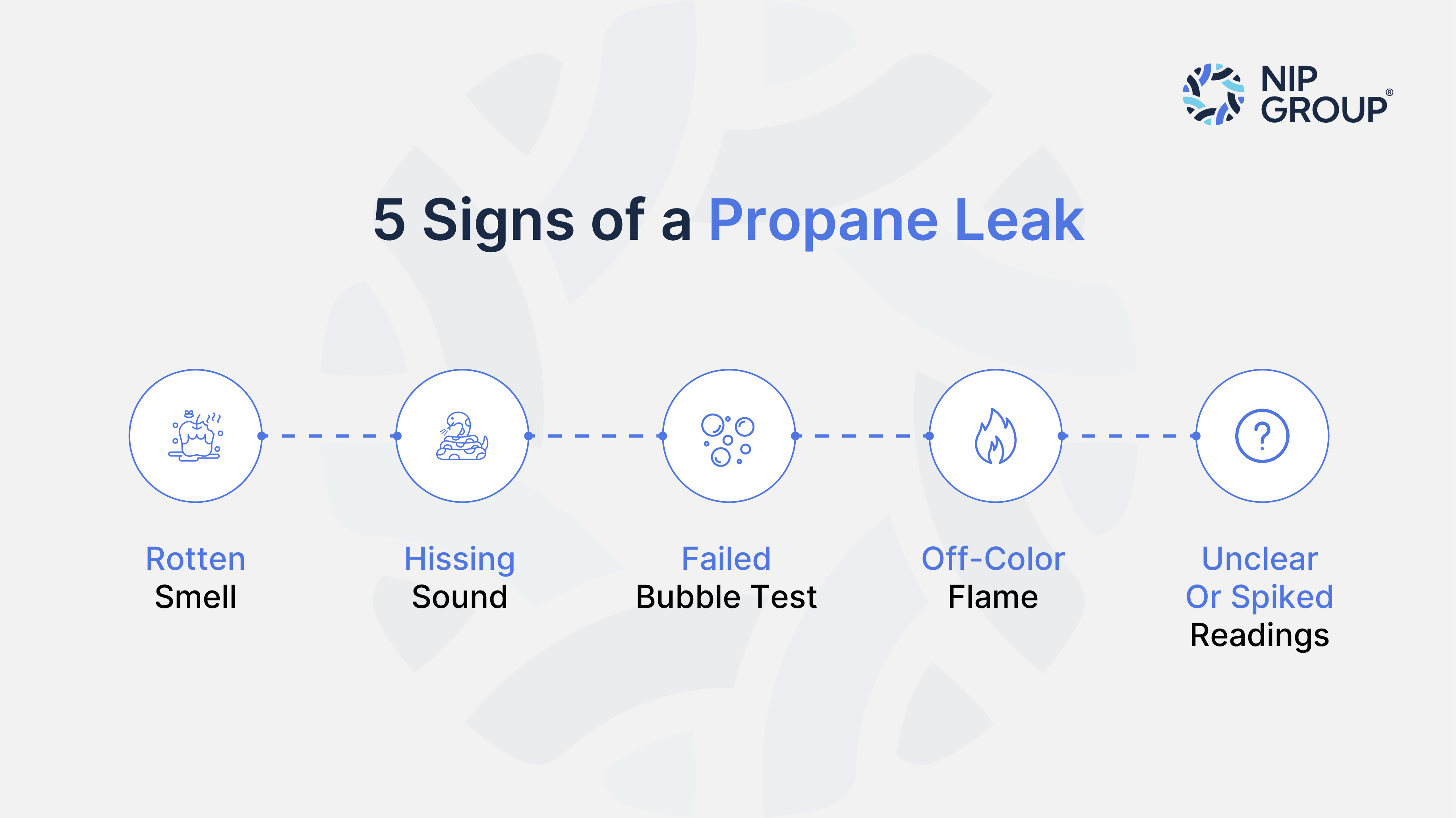
Sign 1: The Rotten Egg Smell That Demands Attention
The most immediate sign of a propane leak is smell. Propane in its natural state is colorless and odorless. Propane gas distributors add ethyl mercaptan so leaks are detectable before they turn dangerous.
If a crew member or customer of an LPG business reports this smell anywhere near a tank, line, or appliance, treat it as a confirmed leak until a full check says otherwise. One critical thing your team needs to communicate clearly to customers: odorant fade is a real phenomenon. Certain conditions, including soil absorption during underground leaks, can weaken the odorant’s intensity.
A leaking propane tank may not always smell as strongly as expected, even at hazardous concentrations.
Sign 2: A Hissing Sound Near a Tank, Line, or Connection
Sound is the second sense your crew should rely on for detecting a propane leak. A hissing noise near a tank, regulator, gas line, or appliance connection means gas is actively escaping under pressure. Even a faint hiss is enough to stop work and investigate.
This sign appears most often right after a tank refill or reconnection, which is precisely when leaks are most likely to occur. Crews should build this check into every delivery and every reconnection, without exception.
A hiss that stops when the valve is closed confirms that gas was escaping from somewhere upstream. That connection needs a full inspection before anything else happens on the job.
Must read: When Does Propane Tank Recertification Become Necessary?
Sign 3: A Failed Bubble Test at Any Connection Point
The bubble test for gas leak detection remains the most reliable field verification method available to your crew. Every technician should know how to run it correctly and when it is required.
Here is how to check for propane leak using this method:
- Apply a thick soapy water solution, or a dedicated leak detection solution, to every connection point between the cylinder valve and the regulator outlet
- Open the valve slowly and watch closely for bubbles forming at any point of contact
- If bubbles appear, close the valve immediately, tighten the connection, and repeat the test
- If bubbles persist after retightening, the component needs service or replacement before the system is used
This gas leak test should be standard on every new installation, after any service interruption, and any time a regulator, appliance, or section of piping is modified. A connection that passes once is not permanently cleared. Conditions change between visits.
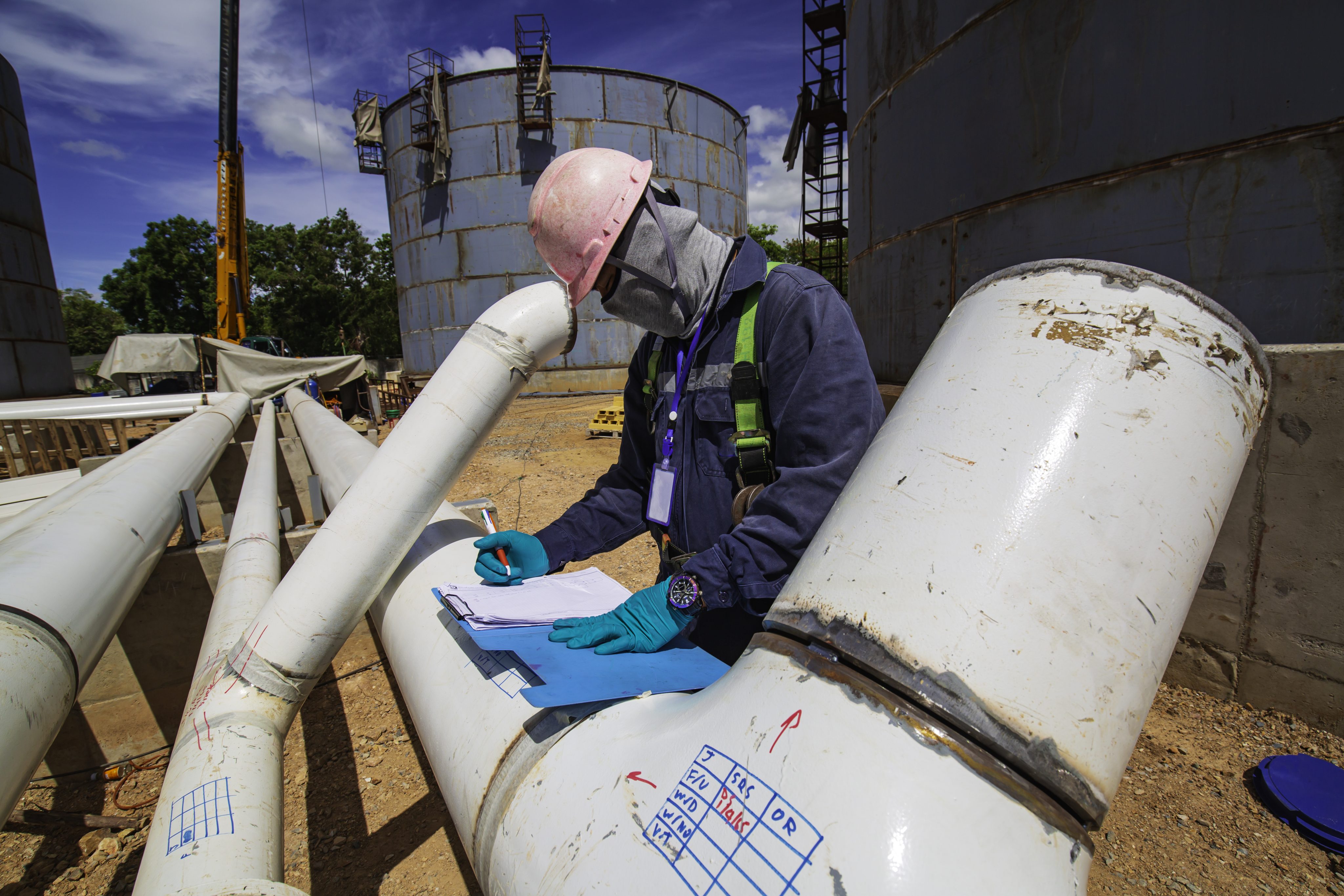
Male worker inspection at steel long pipes and pipe elbow new construction oil tank of visual check record pipeline oil and gas industry.
Sign 4: A Weak, Inconsistent, or Off-Color Flame
If a propane appliance produces a flame that is noticeably weaker than usual, flickers without cause, or burns an unexpected color, something is wrong upstream.
A diminished flame often indicates a drop in gas pressure reaching the appliance. That pressure drop can happen when propane is escaping somewhere between the tank and the burner.
Before assuming the problem is a clogged line or a failing regulator, run a propane leak detector sweep of the full system first. The appliance may not be the cause. The cause may be somewhere behind it, losing gas the whole time.
Must read: LPG Insurance and the Growing Scrutiny on Tank Installation Compliance
Sign 5: Detector Readings That Spike or Won’t Clear
A calibrated propane leak detector provides your crew with an objective measurement when smell and sound are inconclusive.
Since propane is heavier than air, it settles at floor level first. Detectors should be mounted low, where leaked gas will concentrate before it rises.
A few things every crew member needs to know about working with detection equipment:
- OSHA sets the permissible exposure limit for propane at 1,000 ppm over an 8-hour workday. Any reading approaching that threshold requires immediate action
- Propane becomes explosive at concentrations above 2.2 percent by volume, the lower explosive limit
- A propane leak will not trigger a carbon monoxide detector. The two require separate, dedicated devices
- Regular bump testing, using a controlled gas source to confirm the sensor responds, verifies the detector is functional before you depend on it in the field
A reading that spikes and won’t return to baseline after ventilation should never be dismissed as a sensor error before ruling out active signs of propane leak situation. Confirm the environment is clear before assuming the instrument is wrong.
PropanePro: Coverage Built for These Exact Stakes
Odorant fade and undetected leaks are among the most severe loss drivers in the LPG industry. A single missed propane leak can cascade into an explosion, fire, and bodily injury claims simultaneously.
That combination, when it occurs, generates significant financial exposure for LPG businesses at every level of the distribution chain.
PropanePro’s specialized coverage for gas dealers and distributors is built around these high-severity exposures that sit at the heart of LP-Gas liability. It is designed specifically for propane distribution operations, not adapted from a general commercial policy. The carrier behind PropanePro holds an A+ (Superior) rating from A.M. Best, meaning the financial strength to follow through when a claim of this magnitude arrives.
Talk to your broker about PropanePro or contact us directly. Make sure your coverage reflects the actual risk your crew manages on every delivery.
FAQs
How serious is a propane leak?
A propane leak is a serious safety emergency. Propane becomes explosive at concentrations above 2.2 percent by volume. In an enclosed space, especially during propane transportation, a leak can reach that threshold faster than most people anticipate. Fire, explosion, and suffocation are all real risks. Any suspected leak should be treated as confirmed until a full inspection says otherwise.
What do you do if you have a propane leak?
If you suspect a propane leak, the steps are clear and should be followed without improvising:
- Do not search for the source. Get everyone, including pets, out of the area immediately
- Do not activate light switches, phones, or any device that can produce a spark
- Turn the tank valve clockwise to the off position if it is safe to reach
- Once you are clear of the area, call 911 and your propane provider
- Do not return until a technician confirms the area is safe
How long to air out a house after a propane leak?
Airing out a house after a propane leak depends on:
- the size of the space
- how long the leak was active
- how well ventilation can circulate air
In most situations, opening windows and doors and allowing 15 to 30 minutes of active ventilation is a starting point. However, a qualified technician should verify with a propane leak detector that levels are safe before occupants return. Do not rely on smell alone to confirm the space is clear.
Which is the best insurance for propane businesses?
The best insurance for a propane business is one built specifically around LPG distribution risks, not a standard commercial policy adjusted to fit. That means coverage for high-severity exposures like undetected leaks, odorant fade liability, and simultaneous explosion and injury claims. PropanePro is designed exactly for this, backed by an A+ (Superior) rated carrier and specialized expertise in LP-Gas liability. Ask your broker about it.