









Summary
- One missed hazard on a dig can bring OSHA fines and injury claims together.
- A construction site risk assessment flags each hazard early and assigns someone to control it.
- This blog covers each assessment step and the coverage that leftover risks need.
In a recent October release, OSHA cited a Pennsylvania excavation contractor after a worker died in a trench cave-in. The proposed fines total $254,884, and several of the violations trace back to poor planning. Nobody had been assigned to check the trench each day. Hazards like these show up on every construction site, whether you are grading land or digging footings. A missed one can bring fines and an injury claim from the same job.
This blog, therefore, answers what is a construction site risk assessment and explains how to run one. It also shows where insurance covers the risk that remains.
Must Read: How Modern Equipment and Automation Are Shifting Risk for Roadway Contractors
What Is a Construction Site Risk Assessment?
A construction site risk assessment is a written plan for handling every hazard on a job. Your foreman runs the site from it each day. If OSHA ever shows up, it’s also your proof that the work was planned.
The process starts with a construction hazard assessment. Someone walks the site and lists anything that could hurt a worker or damage property. Next, rank each hazard by how likely it is to happen and how bad the damage could be. The most serious hazards get a safety step, plus a crew member who makes sure it’s followed.
You may already have a company safety plan, but that covers every job the same way. A construction site risk assessment is different because it covers one site only. It deals with what’s specific to that job, such as the soil type or where gas lines run underground.
Why Does a Construction Risk Assessment Matter for Excavation Work?
A construction risk assessment matters because excavation hazards often give your crew little warning before they cause harm. These hazards can include, but are not limited to, the following:
- Equipment contact: An excavator can hit workers on foot as it swings. Marking off its swing area keeps the crew clear.
- Falls into open cuts: A worker backing away from a machine can step straight into a trench. Barriers and clear walkways help prevent that.
- Cave-ins: Wet soil gives way fast, sometimes in a matter of seconds. Your assessment shows which trenches need shoring or a trench box.
- Utility strikes: A hit on an unmarked gas line can force an entire street to evacuate. So, wait for 811 to mark every line before anyone digs.
Your construction site risk assessment helps you match each hazard to the policy that would respond. That way, you can ensure your excavation business insurance covers all of them before work starts.
Must Read: Positioning Your Clients For Success: Broker Insights Into Excavation Contractor Insurance
How to Conduct a Risk Assessment in Construction
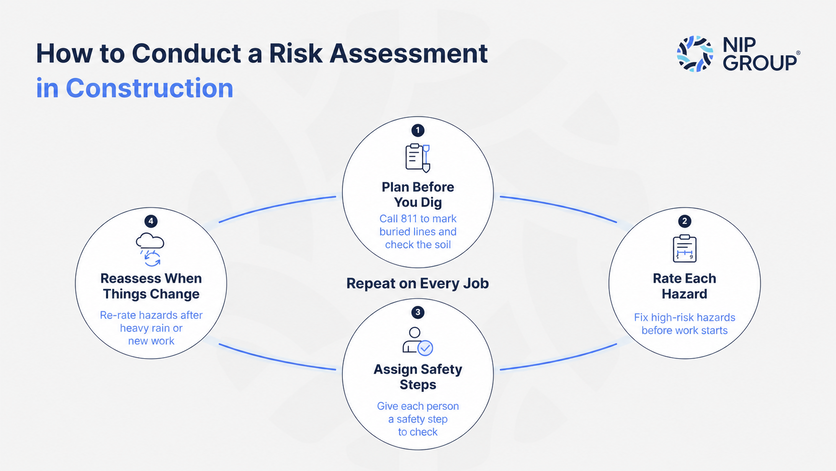
Learning how to conduct a risk assessment in construction is simpler than most owners expect. It takes four steps, and you’ll use them in the same order on every job.
1. Start With a Pre-Construction Risk Assessment
A pre-construction risk assessment is done before any equipment shows up on site. Most of it happens at a desk with the site plans, followed by one slow walk of the property. Begin with these four checks:
- Soil conditions: Find out the soil type and how wet it is. Both decide what kind of trench protection you’ll need.
- Underground utilities: Call 811, then hold off on digging until every line is marked.
- Nearby property: Look for buildings or roads close enough for your work to damage.
- Drainage: Once you start moving dirt, rainwater will find a new path. Mark where it’s likely to go.
2. Walk the Site and Rate Each Hazard
Next comes the site risk evaluation in construction work, where you score each hazard. Rate how likely it is from one to three, then score the harm it could do the same way. Multiply the two, and that’s your score. Anything at six or higher needs control before your crew starts working.
Say you’re digging a five-foot trench beside a busy road. Without protection, a cave-in is likely and could badly hurt someone. That’s three times three, so it scores a nine and tops your list.
3. Set Controls and Assign an Owner
Once your construction site risk assessment ranks the hazards, assign a control and an owner to each. Common controls in a risk assessment for excavation include:
- Protective systems: Any trench five feet deep or more needs a trench box or shoring.
- Spoil placement: Keep dirt and materials at least two feet back from the edge.
- Safe exits: Once a trench reaches four feet, workers need a ladder or ramp within 25 feet.
- Equipment zones: Mark off swing areas so your ground crew stays clear of moving buckets.
4. Reassess When the Site Changes
Your construction site risk assessment needs an update every time conditions on the site change. A hazard you rated on Monday might score differently by Wednesday. After a night of heavy rain, a trench wall can turn soft and unstable.
How to Conduct a Risk Assessment in Construction
What Should a Construction Safety Risk Assessment Template Include?
A good construction safety risk assessment template comes down to six fields:
- Hazard list: Every hazard you found on the site walk, should be written the way your crew would describe it.
- Controls: What your crew will do to make each hazard less dangerous.
- Project details: Where the site is and when you’ll be working there.
- Responsible person: The name of whoever checks each control.
- Risk rating: A score that combines how likely each hazard is with how bad it could get.
- Review log: A dated, signed entry for every change made to the form.
Keep the form short enough for your foreman to finish on site. That’s because a quick form gets filled in every day, and your records stay current.

What Risks Remain After the Assessment Is Done?
Some risk stays on every site after a construction site risk assessment, and the right insurance is what handles it. Soil can still shift in ways no test predicted, or a marked utility line can sit a few feet off. Those risks show up in national data, too: BLS recorded 1,034 private-sector construction deaths in 2024, 389 of them fall-related.
On an excavation job, each leftover hazard usually points to a specific line of coverage:
- Equipment theft: Inland marine replaces tools stolen from the site overnight.
- Trench collapse: Workers’ comp pays an injured worker’s medical bills and lost wages.
- Silt runoff: Contractors’ pollution liability pays for cleanup on a neighbor’s land.
- Utility strike: General liability pays for the damage, with umbrella coverage above that limit.
A well-kept construction site risk assessment shows the insurance company that you acted on a hazard before the loss.
Moreover, for grading and excavation contractors, SitePro groups these coverages in one program, along with commercial auto and property. Employment practices liability and cyber coverage are part of it as well. SitePro’s insurance company holds an A+ (Superior) rating from A.M. Best. Put simply, it has a superior ability to meet its financial promises, including paying your claims.
Ask your broker to sign you up for SitePro, or contact us directly for answers specific to your business.
FAQs
1. How long does a construction site risk assessment take?
It mostly depends on the size of the job. On a small residential dig, a construction site risk assessment can take under an hour. A large commercial site might take a full day, and you’ll still add short updates daily once work begins.
2. Who is responsible for doing a risk assessment on a construction site?
The employer whose crew does the work is responsible for its hazards. On jobs with several contractors,:
- Subcontractors are responsible for hazards their own crew creates or faces.
- General contractors are often liable for site-wide hazards they control.
3. What is the difference between a job hazard analysis and a risk assessment?
A job hazard analysis breaks one task into steps and lists the hazards in each. A risk assessment looks at the whole site and ranks every hazard by priority. Many contractors use both together.
4. Does OSHA need a construction site risk assessment?
No, OSHA doesn’t require a document by that name. What it does expect is regular site inspections by a competent person. A written construction site risk assessment is the easiest way to prove those inspections took place.