








It’s the peak of winter, and while most folks cozy up indoors, the phones are still ringing for your tree care business.
Arborists find no respite in this season; the demand for tree pruning, removals, and health check-ups doesn’t take a break, not even for a snowy day.
For your tree care crew, it’s a season of hard hauling equipment, climbing trees, operating heavy machinery, and more. It’s a physically demanding job with real risks.
The numbers speak for themselves. Tree care professionals face 15x more fatalities and 3 times more injuries than other industries, according to the Tree Care Industry Association (TCIA) and Bureau of Labor Statistics.
You have a duty to keep your team protected, but how do you safeguard against injuries that seem inevitable in this line of work? The truth is, that many common tree care service injuries can be prevented with the right safety measures. Let’s walk through the top five injuries in the tree care industry and what you can do to avoid them.
What Are the Most Common Injuries in the Tree Care Business?
The TCIA reports that May is when the highest number of fatal incidents to tree care workers occurs.
There’s no doubt the duties involved with tree care can be physically demanding, requiring workers to climb, bend, lift, carry, kneel, shovel, and more.
The Bureau of Labor Statistics states that tree trimmers and pruners experience one of the highest rates of fatalities in all occupations.
Here are a few of the most common injuries tree care workers suffer, and some prevention tips to ensure tree care business owners can keep employees safe while on the job.
1. Injuries From Falling
Falls are the most common fatal type of accident for tree care workers. They can also result in broken bones, concussions, and other more severe injuries.
To help reduce potential injuries due to falls:
- Train workers on the types of fall hazards and the correct procedures for using, inspecting, and maintaining fall protection systems.
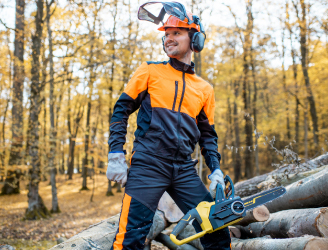
- Supply workers with the proper PPE such as harnesses, gloves, non-slip boots, belts, slings, and climbing equipment.
- Provide proper fall protection like harnesses, ropes, and anchoring gear.
- Secure ladders and place them on stable surfaces.
- Maintain bucket trucks with guardrails in place.
- Caution workers to watch for slick surfaces like wet leaves or sap.
· Provide workers with proper arborist footwear.
2. Injuries From Contact with Objects
Your team works with all sorts of hazardous objects daily – chainsaws, branches, logs, chippers, cranes, and more. A falling or flying object will inevitably strike someone eventually.
Contact with objects is the second most common injury workers in the tree care service business experience, according to the TCIA.
These incidents can be reduced with these measures:
- Talk to your team about situational awareness and never letting their guard down.
- Designate safety zones at a distance from dangerous machinery.
- Lower branches safely to the ground immediately after cutting.
- Workers should understand the basics of equipment safety.
- Consider purchasing smart equipment with built-in safety features.
3. Environmental Injuries
Tree care workers are outside in all types of weather, from the hot sun to the bitter cold.
Working in hot weather can lead to heat stress or heat exhaustion, dehydration, and other injuries and illnesses. The cold can cause hypothermia or frostbite.
Additionally, exposures can happen easily. From gasoline, oil, exhaust fumes, pesticides, and even plants like poison ivy, poison oak, and sumac which can cause allergic reactions such as rashes.
To reduce the chances of environmental injuries:
- Require workers to take frequent breaks to decrease their exposure to the elements.
- Your workers should understand what type of clothing can best protect them, like light-colored, breathable fabrics in the summer and cold weather gear like hats, gloves, and heavy coats in the winter.
- Take precautions when employees are working amongst foliage and could come into contact with poison ivy, oak, or sumac.
- Make sure gear and machinery are well-maintained to prevent leaks or excess emissions.
4. Electrocution
In the tree care business, the proximity to power lines is practically a job requirement. Working close to a power line can put your workers at high risk of contact with the line which can lead to electric shock or electrocution.
This contact is most often indirect when a worker hits the line with a conducive tool like a metal pruner. Or, sometimes a branch the worker just cut and is holding in their hand could touch the power line. Workers may also physically touch the power line themselves inadvertently, especially if the wind picks up and pushes them towards it.
Tree care workers should take extra caution around power lines:
- Workers should always assume lines are energized.
- Workers should follow the proper minimum distances to avoid contact.
5. Transportation Accidents
Any occupation that utilizes vehicles as part of daily job duties is at risk for transportation accidents. Tree care workers are not only at risk driving to and from job sites but automobile accidents and injuries can also occur when employees are working at trees located roadside.
To protect your staff from transportation accidents and injuries, the following steps must be taken:
- A proper work zone must be set up at any job site near the road, including cones, signs, and barricades.
- Flaggers should be used to direct traffic through the area to help workers avoid getting hit.
Protect the limbs and lives of your crew while also protecting your business and interests.
Protect Your Biggest Asset — Your People
In tree care, safety is planted from the roots up. Your workers climb into harm’s way daily, relying on you to cultivate an environment where they can thrive risk-free.
While hazards are inherent in this line of work, injuries don’t have to be inevitable. With precaution, training, and the proper gear, your crew can continue reaching new heights, incident-free.
Your people are your greatest asset. Investing in injury prevention protects your employees, reduces downtime and workers’ compensation claims, improves morale, and boosts your business’s bottom line.
At NIP Group, we have over 35 years of experience helping tree care businesses cultivate robust safety programs with TreePro. Our specialized insurance policies and risk management guidance take protection to the next level.
With the right partner, you can empower your tree climbers to hit their goals, safely and successfully. Don’t leave anything to chance – give your team coverage you can trust.