










Summary
- Most swimming pool construction business plans are still built around market conditions that no longer exist.
- Knowing where the market is actually moving, and planning around it, is what separates growing businesses from stalling ones.
- In this blog, we break down what a strong pool construction business plan looks like in 2026.
PHTA’s Q3 2025 Quarterly Pulse Survey puts the current picture plainly. 44% of swimming pool construction companies reported a revenue increase from new builds last year. But 37% reported a decrease. That split tells you something important about where the industry actually stands right now.
Remodel work is filling some of that gap. 42% of companies reported revenue growth from remodel jobs, compared to just 21% reporting a decline. Service and maintenance is the only segment posting consistent profit growth.
Meanwhile, 70% of businesses cited economic factors, including inflation, interest rates, and consumer spending, as their biggest challenge heading into 2026.
That’s the environment a pool construction business plan needs to be built around today. What’s actually in front of you right now? This blog will discuss everything in detail.
What the 2026 Pool Market Is Telling You
The post-pandemic construction surge is behind us. For swimming pool construction businesses that built their revenue model around new residential builds, the softening is real and worth planning around directly.
The segment that’s holding up well is premium residential. Homeowners commissioning custom pool construction tend to be less sensitive to interest rate pressure. They’re investing in high-end finishes, automation systems, and water features, and that work carries better margins than volume new builds.
Commercial pool construction is following a different curve. Hospitality development, multifamily amenities, and institutional projects are more tied to debt financing cycles. Some markets are still seeing activity, while others have stalled.
If your business hasn’t mapped which commercial segments are active in your specific geography, that’s a gap worth closing before the next planning cycle.
The contractors posting consistent growth right now have one thing in common. They know exactly where their revenue is coming from, and they’ve deliberately shifted capacity toward the segments that are still moving.
Must Read: Year-Round Insurance Considerations for Pool Equipment Distributors
What a Swimming Pool Construction Business Plan Should Cover
Most swimming pool construction business plans cover revenue projections and equipment lists. A plan built for 2026 needs to go further than that. Here’s what the strongest ones include.
A Deliberate Revenue Mix
New builds, remodel work, and service contracts, they carry different risk profiles, different cash flow cycles, and different insurance requirements.
A plan that maps the revenue mix intentionally, and accounts for how that mix shifts seasonally, gives you a much clearer picture of where your margin actually lives.
Realistic Cost Modeling
Material costs haven’t stabilized the way most operators hoped they would. PHTA’s data shows that for building and remodeling businesses, revenue gains are being absorbed by input costs. Meaning top-line growth isn’t translating to bottom-line improvement.
A pool construction business plan that uses last year’s material prices is already behind. Build in a cost cushion, and model multiple scenarios rather than a single revenue projection.
A Workforce and Subcontractor Strategy
Labor availability ranks as the second most significant challenge in PHTA’s survey data. If your business plan doesn’t address how you recruit, retain, and manage subcontractors, it’s missing a critical operational risk.
Subcontractor gaps also carry direct liability implications. When a subcontractor causes damage or injury on your job site, the claim starts with you.
A Risk and Coverage Review Built Into the Calendar
This is the section almost no swimming pool construction business plan includes, and it’s one of the more consequential omissions.
As project complexity grows, as custom pool construction pushes into automation and water features, and as commercial pool construction brings more stakeholders and contracts into the picture, coverage needs change.
Building an annual insurance review into your planning cycle is the difference between catching a gap early and discovering it mid-claim.
How to Start a Swimming Pool Business That Scales
For operators earlier in the journey, those researching how to start a swimming pool construction business that can grow, the foundational decisions matter more than most people realize at the time they’re making them.
A few that consistently separate scalable businesses from ones that plateau:
- Licensing and certification need to come first, not later. Every state has specific requirements for pool construction contractors. Operating without proper licensing creates contract disputes, regulatory exposure, and underwriting problems when you go to place coverage.
- Define your scope before you expand it. Starting with a clear specialty, including residential new builds, renovation work, or commercial pool construction, lets you build operational depth. Trying to do everything early tends to produce thin margins and a risk profile that’s harder to insure.
- Build your insurance program around the work you’re planning to do, not just the work you’re doing right now. A policy written for a two-person operation doesn’t scale automatically. Reviewing coverage as the business grows is far less expensive than finding a gap after a claim has already arrived.
Must Read: How Weather Extremes Are Changing the Way Every Pool Builder Manages Risk in 2026
PoolPro: Coverage Built for the Full Scope of Pool Construction Work
A swimming pool construction business plan that doesn’t address coverage is missing a structural piece. The work involves excavation, electrical systems, water features, automation technology, and completed operations that generate claims months or years after a job closes. Standard contractor policies weren’t built for that combination.
PoolPro is built specifically for pool construction and contracting businesses. It covers general liability, workers’ compensation, commercial auto, inland marine, errors and omissions, equipment breakdown, cyber liability, and EPLI.
Specialized extensions for pool popping, completed operations, and design services address exposures that general policies consistently miss. It’s structured around how swimming pool construction operates, from residential new builds through custom pool construction and commercial pool construction projects.
Talk to your broker about PoolPro, or contact us directly to review your coverage before the next project season starts.
FAQs
- Is it cheaper to build a pool during construction?
Building a pool during home construction can save on costs like excavation and landscaping, since crews and equipment are already on site. That said, savings vary considerably by project scope and contractor. Getting a dedicated swimming pool construction quote alongside your home build is the smarter move.
- What is the most expensive part of a pool?
Excavation and the structural shell typically carry the highest costs in pool construction. For custom pool construction with automation systems, water features, or specialty finishes, technology and materials can push those numbers significantly higher. Labor is the other major variable, especially in markets where skilled swimming pool construction crews are in short supply.
- What are the steps to build a swimming pool?
The process generally follows this order:
- Site assessment and design approval
- Permits and inspections
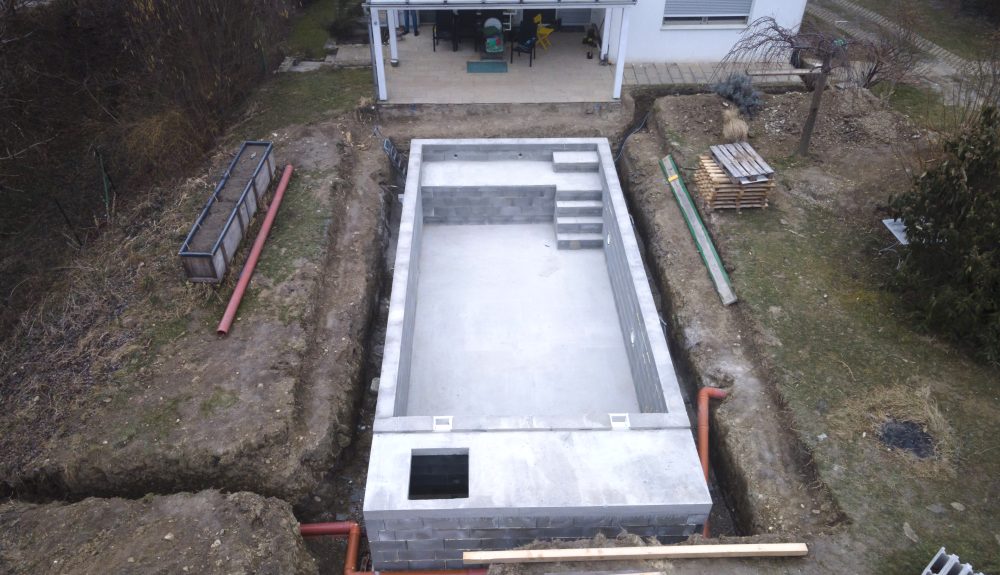
- Excavation and grading
- Steel and shell installation
- Plumbing and electrical rough-in
- Decking and coping
- Interior finishing and equipment installation
- Final inspection and water fill
Commercial pool construction projects add layers of regulatory review and stakeholder sign-off at several of those stages, which extends timelines considerably compared to residential builds.
- Which is the best insurance for swimming pool construction businesses?
The best insurance for swimming pool construction businesses covers the full scope of the work. That means completed operations coverage for post-job claims, errors and omissions for design and workmanship disputes, equipment breakdown, and workers’ compensation built for construction site risk. PoolPro is designed specifically for this industry, backed by 35+ years of expertise and an A+ (Superior) rated carrier. Ask your broker about it.