










Summary
- Skipped service intervals quietly drain excavation businesses of billable hours and unplanned repair costs.
- A disciplined heavy equipment maintenance routine keeps machines running and crews earning every day.
- This blog breaks down practical steps for heavy equipment maintenance. It also gives you a realistic schedule and the coverage that keeps you protected.
Every excavation contractor knows the drill. No working machine means no working day. The second an excavator goes quiet, your crew stops earning, and so do you. That’s what heavy equipment maintenance comes down to. It decides whether your crew logs billable hours today or waits on a call to the dealer instead.
This connection matters even more this year. Machines cost more to own than they used to. That means every skipped service interval carries a bigger price tag than before. The global heavy construction equipment market was valued at $204.4 billion in 2023. Grand View Research projects it will climb to $233.4 billion by 2026.
That growth isn’t only about new machines rolling off the line. Fortune Business Insights points to rising fuel and parts costs. Maintenance expenses are climbing too, adding to the operational burden for construction companies. Put simply, equipment is pricier to buy and run, which raises the cost of every shortcut a crew takes on maintenance.
Why Heavy Equipment Maintenance Matters
Excavation contractors are squeezing more out of the same fleets, under tighter margins and higher stakes than they used to. The construction equipment repair and maintenance service market reflects that shift, valued at $56.16 billion in 2024 and projected to reach $94.88 billion by 2035, according to Market Research Future. More businesses are choosing to keep machines running instead of replacing them.
A few specific pressures explain that spending, and each one puts more weight on every heavy equipment maintenance call you make.
- Equipment prices are still climbing, so replacing a machine now costs more than keeping the one you already have running
- Contractors are booked tighter than usual, with busier project pipelines leaving little room to absorb a breakdown
- Fewer shops keep mechanics on staff these days, so a breakdown often means a longer wait for outside repair, turning a one-day fix into a week-long delay
Well-maintained equipment can last up to 30% longer than equipment that isn’t kept up properly, turning routine service into real savings over a machine’s working life.
Must Read: Why the Construction Industry is Facing a Labor Shortage and 5 Tips to Lessen Its Impact
What Good Heavy Equipment Maintenance Prevents
Most equipment failures start as small, ordinary things a busy crew overlooks. By the time they turn into a breakdown, the fix costs a lot more than it would have earlier.
The Warranty Problem
Every machine comes with a maintenance schedule built around how its engine and undercarriage are designed to hold up. Skipping intervals to finish a job voids warranties and shortens component life. It also makes resale or trade-in value harder to defend later.
So, build your heavy equipment maintenance calendar around the OEM schedule first. Then adjust it to fit how the machine gets used on your jobs.
The Outdated Schedule
A machine running ten hours a day wears out faster than one running three, no matter when you bought either one. Servicing by the date instead of the clock means neglecting the hardest-working machine first.
That’s why track engine hours on every machine. Set your service triggers around those hours. Most excavators and loaders log this data through the onboard computer, so pulling it takes minutes. This ties your heavy equipment maintenance schedule to real use.
What’s Failing on the Inside
Some damage never shows up on a walk-around at all, because it’s happening inside the machine. By the time a bearing or gear shows signs of wear, the damage is already expensive.
Oil and hydraulic sampling catches it earlier. Metal particles and discoloration in a sample show up long before a failure would. So sending a sample to the lab every few hundred hours means scheduling the fix on your terms.
Budget That Undercarriages Blow Through
Few components drain a repair budget faster than a neglected undercarriage. Packed mud and debris strain rollers long before the wear becomes visible. Contractors also tend to notice it only once the repair bill outgrows their budget.
Hose down tracks after wet jobs and check tension weekly. Swapping the worn parts out early also keeps that bill in check. Waiting for a full failure costs far more than a scheduled fix.
On the rare occasion, though, a failure isn’t something maintenance could have caught. When that’s the case, excavation business insurance is what absorbs the cost instead of your operating budget.
Must Read: Excavation Insurance for Contractors: What Changes When Your Business Grows
The Service History That Disappears
Paper logs get lost or left in a truck, and once that happens, the service history walks out the door with them.
A digital record solves that by tying every service and inspection to a specific machine. So any technician can pull it up in seconds. A good heavy equipment management software goes further and flags overdue service on its own, so a supervisor juggling five jobs doesn’t have to remember it too.
Best Practices for Heavy Equipment Maintenance
What a Heavy Equipment Maintenance Schedule Should Look Like
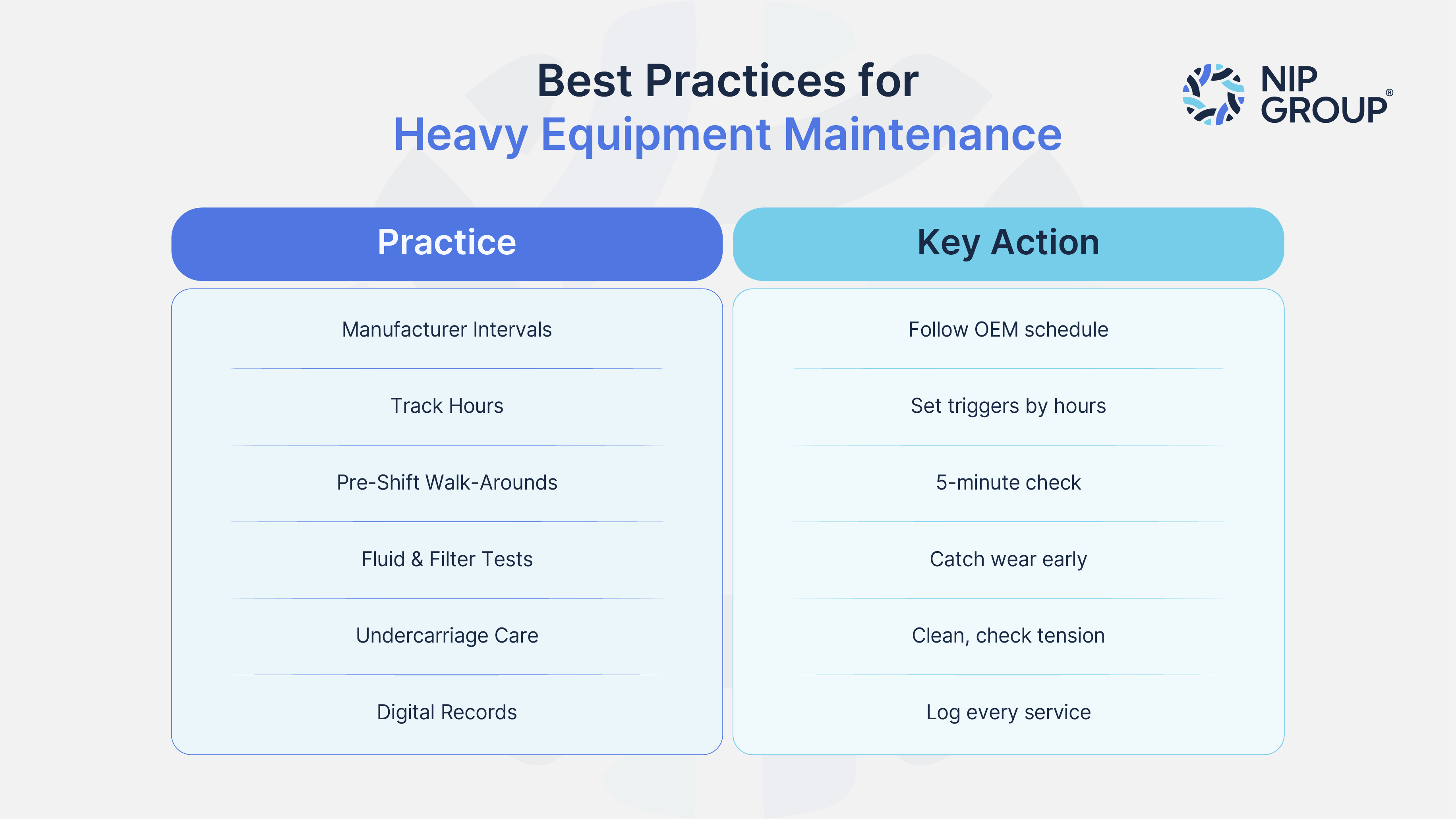
A written schedule ensures everyone in the crew can follow these six practices, instead of relying on your memory alone.
- Daily: fluid levels, visual inspection, operator walk-around
- Weekly: track tension, filter checks, grease points
- Monthly: fluid sampling, belt and hose inspection, battery check
- Annually: full inspection, major component service, safety compliance review
Write this schedule down and assign it to one person on your crew. A schedule nobody owns is the first thing to slip once the job gets busy. Pin it up where the crew can see it. Run through it at your safety meetings so it stays part of the heavy equipment maintenance routine. Pair it with the right coverage so the schedule and the policy are both doing their part too.
Coverage Built for Grading and Excavation Contractors
A generic contractor policy is written for a little bit of everything, which usually means it fits nothing particularly well. Grading and excavation work comes with its own set of risks, from fleet exposure to jobsite liability. SitePro was built around that reality instead of around a checklist.
SitePro includes:
- General liability with limits up to $1 million per occurrence and $2 million general aggregate
- Auto liability and physical damage up to $1 million combined single limit
- Property coverage up to $3 million in total insured value
- Inland marine coverage up to $3 million, protecting your fleet against loss, theft, and damage
- Workers’ compensation at statutory limits
The program is admitted and written in all states. It welcomes excavation, site preparation, grading, and land improvement contractors of any size. It is also backed by carriers rated A+ for financial strength. That means a superior ability to pay claims when you need them to. So, talk to your broker and add SitePro to your policy. Or, contact us directly, and we’ll help you get started.
FAQs
1. What is the 10 rule in maintenance?
It’s a simple rule of thumb. Every dollar you put into preventive heavy equipment maintenance saves you roughly ten dollars in repairs and downtime later. Put off that $200 filter change, and you might be staring down a $2,000 repair bill a few months from now.
2. How much do heavy equipment mechanics make in California?
Pay swings a fair amount depending on employer, certification, and region, but most heavy equipment mechanics in California land somewhere between $65,000 and $90,000 a year, or roughly $28 to $35 an hour.
3. What skills do heavy equipment mechanics need?
The heavy equipment maintenance job leans heavily on hands-on technical know-how. Strong candidates usually bring:
- Diesel engine and hydraulic system knowledge
- Comfort with electrical diagnostics and onboard computer systems
- Welding and fabrication skills for field repairs
- Physical stamina, since a lot of the work happens outdoors, on your feet, or underneath a machine
4. What is covered under equipment insurance?
It depends on the policy. But equipment insurance, often written as inland marine coverage, protects against theft, vandalism, transit damage, and accidental loss. It usually does not cover routine wear and tear or a mechanical breakdown caused by neglected maintenance. This is also why keeping clean service records matters.