











Summary:
- Pool contractors often carry insurance that misses their real construction and liability risks.
- Understanding swimming pool insurance requirements means pairing the right policies with limits that hold.
- This blog breaks down each required coverage and where contractors often fall short.
The Consumer Product Safety Commission released a report on June 24, 2026, on drowning risks among young children. It found that an average of 376 children under 15 died in pool or spa incidents each year between 2021 and 2023. Fatalities peaked hardest in June, July, and August.
That timing raises the stakes on every job during peak season. A new build finished in June or a service call made in July can end up connected to an incident weeks later. When that happens, the first document anyone asks for is your certificate of insurance. That single fact is why swimming pool insurance requirements deserve attention long before a claim ever surfaces.
Why Are Swimming Pool Insurance Requirements Tightening
Swimming pool insurance requirements are getting stricter for a clear reason. Claims tied to pool work have grown more frequent and more costly.
Drowning and entrapment incidents drive part of that shift. The Virginia Graeme Baker Pool and Spa Safety Act has required anti-entrapment drain covers at public and semi-public pools since 2008. It is not a new law, but it stays relevant.
In 2026, the CPSC issued several recalls for pool drain covers that violated its entrapment protection standard. When a non-compliant cover ends up on a job you built or serviced, the contractor who installed it often becomes the first point of liability.
Insurance companies have responded by raising minimum coverage limits and asking sharper questions before writing a policy. Many now require proof of completed operations coverage before quoting a pool builder at all. A policy that once covered basic bodily injury and property damage no longer satisfies most underwriters.
Clients have tightened their expectations too. Commercial property managers and HOAs increasingly ask for a certificate of insurance before signing a contract. Homeowners are asking the same question earlier in the bidding process.
This shift changes how contractors need to plan. Swimming pool insurance requirements now need to be settled before you bid a job, instead of after winning one.
Must Read: From Repairs to Remodels: Choosing the Right Pool Insurance for Every Project
The Core Insurance for Pool Contractors
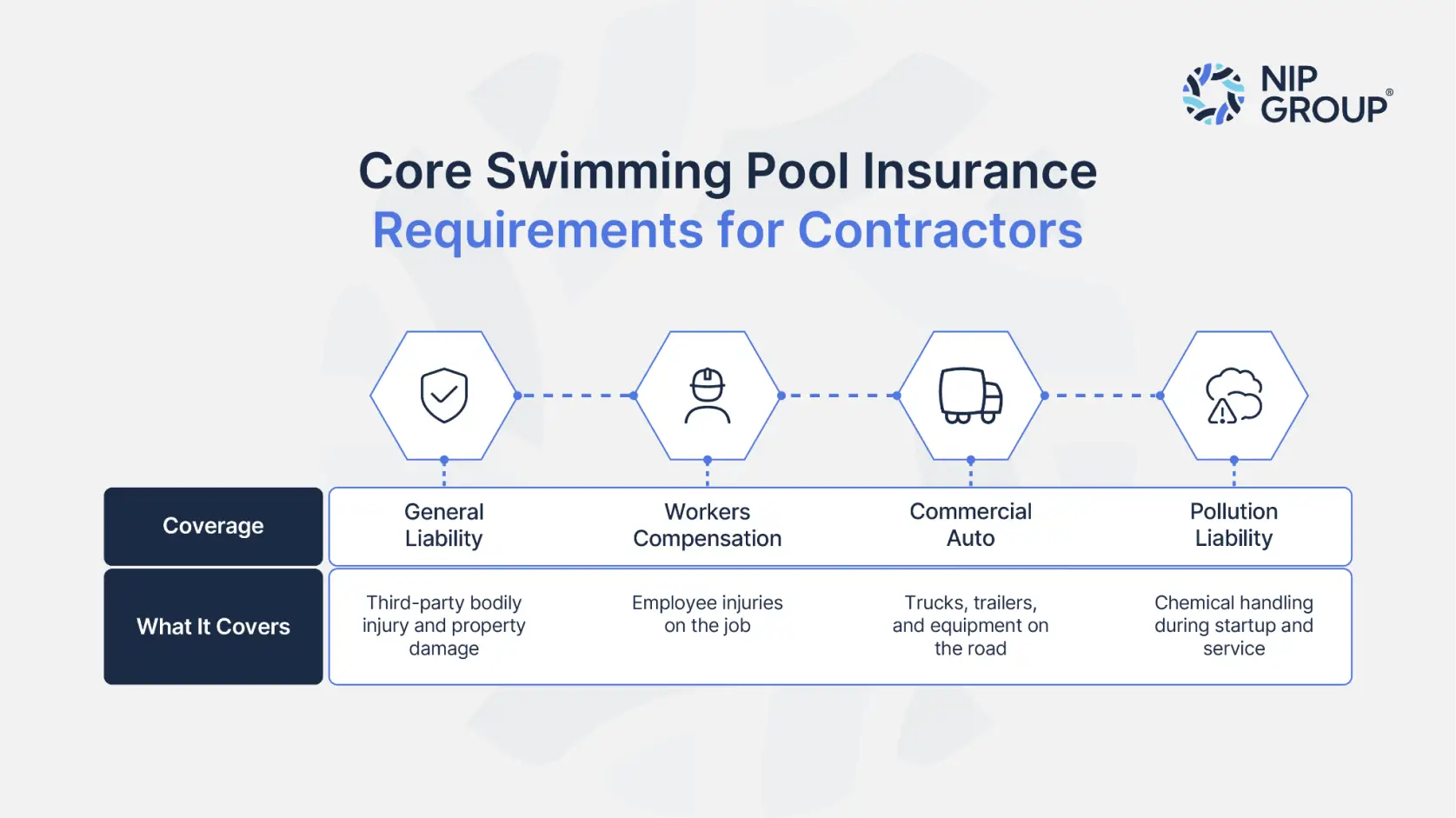
Every pool contractor, whether you build or service pools, needs a foundation of coverage. Insurance for pool contractors includes six coverages, and each one responds to a different point of failure on the job.
General liability
This policy covers third-party damage claims. It responds when a client slips near an open excavation, or a delivery truck damages a fence during a build. Most swimming pool insurance requirements start here, since general liability is the coverage clients ask for first.
Workers’ compensation
This is required in most states once you have employees on payroll. Pool work involves trenching and heavy equipment that also includes electrical connections near water. Each of those carries real injury risk for your crew. That’s why workers’ compensation covers medical costs and lost wages when something goes wrong on site.
Commercial auto
This covers trucks, trailers, equipment, and any vehicle used for business travel. A personal auto policy usually excludes vehicles used for work. Once your truck is loaded with tools and headed to a job site, that exclusion kicks in. From that point, you are driving without coverage until the job is done..
Pollution liability
The coverage includes chemical handling during pool startup and routine servicing. Chlorine and acid are common in this work, and both carry real exposure once they leave storage. Standard general liability policies often exclude pollution-related claims outright, leaving that exposure uncovered. Service technicians who handle these chemicals daily carry more of this risk than almost anyone else in the business.
Missing a policy is only part of the picture. Limits matter just as much as the coverage list itself. Many commercial clients and municipalities require general liability limits before they will sign a contract. Falling short of that threshold can cost you the bid before the work starts.
Meeting swimming pool insurance requirements, therefore, means pairing the right policies with limits that hold up under a real claim. Pool business insurance built for this industry is designed around that exact balance.
Core Swimming Pool Insurance Requirements for Contractors
Must Read: State Licensing and Coverage Must-Haves for Contractors for Swimming Pools
Pool Construction Insurance vs. Pool Service Insurance Requirements
Not every pool business carries the same risk profile. Your swimming pool insurance requirements should reflect that. Where you sit in the industry changes what your policy needs to prioritize.
Pool Construction Insurance vs. Pool Service Insurance Requirements |
||
| Risk Area | Pool Construction Insurance | Pool Service Insurance Requirements |
| Core exposure | Excavation, concrete, plumbing, electrical trades | Routine site visits and chemical handling |
| Subcontractors | Common, adds liability pass-through risk | Rare, usually a solo technician or small crew |
| Builder’s risk | Needed to protect the project mid-build | Not applicable |
| Completed operations | High priority, since leaks and cracks surface months later | Lower priority, minimal structural work involved |
| Pollution liability | Relevant during startup and chemical balancing | Daily necessity, given constant acid and sanitizer handling |
| Commercial auto | Needed for equipment and crew transport | Needed for daily multi-property routes |
Whichever side of the business you run, matching your policy to your work is what keeps your swimming pool insurance requirements from becoming a surprise later.
Does Homeowners Insurance Cover Pool Leaks?
Clients ask contractors this question often. The short answer is usually no, because most policies exclude gradual leaks or maintenance-related damage.
That leaves the homeowner looking for someone else to cover the cost. If the leak traces back to your build or your service work, they will turn to you next. This is why completed operations coverage matters. It responds to claims that surface after the job closes, even months later.
Explaining this to clients upfront builds trust and helps you handle disputes later. It shows you understand insurance for swimming pools better than most contractors do.

Swimming Pool Insurance Coverage Built Around How Contractors Work
Meeting swimming pool insurance requirements takes more than checking a box on a client contract. It covers excavation risk and chemical handling in the same policy. It also needs to account for liability that follows a completed job for years.
That is what PoolPro is designed to cover. PoolPro brings together general liability, workers’ compensation, commercial auto, completed operations, professional liability, and pollution liability under one program. It’s built specifically for pool contractors and is backed by A+ rated carriers. This means those carriers have a superior financial ability to pay claims when it counts.
Contact us to see how your current swimming pool insurance requirements measure up. Or, ask your broker to sign you up for PoolPro today.
FAQs
1. Do insurance companies require you to have a fence around your pool?
Yes, because many homeowners’ insurers will not issue or renew a policy without a compliant pool fence. Some even flat out deny claims tied to unfenced pools. For contractors, this is worth flagging to clients early. A barrier that misses local code can turn into a liability problem for both sides down the line.
2. Are pools in the US 25 yards or meters?
It depends on the type of pool. The U.S. competition pools for short course events run 25 yards, while international short course facilities use 25 meters. Olympic-size pools are longer still, at 50 meters. If you are building or servicing a competitive pool, the spec matters:
- 25 yards: Standard U.S. short course
- 25 meters: International short course
- 50 meters: Olympic long course
Getting this wrong mid-project is an expensive mistake to walk back.
3. What is an insurance pool?
This one trips people up, since it has nothing to do with swimming. An insurance pool is a risk-sharing setup. Multiple insurers, or a group of policyholders, combine resources to cover losses that would be too large for an individual to absorb. Specialty programs built around one industry, like pool contractors, work on a similar logic.
4. What is the law for pool fence in Texas?
Texas does not have one statewide pool fence law that applies everywhere. Instead, most cities and counties adopt their own ordinances, often based on the International Swimming Pool and Spa Code. As a contractor, do not assume the rules are the same from one job site to the next. Always check local code before you build or install.