






Utility arborists and arboriculturists face some of the greatest risks of any occupation. Like loggers (the most dangerous occupation in the U.S.), they deal with heavy machinery, large trees and flying objects. Similar to utility workers, arborists operate at elevation and in close contact with high-voltage power lines, toxic chemicals and flammable gases. These risks, coupled with the complex nature of the tree service industry, make it very difficult for vegetation management professionals to carry the right insurance coverage for the job. In this article, we will explore the trends in arboriculture including complications stemming from urbanization and weather, changes in licensing regulations, and the impact of technology in this industry.
The tree service industry is becoming more complex.
Tree service and vegetation management have become more complex in recent years due to several factors, including urbanization, more frequent severe weather events and the critical role of regulations and licensing.
Urbanization
Urbanization complicates the work of utility arborists by increasing population density and the addition of new utility lines in undeveloped or underdeveloped areas. Utility arborists and tree service professionals must manage more vegetation, implementing more rigorous safety measures while contending with tighter licensing regulations imposed on urban areas. As the population grows and developers replace wild vegetation with impermeable surfaces like concrete, glass and steel, the risk of flooding increases, adding another layer of complexity to the job of utility arborists.
Harsher weather
Severe weather events such as wildfires, hurricanes, flooding and windstorms are more common and are causing more damage to communities across the U.S. The U.S. Environmental Protection Agency (EPA) notes “the extent of area burned by wildfires each year appears to have increased since the 1980s.” As a result of longer, drier seasons and windy conditions, there is a greater risk of more frequent, more severe wildfires. Utility arborists need to account for these threats and strategically manage the vegetation around utility lines to minimize the risk of both fires and power outages.
Licensing regulations
Given the inherent risks associated with arboriculture work, regulations and licensing play a pivotal role in ensuring safety and professionalism in the field. State and local governments often regulate the activities of arboriculturists, establishing licensing requirements and safety standards to protect both workers and the public.
For example, California law requires tree service contractors and landscaping contractors to obtain licenses. In New Jersey, the “Tree Experts and Tree Care Operators Licensing Act” established new licensing titles for arboriculture workers. For companies performing arboriculture work in New Jersey, the 2017 law introduced a requirement that at least one person in each company be a “Licensed Tree Expert” or “Licensed Tree Care Operator.”
Contractors who work with restricted-use pesticides such as cyanide and methyl bromide must meet certain certification standards per the EPA and comply with any state, territorial or tribal laws.
Though these laws might seem obvious to most, other licensing regulations might be less apparent. To promote increased safety,licensing regulations and rules around vehicle and trailer weights have become stricter. Tree service workers regularly haul away large sections of trees weighing tens of thousands of pounds. States require a special commercial license to drive large vehicles, and contractors may also need to obtain an oversize load or overweight hauling permit depending on the vehicle’s gross weight.
As governing bodies continue tightening and enforcing these laws and licensing regulations, contractors and their insurance policies need to keep up.

The arboriculture industry is growing quickly.
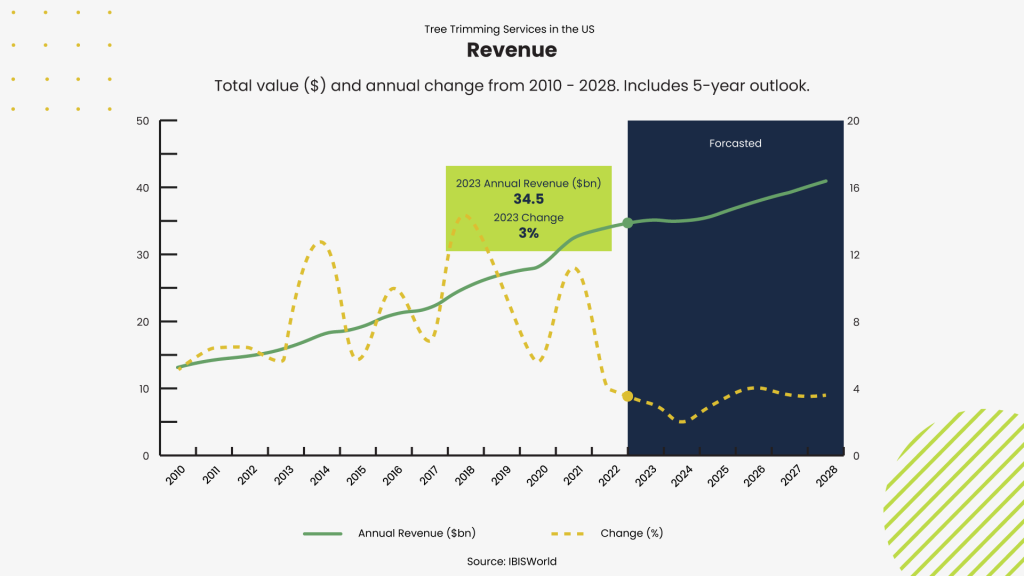
The arboriculture industry is quickly growing and is slated to continue its impressive trajectory for the next several years. After a pandemic-related hiatus, U.S. housing starts exploded to 30-year highs in the first half of 2023. Recent increases in residential and commercial construction are a boon to the arboriculture industry, and with the pandemic mostly in the rearview, economic stability will further benefit vegetation management professionals.
Revenue forecasts for the U.S. tree service industry will likely hit $37.1 billion in 2023, with growth estimates pushing that number to $44 billion by 2028. If we look at the landscaping services industry more broadly, revenue estimates are considerably higher.
Increased government spending is another asset to the arboriculture industry, particularly around planned upgrades for utility lines nationwide. The Biden-Harris Administration is investing hundreds of billions of dollars in U.S. infrastructure, including $1.5 billion in federal grant funding for planting trees in urban areas. With both the public and private sectors building and prioritizing greener spaces in developed areas, demand for arboriculturists is likely to rise.
Source: https://my.ibisworld.com/
Technology has supported the industry’s advancement.
In an age of rapid technological advancement, the arboriculture industry has not remained untouched by innovation. Technological developments have revolutionized the way arborists and vegetation management professionals approach their work, enhancing efficiency, safety, and precision. In this section, we will explore some of the key technological advancements that have reshaped the field.
Role of Technology in Surveying Tree Health
Today, camera technology is often used to survey tree health, while computers can formulate pesticides and automate spraying. Most vegetation management professionals will also use heavy machinery like cranes, booms and excavators, all of which contribute to more efficient operations. Though these tools are extremely useful, they’re also incredibly expensive and can increase a company’s liability risk.
As cities and roads get busier, arboriculturists and other vegetation management professionals must learn to work around these potential hazards. One of these dangers is from vehicles traveling on roads where arborists are working nearby. Fortunately, technological advancements have improved road safety, and consequently, safety for arboriculture workers.
Speed enforcement and cell phone use detection systems promote safer working conditions
Speed enforcement systems and cell phone use detection systems are two of the most common tools used to improve traffic safety for motorists, pedestrians, construction workers and arboriculturists.
 Source: ResearchGate
 Source: ResearchGate
These systems are far from new but in the U.S., state laws have made it difficult or impossible to utilize speed cameras and other speed enforcement technology. Note that in the graph above, Australia, the U.K. and France all saw significant declines in traffic fatalities after implementing speed cameras; the U.S., which didn’t implement speed cameras, failed to follow this downward trend.
Speed enforcement systems utilize radars and cameras to identify vehicles exceeding the speed limit, sending warnings or issuing fines to drivers who speed. According to the Federal Highway Administration, fixed unit speed safety cameras (SSCs) reduced crashes on busy urban roads by up to 54%. Furthermore, data published by the National Institutes of Health cited studies showing speed cameras were associated with up to 44% fewer traffic fatalities.
Every year, thousands of people are killed by distracted drivers. Unlike pedestrians, tree service professionals often work out of view of drivers, on aerial work platforms or in boom truck buckets. At these heights, even a seemingly minor traffic accident can be fatal for workers, making distracted driving especially dangerous to tree service professionals.
To protect people from the dangers of distracted drivers, cell phone detection systems are growing in popularity, particularly in Australia. One way these systems work is by capturing photos of drivers and leveraging artificial intelligence (AI) to identify drivers who are using their cell phones.
The future of road safety technology
While speed enforcement and cell phone detection systems have the potential to positively impact tree worker safety, tree worker incidents have remained relatively consistent over the past two decades. Though we’re still several years shy of fully automated safety features and fully autonomous vehicles, these technologies will likely help minimize vehicle crashes and protect tree service workers.
Despite tremendous leaps in road safety technologies, the bulk of the responsibility to protect arboriculture workers still rests on the shoulders of employing contractors. Tree service professionals do much more than just trim and plant trees. They also deal with snow and ice, toxic pesticides and herbicides and utility line clearance. So, in addition to proper training and safety equipment, tree service contractors need the backing of an insurance policy that goes beyond the basics.
The Impact of Trends in the Modern Arboriculture Industry
The arboriculture industry stands at a pivotal juncture, with a number of factors reshaping its landscape. Urbanization has brought about a surge in demand for tree care. This, coupled with severe weather events that are becoming more frequent and destructive, underscores the urgent need for resilient tree management practices.
Despite these complexities, technological advancements have emerged as a beacon of hope, offering arborists innovative tools and strategies to navigate their daily tasks efficiently and safely.
However, with progress comes new challenges, and the modern arboriculture industry is not without its own. As arborists and vegetation management professionals navigate the complexities of urbanization, severe weather events, and technological advancements, their insurance needs have evolved accordingly. Traditional insurance coverage may not adequately address the specialized risks inherent to this field.
To safeguard their operations and personnel, tree service contractors require insurance policies that go beyond the basics. One such solution is TreePro.
TreePro is the gold standard of risk management for contractors who work in tree service or vegetation management. Standard insurance policies can have major gaps in coverage, leaving contractors exposed to serious risks.
NIP Group recognizes and insures against the unexpected scenarios and rare risks tree service pros might encounter on the job. These include pesticide and herbicide applicator coverage, crane coverages, pollution liability protection and snow and ice removal. On top of all these coverages, TreePro also acknowledges the higher-risk nature of arboricultural work, offering $25 million in excess capacity and specialized wildfire liability in all states (including California).
Tree service contractors and brokers can accomplish more knowing they’re backed by TreePro’s best-in-class coverage, a 30-year track record of excellence, an A+ financial rating from A.M. Best, and the expertise of its dedicated Program Manager, Tim Greifenkamp.
If you’re a tree service contractor or an insurance broker, check out all of TreePro’s unique features to learn how to get the best insurance coverage and value for your business.