









“Piecing together monoline policies can leave clients with coverage gaps and invite unnecessary E&O exposure for brokers. In high-risk industries like tree care, a specialized policy can help fill coverage gaps while protecting brokers from E&O claims.”
– Tim Greifenkamp, TreePro Program Manager
For tree care companies and their insurance brokers, the continued growth and evolution of the arboriculture industry have introduced both new opportunities and challenges. While the risks of tree care work are well known, insurance brokers now face an increasingly litigious business environment. Nevertheless, many brokers continue to fall into the trap of chasing the lowest possible premiums to win or retain clients. But when coverage gaps — such as wildfire liability, crane endorsements, or inadequate auto limits — go unnoticed, brokers frequently shoulder the blame, resulting in claims denials for the client and potential errors and omissions (E&O) risks to the firm.
To successfully scale over the long term, brokers should use smart growth strategies that focus on protection, not just cost. In doing so, brokers can establish a relationship as trusted advisors, going beyond simply providing quotes and protecting themselves and clients in the process.
Why Do Clients Sue Their Insurance Brokers?
Increased complexities and a hard insurance market have made it more difficult for brokers to provide competitive, comprehensive tree service insurance. Companies rely on their insurance brokers to assess risk exposures, provide requested coverages, and communicate clearly, but when this doesn’t happen, it can create multiple insurance E&O pitfalls, any of which can lead to a client bringing a lawsuit against their broker.
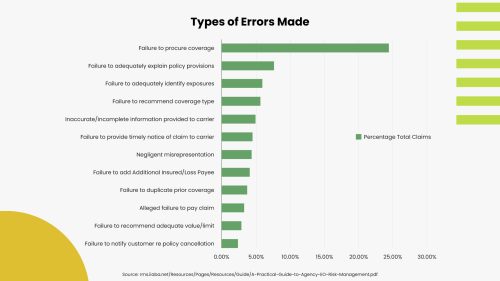
Source: rms.iiaba.net/Resources/Pages/Resources/Guide/A-Practical-Guide-to-Agency-EO-Risk-Management.pdf
Failure to adequately assess exposure
Though most states don’t necessarily require insurance brokers to provide specific advice on which coverages to choose, there is an expectation that brokers will understand the business and explain what’s covered or excluded under a policy. However, when a special relationship exists between the two parties, a duty to advise may come into play, introducing a new level of E&O risk. For instance, if a broker suggests a basic landscaping policy for an arborist instead of high-risk tree operations insurance, it could lead to a negligence claim.
Failure to communicate
Brokers are responsible for keeping clients updated about any policy changes or conflicts of interest. For example, if coverages change or if there’s a nonrenewal and the broker fails to inform the client, it could result in a negligence claim against the broker.
Failure to obtain requested coverage
Whether a client is purchasing a new policy or needs to increase or supplement existing coverages, brokers have a responsibility to obtain coverage for clients as directed, within a reasonable time frame.
Administrative errors
Though administrative errors might seem harmless, they can create significant liability risks for brokers. Even something as small as a typo on a certificate of insurance can have potentially severe consequences and create E&O exposure.
Why Piecing Together Monoline Policies Is a Risky Proposition
Tree care insurance exposure spans a wide list of perils, which can make it difficult for brokers to find coverage that fits the client’s price point. While specialized high-risk insurance might result in higher premiums than cobbling together monoline policies, this cost-saving strategy is a risky proposition for brokers and clients alike. Besides complicating renewals and claims processing, piecing together monoline policies can shift liability to the broker, who might be held responsible for the client’s coverage gaps.
Missing Client Coverage: NJ Broker’s $1.8 Million Mistake
In 2015, a New Jersey-based company (RML Construction) won a $1.8 million contract to remove damaged trees in New York City in the aftermath of Hurricane Sandy. While on the job, a tree branch struck a bicyclist, causing fatal injuries. The family filed a wrongful death suit against RML Construction, alleging negligence. The company, which was hired to remove trees, had coverage under a landscape gardening policy (Classification 97047) that clearly excluded tree trimming and tree removal. So even though the company’s scope of work necessitated tree care operations coverage (Classification 99777), its broker sold a policy that only covered basic cosmetic gardening activities.
In 2022, the Superior Court of New Jersey ruled that the wrongful death claim was the full responsibility of Suburban General Insurance Agency (the broker), and not Gotham Insurance Company (the insurer). The broker claimed to have missed the fact that the policy didn’t have an endorsement for tree removal, stating that “the classifications were broad … and that landscape gardening included tree removal.” The Court was not convinced.
This case study underscores the importance of getting the right coverage, particularly for high-risk industries like tree care.
Lead with Protection to Minimize E&O Exposure
Underinsurance and blind spots in coverage aren’t just a problem for clients — they can leave brokers exposed, too. To minimize E&O exposure, brokers should lead with protection rather than focusing on bottom-line premiums. This includes asking questions about the business’s operational risks that go beyond basic liability coverage. For example, if the company uses specialized equipment such as cranes and boom trucks, you should ask if there’s a contingency plan if one of these goes down during peak pruning season. In addition, many general liability policies exclude coverage for work above certain heights, which could leave a major blind spot for arborists. Similarly, most policies have exclusions for pollution liability, which can leave tree care companies on the hook for damages related to chemical spills. These conversations can help brokers build trust with clients, provide more comprehensive coverages, and minimize E&O exposure.
How TreePro Helps Brokers Avoid Blind Spots
NIP Group’s TreePro high-risk liability insurance is an all-lines, single-placement solution that can give brokers the confidence they aren’t missing key coverages. Standard general liability policies often exclude key tree care risks, such as crane and boom exposure, tree spraying, snow and ice removal, and pollution liability. With specialized tree care coverages, your clients can get the comprehensive, high-risk insurance they need to protect what matters most and continue to successfully scale their businesses — all while helping reduce your agency’s E&O exposure.
Learn more, submit your accounts, or speak with a TreePro expert today.
Conclusion
Piecing together a patchwork of monoline policies can result in claims denials, uncovered losses, and finger-pointing disputes that can lead back to the broker. With negligence claims continuing to rise, brokers must remain vigilant and recognize the risks of recommending monoline policies over more comprehensive specialty insurance programs. By using single-placement, all-line risk solutions — like TreePro — brokers can provide better protection while limiting their own E&O exposure.
Checklist: Mitigating Broker E&O Risks