












“A busy season can change a pool contractor’s operation quickly. New employees, vehicles, equipment, service routes, or a shift in the type of work being performed can all make the business look different from the one reviewed at the last renewal. For brokers, understanding what changed is an important part of telling the account story.”
– Michael Finati, PoolPro Program Manager
A pool contractor can enter peak season as one type of business and come out of it looking noticeably different.
New service routes may have been added. Additional employees or vehicles may now support the operation. A builder may have taken on more renovation work, while a service contractor may have expanded into repairs or equipment replacement.
For brokers, the end of a busy season creates a natural opportunity to check in with pool contractor clients before the next renewal.
A useful question is:
“What changed in the business?”
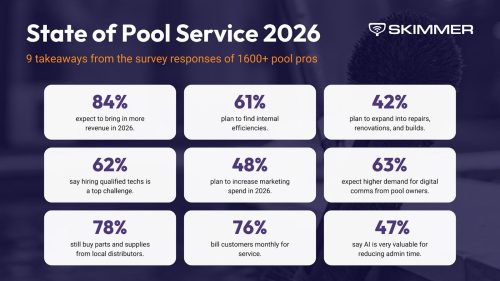
Source: Pool Service Software -The 2026 State of Pool Service report
1. Has the mix of work changed?
“Pool contractor” can describe several very different businesses.
Some contractors focus heavily on new pool construction. Others generate a larger share of their business through recurring service, repairs, renovations, plastering, resurfacing, spas, or related work.
And that mix does not always stay the same.
A contractor may have responded to customer demand by taking on more repair work. A builder may now be pursuing renovation projects. A service company may have added work it did not perform at the previous renewal.
Consider asking:
- Is new construction still the primary operation?
- Has repair or renovation work increased?
- Is recurring service becoming a larger part of the business?
- Has the company added plastering, resurfacing, spa, or other related work?
Understanding the current mix gives a broker a much clearer picture than relying on how the business was classified a year ago.
2. Did staffing change during the season?
A busy season often puts pressure on staffing.
Pool contractors may add technicians, construction employees, drivers, seasonal workers, or supervisors to keep pace with customer demand.
Some of those hires may be temporary. Others may become a permanent part of the operation.
That makes a post-season conversation a useful time to ask:
- Did employee count increase?
- Were seasonal or temporary workers added?
- Are employees performing different types of work?
- Has payroll changed materially?
- Were new crews or supervisors created?
The goal is not simply to update a headcount.
It is to understand whether the workforce supporting the business today looks different from the one previously reviewed.
3. Did the fleet or service territory grow?
Growth in service and repair work can also mean more time on the road.
A pool contractor may add vehicles, increase the number of daily stops, create new service routes, or begin working farther from its primary location.
Ask whether the business:
- Added or replaced vehicles
- Added drivers
- Expanded its service territory
- Created new service routes
- Increased the amount of recurring service work
These changes can be easy to miss when the conversation focuses primarily on revenue growth.
For a contractor with crews moving between multiple customer locations each day, however, fleet and route changes are an important part of the current account story.
4. Was new equipment added?
A successful season can also lead to investment.
Depending on the contractor’s operations, that could include new construction equipment, trailers, service tools, pumps, testing equipment, or other specialized machinery.
Some purchases happen because the business is growing. Others happen because the contractor is expanding into a different type of work.
Brokers should consider asking:
- What equipment was purchased or replaced?
- Have equipment values changed materially?
- Is new equipment being used for a different type of work?
- Are there major purchases planned before the next season?
The objective is straightforward: make sure the account reflects what the contractor actually relies on today rather than an equipment picture that may be a year or more out of date.
5. Did anything else happen that changes the account story?
Not every meaningful change fits neatly into a schedule.
A particularly busy season may introduce new customers, larger projects, subcontractor relationships, contract requirements, or losses.
It may also reveal areas where the contractor changed how it operates.
Consider whether the client:
- Took on larger or more complex projects
- Increased its use of subcontractors
- Began serving a new type of customer
- Entered a new territory
- Added a new service or revenue stream
- Experienced a loss or significant near miss
- Changed procedures after an incident
If something significant happened, understanding it before renewal can help the broker tell a more complete story.
And if the business made improvements following a loss or operational issue, that context may be just as important as understanding what happened in the first place.
Is your pool contractor client the same business it was before peak season?
A busy season can change more than revenue.
It can change the work being performed, the people performing it, the equipment supporting it, and the territory the business serves.
For brokers, understanding those changes can help create a stronger renewal conversation and a clearer picture of the operation today.
PoolPro by NIP Group works with qualifying pool construction, service, repair, plastering, and related contractor operations.
If your client looks different from the business you reviewed at the last renewal, start with what changed.
Ready to learn more about customized pool contractor insurance? Visit the PoolPro webpage to speak with a specialist.
Preparing for Peak Season: A Pool Pros Checklist