











Summary:
- A disorganized landscaping truck setup wastes crew time and puts costly equipment at real risk.
- Organizing gear by zone fixes that, keeping tools ready and equipment secure all season.
- This guide walks through building a system your crew can rely on daily.
The U.S. landscaping industry reached $176.7 billion in value in 2026, according to IBISWorld. That growth now supports 556,238 landscaping businesses nationwide. Most of them run their entire operation out of a truck every day.
With that many businesses competing for the same routes, a fast and organized landscaping truck setup becomes a real advantage. Speed matters, but so does what happens when something goes wrong on the road. Loose equipment and exposed chemicals turn routine drives into safety risks. A worn hitch connection can just as easily turn one into a liability claim.
This guide breaks down how to build a landscaping truck setup that keeps your crew fast and your business protected.
Must Read: What to Include in Every Landscaping Contract: Scope, Payment Terms, and Liability Clauses
Why Does Your Landscaping Truck’s Setup Affect More Than Just Storage?
A landscaping truck setup decides how fast your crew unloads and how well your equipment survives the drive.
- Time cost: A crew hunting for a tool at every stop loses minutes it never gets back. On a route with eight or nine stops, that adds up to real, billable time lost before lunch.
- Safety cost: Loose equipment that shifts during a hard stop can damage itself or a vehicle nearby. Chemicals stored too close to fuel or tools raise the odds of a spill you end up having to report.
Neither cost is obvious on day one. That is why an intentional landscaping setup pays off twice, in time saved and risk kept off your plate.
What Does an Efficient Landscaping Truck Setup Look Like, Zone by Zone?
A landscaping truck setup works best when storage is planned out, and your crew moves through a job without hesitation. When it is not, every stop turns into a search, and that search costs paid time.
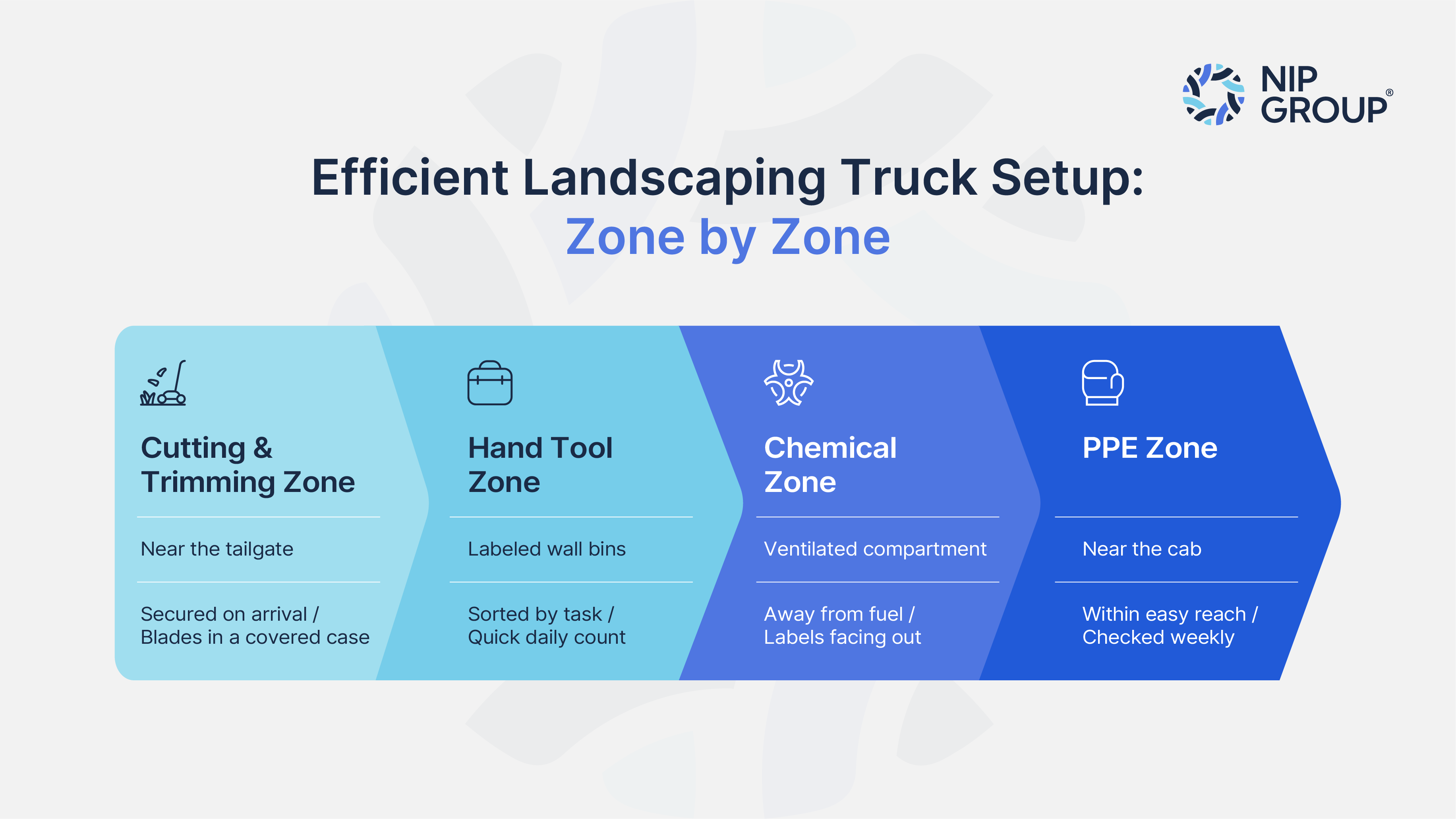
Zones solve this problem better than one open space. A landscaping setup built in zones follows the order a crew works in, from cutting and trimming through cleanup. A well-organized truck typically breaks down into four zones:
-
Cutting and Trimming Zone
Secure mowers and trimmers near the tailgate for the fastest access on arrival. Keep blades in a separate case, sheathed or covered, rather than riding loose in the open. A loose blade can shift during a hard stop and injure whoever unloads the truck next. Loading heavier equipment first also means it comes off first at every stop, which speeds up setup at each site.
-
Hand Tool Zone
Store rakes and shears in labeled bins along one wall, sorted by task. Small hand tools belong in the same zone, so nothing gets buried under bigger gear. A quick visual count at day’s end catches a missing tool before it becomes a lost one. That habit alone cuts down on replacement costs across a season.
-
Chemical Zone
Keep fertilizers and treatments in a sealed, ventilated compartment away from tools and fuel. Store containers upright and secured, so a hard brake does not tip or crack one open. Keep product labels facing out and legible, in case a crew member needs details fast. This separation limits fire risk and keeps a spill from reaching gear the crew handles daily.
-
PPE Zone
Store gloves and eyewear near the cab, instead of burying them under equipment. Keep the rest of your safety gear in the same spot. Crews are more likely to use it when it is within reach. Check this zone weekly, since torn gloves or scratched eyewear tend to go unnoticed until a job goes wrong.
Once your crew learns where everything belongs, restocking between routes takes minutes instead of a search. This kind of setup turns a chaotic load into a system your crew can follow without thinking. It also protects real money sitting in that truck bed. That investment is worth backing with landscaping business insurance, especially once trucks and trailers start adding up in value.
How Should Weight and Trailer Setup Factor Into Your Truck Plan?
Weight and trailer setup decide how a truck performs under real load. An unevenly loaded truck pulls to one side and strains the suspension faster than normal use. That wear adds unplanned repair costs across a season. It also affects how the truck responds in a hard stop, raising accident risk on the road.
Trailer connections carry a similar weight, literally and financially. A loose hitch or a worn safety chain can fail under load. On a highway, that kind of failure puts your crew and other drivers at risk.
A few habits keep both risks in check:
- Balance the load front to back and side to side: Heavier equipment sits low and centered. Don’t stack them towards one end.
- Check the hitch and coupler before every route: Inspect safety chains at the same time so nothing gets missed.
- Match your trailer to your truck’s rated towing capacity: The best landscape truck setup respects that rating instead of pushing past it on busy weeks.
- Add tire pressure and brake checks to the same routine: Bundling these into one weekly habit means nothing gets skipped when the schedule is tight.
Compliance adds one more layer to this part of landscaping truck setup. Many states require a commercial license if your combined truck and trailer weight is 26,001 pounds or more. Visible business signage and a DOT number may also apply, depending on your state. Confirm your state’s threshold before adding a heavier trailer to your fleet. A routine stop should not turn into a costly delay.
Does Your Landscaping Truck Setup Need to Change by Season?
Landscaping work shifts with the seasons, and your setup should shift with it. A spring lawn care truck setup built for mowing looks different once snow season starts.
Swap mowing decks and trimming gear for plows and ice melt storage as the season turns. Rebalance weight distribution at the same time, since plows sit heavier up front than trimming gear does. Skipping this step slows your first routes of the new season and strains parts not built for a front-heavy load.
A seasonal-ready truck also gives you an edge in a crowded market. The industry keeps growing, and competition for routes grows with it. The National Association of Landscape Professionals reports the industry now employs more than 1.4 million people nationwide. With that many crews chasing the same seasonal work, being ready first keeps you ahead of the pack.
Must Read: Is Your Landscaping Insurance Coverage Built for All Risks and Seasons?
A Landscaping Truck Setup Built Right Is a Business Built to Last
A well-planned landscaping truck setup pays off in hours saved and equipment that lasts. Fewer wasted stops mean tighter routes and stronger margins by the end of the season.
That same setup also shapes your risk on the road. A secured load and a documented system hold up when a claim comes in. But careful planning cannot prevent every accident or breakdown.
That’s where the right coverage picks up. LandPro is built specifically for landscaping and lawn care businesses. The program covers general liability, workers’ compensation, auto liability and inland marine, all built around how this industry runs. LandPro is backed by carriers rated A+ by A.M. Best. That rating means real financial strength to pay claims when they matter most. Ask your broker to sign you up for LandPro or contact us to see how LandPro fits your operation.
FAQs
1. What does every truck owner need?
Every truck owner needs valid registration and active insurance on hand. Maintenance records matter too, once a truck starts logging real miles on the job. For a landscaping business, that also means commercial auto coverage built for work use.
2. What are the different types of truck loads?
Landscaping trucks usually carry a few distinct kinds of loads.
- Equipment loads: Mowers and trimmers bound for the job site, plus hand tools for finish work.
- Material loads: Mulch, soil, or stone hauled for installation.
- Chemical loads: Fertilizers and treatments that need separate, ventilated storage.
- Debris loads: Clippings and cleanup waste hauled away once the job wraps.
Each type carries its own weight and storage needs, which is why a zone-based setup earns its keep.
3. What are the most useful truck accessories?
A few upgrades make a real difference for landscaping trucks.
- Tool racks and lockable bins: Keep gear organized and protected from the weather.
- A weight-distribution hitch: Improves handling once a trailer joins the mix.
- Backup sensors or a camera: Help with tight driveways and blind corners.
None of these need to be expensive to earn back their cost in daily time saved.
4. What are some tips and tricks for trucking?
Stick to a simple routine and it pays off fast. Load the same zones the same way every morning, so nothing gets missed under pressure. Run a quick walk-around before each route. Check tires and lights, then confirm tie-downs are secure. Small habits like these protect your landscaping truck setup.