










Summary:
- Most contractors sign contracts requiring liability coverage without knowing exactly what it protects.
- What does general liability insurance cover, and where does it stop paying on a claim?
- This guide explains covered claims and exclusions, then shows how to size your limits.
In 2025, commercial liability insurance held the largest share of the global liability insurance market by type. Fortune Business Insights estimates the U.S. market alone at $84.20 billion that year, in a report updated September 14, 2026. For most contractors, that coverage is simply general liability, and contracts and lender agreements often require it.
On a job, that requirement shows up well before any claim does. A general contractor wants your certificate before your crew unloads. A lender may want proof of coverage before financing a skid steer. Each request assumes your policy will pay if your work injures someone or damages their property. Yet most owners never read past the declarations page.
So, what does general liability insurance cover on a job site, and where does it stop? In this blog, we walk through the claims it covers and the ones it passes to other policies. We also show you how to check your limits against the contracts you sign.
Why Does General Liability Matter So Much for Contractors?
General liability matters because contractors work on property they don’t own, around people who aren’t on their payroll. A homeowner walks past your equipment, or a neighbor parks under the tree your crew is trimming. If your work injures either one or damages their property, they can hold your business responsible. These are third-party claims, and paying them is the core job of general liability.
Without coverage, your business pays those costs out of pocket. You would still need a lawyer to respond, even if you did nothing wrong. Any settlement or court award would then come out of your business savings or assets.
Those costs are more likely to be incurred in the U.S., where people often turn to lawsuits to settle disputes. Fortune Business Insights links U.S. demand for liability coverage to this highly litigious environment. That makes it worth knowing exactly what your policy covers before a claim arises.
What Does General Liability Insurance Cover on a Typical Job?
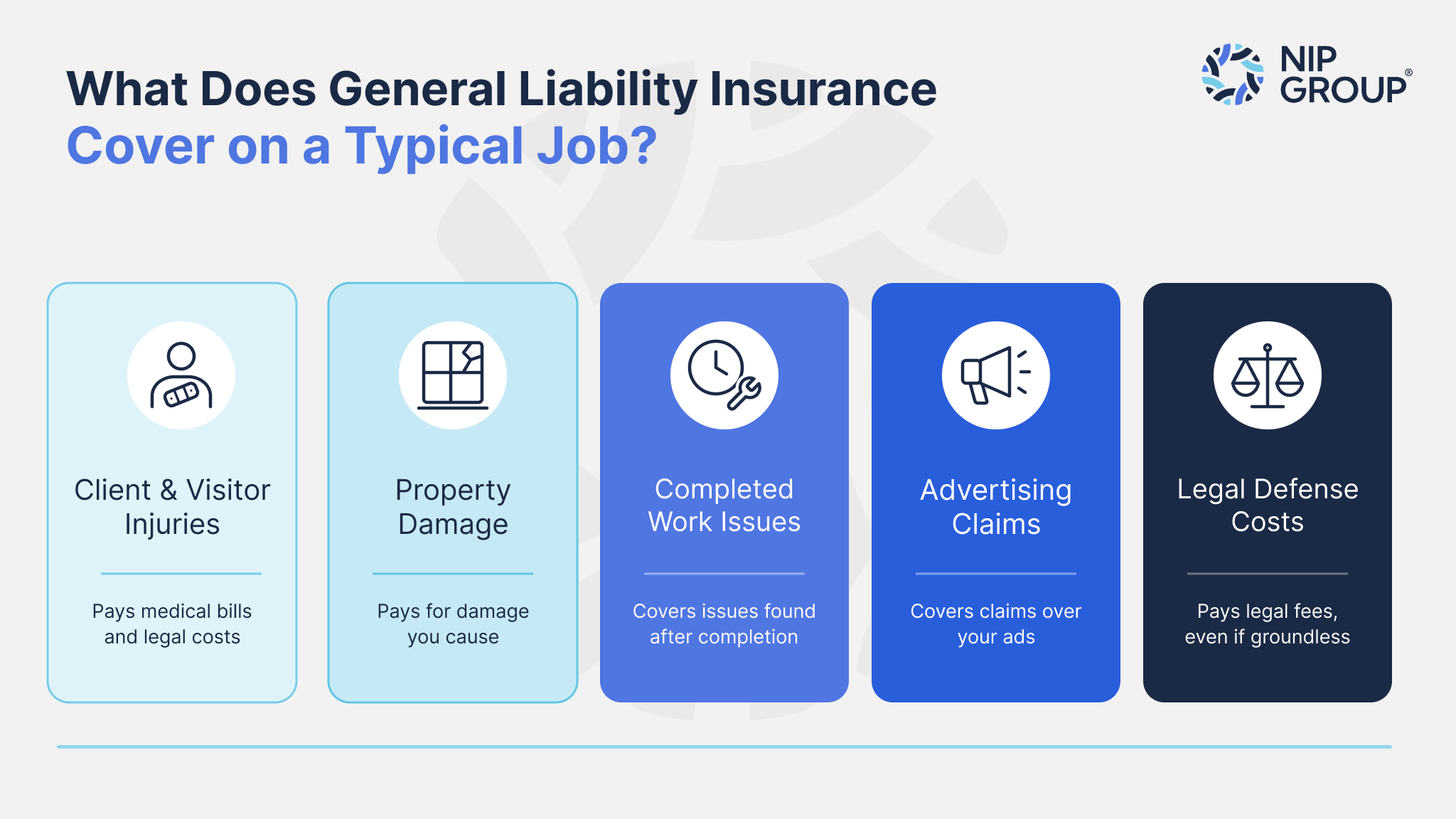
On a typical job, general liability covers injuries and property damage your work causes to people outside your business. It also covers certain advertising claims and pays to defend you if a covered claim becomes a lawsuit.
What Does General Liability Insurance Cover on a Typical Job?
Injuries to Clients and Visitors
Bodily injury coverage pays when your work injures someone who doesn’t work for you. Say a homeowner trips over a hose your crew left on the walkway and breaks a wrist. If you’re legally responsible, your general liability insurance policy can pay their medical bills and lost wages.
Damage to Property You Don’t Own
Property damage coverage pays when your work damages something that belongs to someone else. If a mower throws a rock through a client’s window, this part of the policy pays for the repair.
But what does general liability insurance cover when the damage is to the project itself? It’s usually less than the contractors expect. Most policies exclude damage to the part of a property you’re working on. A patio you crack while resetting it may not be covered, while the window beside it would be.
Problems That Show Up After the Job Is Done
Completed operations coverage handles claims that surface after you finish the job and get paid. If a drainage line you installed backs up into a basement a month later, it covers the water damage. Most policies give it a separate aggregate limit, which caps what it pays for these claims each policy year.
Advertising and Personal Injury Claims
Personal and advertising injury coverage covers claims arising from what your business publishes or says. So, what does general liability insurance cover if a competitor says the photo on your truck wrap is theirs? It can respond to that copyright claim, along with slander or libel claims over what you post online.
Legal Defense Costs
Defense coverage pays your legal costs when you’re sued over a claim the policy covers, even when that lawsuit has no merit. This is because your insurance company usually has a duty to defend covered suits. Many standard policies pay defense costs on top of your limits. Others subtract them, leaving less money for the claim. So, check your policy with your broker to understand how defense costs are handled.
Must Read: Why General Liability Insurance for Utility Contractors Needs a 2025 Update
What Does General Liability Coverage Not Include?
Since general liability coverage responds to claims from outside your business, problems inside your own business need a different policy. These are the most common gaps.
- Injuries to your employees: Workers’ compensation covers these, and most states require it once you have employees.
- Your trucks and trailers: Accidents involving your business vehicles need commercial auto coverage.
- Your own tools and equipment: Theft or damage to your mower or chipper needs contractor’s equipment coverage.
- Redoing your own faulty work: The policy may cover damage that your mistake caused. It won’t cover redoing the work.
- Pollution and chemical claims: Standard policies carry a broad pollution exclusion, so a fuel spill needs separate coverage.
- Data breaches: Standard policies exclude claims tied to leaked personal or confidential data.
Data breach claims are a growing risk, too. Market Data Forecast projects U.S. cyber liability insurance to grow faster than any other liability line. It expects a 16.4% annual rate from 2026 to 2034. Some contractor policies, therefore, allow you to add cyber or pollution extensions to help close part of this gap.

What Determines How Much General Liability Coverage You Need?
Your contract usually sets that number first. Clients and contractors, as well as property managers, often name specific limits before they’ll sign. Your policy has to meet or beat those minimums.
Every policy carries two kinds of limits. The per-occurrence limit caps what your policy pays for a single claim. The aggregate limit caps the total it pays across all claims in a single policy period. Several smaller claims in a busy season can use it up fast.
A per-project aggregate can help here. Each job draws from its own limit rather than a single shared pool across your entire book of business.
Once a claim passes either limit, your policy stops paying, and the difference becomes your cost. That’s one reason larger jobs often call for excess liability on top of your base policy.
Before you sign your next contract, check it against your policy for:
- Required limits: Does your policy meet or exceed the contract’s requirements?
- Additional insured status: Does the client need to be listed on your policy?
- Waiver of subrogation: Does the contract stop your insurance company from recovering costs from the client?
Coverage Built Around How Contractors Work
A policy earns its keep when it fits the work you do and the contracts you sign. LiabilityEdge is built around that fit, covering more than 50 contractor and grower classes. That range runs from landscapers and tree services to excavators and pool builders. It’s a monoline general liability policy, available nationwide except in Alaska, Hawaii, and Louisiana.
Its coverage includes the terms contracts often ask for:
- Contract terms: Blanket additional insured and additional insured for ongoing and completed operations. It also includes a waiver of subrogation.
- Built-in protection: A per-project aggregate and workmanship errors and omissions coverage.
The program is also backed by insurance companies rated A+ XV by A.M. Best. This means these insurance companies can meet their financial obligations, including claims. XV is the rating agency’s largest financial size category. It means each company holds $2 billion or more in policyholder surplus, its cushion of capital beyond what it owes.
Ask your broker to sign you up for LiabilityEdge. If you have questions about your coverage before then, contact us directly.
FAQs
1. What are the four types of general insurance?
There isn’t one fixed global list. In the U.S., general insurance is usually called property and casualty insurance, and it’s grouped by what it protects rather than a strict “four types” model. The main categories are property insurance, liability insurance, auto insurance, and health insurance. However, the way insurers and regulators split them varies.
2. What are the five elements of an insurance policy?
Most U.S. insurance policies, including general liability policies, break down into five parts:
- Declarations: Name who and what the policy covers.
- Insuring agreement: States the insurer’s promise to pay.
- Exclusions: List what the policy leaves out.
- Conditions: Set the rules that both sides must follow.
- Definitions: Clarify key terms used throughout the policy.
3. Is general liability insurance legally required for contractors?
No federal law requires it, but many states and local licensing boards require proof of general liability insurance before issuing a contractor’s license. Public projects often list it as a bidding requirement, too. Even where it’s optional, most commercial clients won’t hire you without it.
4. Do I need both general liability and professional liability?
Most trade contractors need both if they combine hands-on work with design or inspection services. General liability covers physical injury or property damage. Professional liability covers financial losses from a judgment or advice mistake, which general liability leaves out. If you only install or maintain what’s contracted, general liability is usually enough.