












Summary
- With costs rising and demand slowing, more jobs no longer mean more profit for landscapers.
- Winning higher-value clients and protecting that work with the right coverage leads to profitable growth.
- This blog shares nine practical tips on how to grow a landscaping business in 2026.
US landscaping revenue will reach $176.7 billion in 2026, according to IBISWorld’s May 2026 report. Yet that total reflects only 0.9% growth in 2026, which leaves little new demand to go around. About 556,000 landscaping businesses are now chasing that same small pool of new work. For most of them, taking on more jobs no longer adds much to the bottom line.
So growth now comes from landing better-paying clients and earning more from each one. Those clients, especially commercial ones, usually check a contractor’s paperwork and insurance before they sign. As a result, a growth plan has to cover winning new work and protecting it.
In this blog, we share nine tips on how to grow a landscaping business with both needs in mind.
Why Is It Harder to Grow a Landscaping Business in 2026?
It is harder for landscapers to grow in 2026 because operating costs keep rising while demand grows slowly. IBISWorld reports that chemical and supply costs continue to put pressure on industry profits. As a result, each job now costs more to complete than it did before. So, adding more jobs no longer guarantees more profit for a landscaping company. That’s why how to grow a landscaping business in 2026 depends on taking on the right work.
For most companies, that means larger contracts and bigger crews, both of which bring new risks. Commercial clients set stricter contract terms, and each new worker needs workers’ comp coverage. A successful landscaping business, therefore, secures the right coverage before taking on that extra work.
Must Read: Landscaping Maintenance Checklist Every Business Should Follow
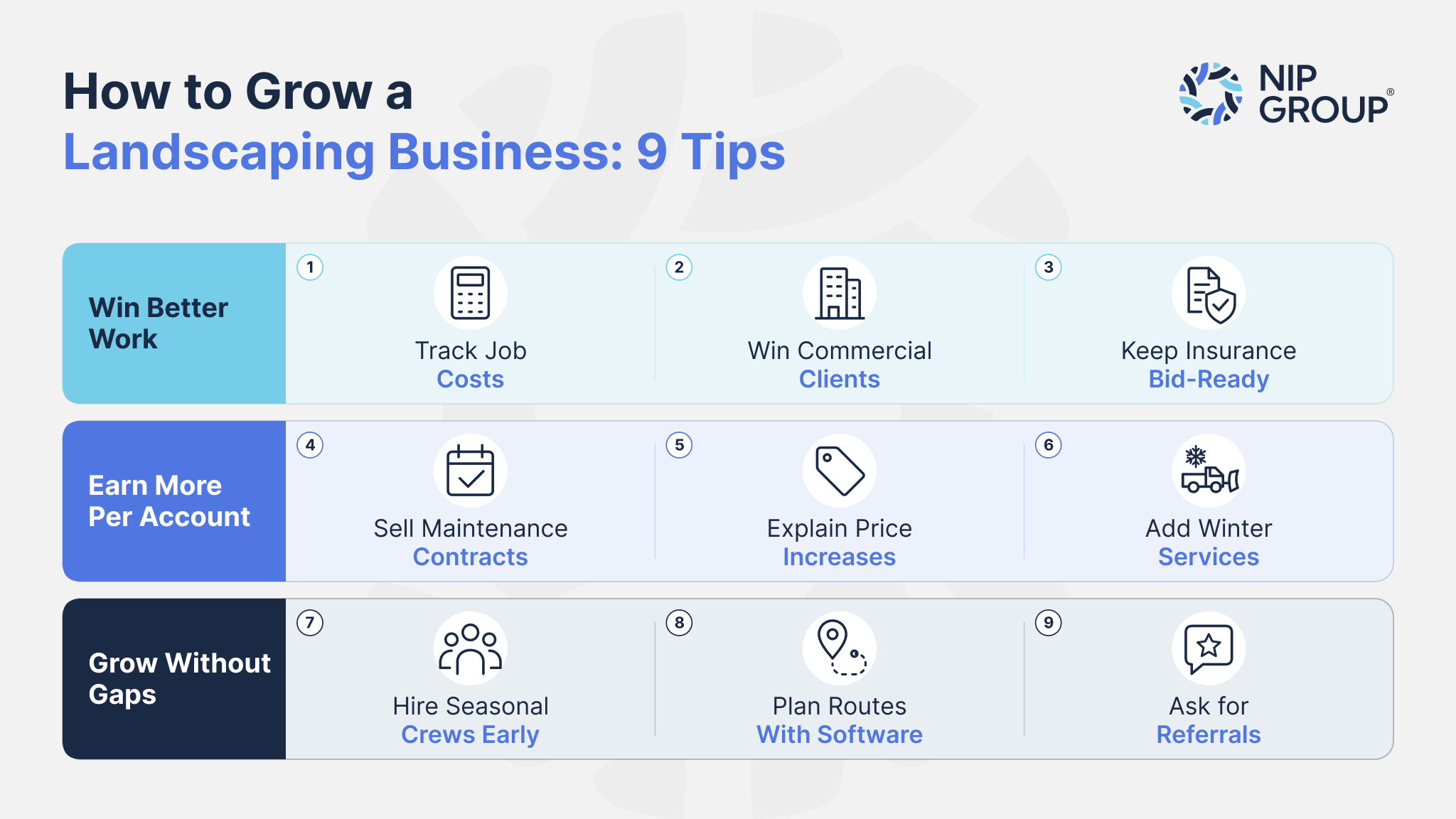
9 Tips To Grow A Landscaping Business
These landscaping business tips work best in order, since each step depends on the one before it.
1. Know Your Job Costs First
Growth starts with knowing what each landscaping job costs to complete. Total revenue alone cannot show which clients bring in profit and which ones drain it. That is why learning how to manage a landscaping business begins with a few numbers tracked on every job:
- Hours on site: The hours quoted compared with the hours the crew worked.
- Drive time: Time spent driving between stops, which the business still pays for.
- Fuel and materials: What each job used, which shows its true cost.
Together, these numbers show which jobs earn the most and which type of client is worth chasing next.
2. Go After Commercial Clients
According to Grand View Research, commercial properties brought in 58.4% of global landscaping revenue in 2024.
That large share comes from steady, year-round demand. Office parks and HOAs need their grounds maintained all year, and so do schools and shopping centers. Most of these properties also plan for landscaping in their yearly budgets. For owners working out how to grow a landscaping business beyond homeowners, that steady budget is the main draw.
3. Keep Insurance Ready for Bids
Landscapers should have proof of insurance ready before bidding, since commercial clients usually ask for it first. A company without the right landscaping business insurance can lose a contract before the price is discussed. Most commercial contracts require these documents:
- Certificate of insurance: Most clients want this document in hand before the first mowing visit, as proof that coverage is active.
- Additional insured status: The client is named on the landscaper’s liability policy, so a claim from the job protects them too.
- Minimum liability limits: Many contracts set a floor of $1 million for each incident the business could be blamed for.
- Pollution coverage: Basic liability policies often leave out fertilizer and pesticide spraying, so commercial clients may ask for this separately.
Once this paperwork is ready, a landscaper can start new contracts faster and bid on larger accounts with confidence.
4. Offer Year-Round Maintenance Contracts
Year-round maintenance contracts turn newly won accounts into steady monthly income. Since the work is booked well ahead, owners know which crews they need and when.
They can also see roughly what revenue the next few months will bring. Offering two or three clearly priced packages makes the decision simple for clients. That predictable base gives owners room to plan how to grow a landscaping business year after year.
Must Read: What to Include in Every Landscaping Contract: Scope, Payment Terms, and Liability Clauses
5. Explain Price Increases Clearly
Landscapers should raise prices when their costs increase and explain exactly why. A short note on rising fuel or labor costs, sent 30 days before renewal, gives clients time to plan. Many owners searching “how to grow my landscaping business” skip this step while chasing new customers. Yet a small increase in existing accounts brings in more revenue without one extra job.
How to Grow a Landscaping Business: 9 Tips
6. Add Services for the Off-Season
Adding winter services keeps revenue coming in after mowing season ends. Snow and ice removal fits best, since many commercial properties already on a landscaper’s route need it. This makes winter work a practical way to grow a landscaping business with existing clients. It also keeps crews employed through winter, so they are more likely to return in spring.
That added work brings added risk, since a plow truck on icy roads faces different hazards than a mower. So, before the first storm, landscapers should ask their broker to confirm that their policy covers snow removal.
7. Start Seasonal Hiring Early
Landscaping owners should plan next season’s hiring in the fall, before experienced seasonal workers are taken. Many landscapers fill these roles through the H-2B visa program, which has a yearly cap.
In February 2026, a federal rule authorized up to 64,716 extra H-2B visas for fiscal year 2026. That rule ended on September 30, 2026, so extra visas for 2027 depend on a new one. Once new workers arrive, make sure your workers’ comp policy covers every hire from day one. A short safety briefing before the first shift also lowers the chance of an early claim.
8. Use Software to Plan Routes
Scheduling software helps each crew finish more stops in a day with less driving. For a business that has just hired, that means more paid hours from every new worker. Dated before-and-after photos in the same app also give owners a record if a client disputes damage. With routes and records handled, owners can focus on growing a landscaping business without extra office staff.
9. Ask Happy Clients for Referrals
Referrals from satisfied clients bring in new work at almost no cost. Clients tend to recommend companies that show up on time and do good work. That means reliable service does much of the selling.
The best time to ask for an online review is right after a job the client clearly liked. Commercial clients are worth asking first, since one property manager may look after several sites. Over time, a steady flow of referrals lets owners grow a landscaping business while spending less on ads.

What Insurance Do You Need When Growing a Landscaping Business?
You need insurance that grows with your contracts and crew. Larger contracts bring stricter liability terms, and each new hire adds workers’ compensation exposure. Covering those risks early is part of running a successful landscaping business. LandPro is built for those risks in landscaping and lawn care.
Backed by more than 35 years in the industry, LandPro covers everything from lawn care to snow removal. Its coverage grows along with the business:
- General liability and umbrella: Covers injury and property damage claims, with higher limits when contracts need them.
- Commercial auto and inland marine: Protects work trucks and the equipment they haul.
- Workers’ comp and employment practices liability: Protects the business as the crew grows.
- Pollution and property: Covers spraying work and the shop or office.
The program’s insurance company is also rated A+ (Superior) by A.M. Best. Landscapers can read that as a sign the company has the money to honor claims after a loss. So, ask your broker to sign you up for LandPro. Or, contact us to see how LandPro fits your next season’s plans.
FAQs
1. What makes the most money in landscaping?
Installation projects often make the most money in landscaping, since one design-build job can outearn months of mowing. Water-saving work is also worth learning. Drought-tolerant plantings and drip irrigation are in rising demand and can support stronger margins.
2. What is the best business structure for landscaping?
An LLC (Limited Liability Company) suits most small landscaping companies because it balances protection with easy setup. The three common options compare like this:
- Sole proprietorship: Quick to set up, though personal savings stay exposed.
- LLC: Separates your personal assets from business debts.
- S corporation: Can lower self-employment taxes as profits grow
3. What is the best way to promote my landscaping business?
The best way to promote your landscaping business is through local visibility, using low-cost options like these:
- Google Business Profile: Add job photos so nearby searches find you.
- Branded trucks: Your vehicles advertise on every route.
- Door hangers: Leave them at neighbors’ homes after each job.
4. What is the cheapest way to landscape a garden?
The cheapest way to landscape a garden is with native plants and mulch. Native plants need less water once established, and mulch keeps weeds down and holds soil moisture, so upkeep costs less.