










Summary
- One bucket truck accident can injure a worker and lead to several insurance claims.
- A daily boom lift safety checklist helps your crew catch problems before anyone goes up.
- This blog explains bucket truck risks and the checks your crew should run every day.
In 2024, 99 tree trimmers and pruners died on the job, according to the Bureau of Labor Statistics fatality census. Falls alone caused 39 of those deaths. Your crew faces that same fall risk every time a bucket truck lifts someone into a tree. That is why boom lift safety deserves more than a quick look before the first job.
It matters even more at this time of year, as a storm cleanup sends your lifts under broken limbs and close to sagging power lines. So, in this blog, we explain why bucket work in trees is risky and what one incident can cost you. We also share a simple daily checklist your crews can follow.
Why Does Boom Lift Safety Look Different in Tree Work?
Boom lift safety looks different in tree work because the job keeps changing while you are up in the bucket. On a building site, the wall beside the bucket stays in one place from start to finish. A tree works the opposite way, since every cut you make shifts its weight and moves its branches. So, the changes usually show up in these four ways:
- Swinging limbs: A heavy limb can swing back toward the boom after you cut it, so if it hits the bucket hard, the jolt can throw the operator out of it.
- Soft or sloped ground: A backyard can look flat and firm, but soft soil or a slight slope may sit under the grass. When an outrigger sinks into that ground, the truck can tip while the operator is still up in the bucket.
- Hidden power lines: Trees near homes often grow around the power lines that run to the house. As the boom moves through the leaves, it can touch a wire that nobody on the crew could see.
- Moving the truck mid-job: Big trees usually need the truck moved so the bucket can reach the other side. That’s why operators end up unclipping their lanyards to step out during the move. Some among them forget to clip back in. That missed step leaves them unprotected once work resumes.
Must Read: Never Do This When Cutting Down a Tree: 9 Mistakes That Get Crews Hurt
What Does One Boom Lift Safety Lapse Cost a Tree Service Company?
A single boom lift safety lapse can trigger several insurance claims at once, and each one raises your cost. Consider an operator thrown from the bucket while the limb they cut falls through a client’s roof. That one moment can draw on every part of your tree service insurance at the same time, like:
- Workers’ compensation, which pays your injured operator’s medical bills and lost wages. A serious claim can also raise your workers’ comp premium for the next few years.
- General liability that covers repairs to the client’s roof and anything inside the home that the limb damaged.
- Commercial auto, since your bucket truck is a vehicle and some losses tied to the truck may fall under your auto policy.
- Equipment coverage, which pays to repair or replace your boom if the impact bent or cracked it.
What Should Every Tree Service Company Include in a Boom Lift Safety Checklist?
Your boom lift safety checklist should cover each stage of the job, from the first setup check to packing up.
1. Before the Boom Goes Up
Problems are easiest to fix while everyone is still on the ground, so start every job with these five checks:
- Walkaround inspection: Walk around the truck and look for oil leaks or cracks on the boom. A small leak or crack can turn into a big failure once someone is up in the air.
- Control test: Move the boom in every direction with both the top and bottom controls before anyone gets in. If a control is slow or does not respond, it is safest to find that out on the ground. OSHA requires this test every day for that reason.
- Power lines: Look up and find every power line near the tree before the boom moves. Treat each one as if it is live, because one touch can send electricity through the boom.
- Drop zone: Put cones around the spot where branches will land. Keep the ground crew out of that spot until the operator says it is safe.
- Outriggers: Put the outriggers on pads or hard ground so they don’t sink. If the yard is on a slope, also set the brakes and block the wheels.
Must Read: 101 Tree Cutting Safety Tips: Detailed Guide for Arborists
2. While the Operator Is in the Bucket
Once the bucket is in the air, your operator and ground crew should follow one plan.
- Cut order: Plan each cut so the falling limb moves away from the bucket and the boom.
- Gate shut: Keep the bucket gate closed in the air, and never lean out to reach a branch.
- Lanyard on the boom: Keep the lanyard clipped to the boom or bucket. If it is clipped to the tree, the operator falls when the tree does.
- Keep the boom down before driving: Lower the boom before moving the truck, unless the truck is made to drive with it raised.
- Command and response: Have the operator call out every cut and wait for the ground crew’s answer before it drops.
3. After the Job Ends
Before you leave the site, a few quick checks help you catch equipment problems early:
- Inspect after impact: If a limb hit the bucket, have the boom inspected before using it again.
- Jot down the defects: Write down any leak or slow control so it gets fixed before the next job.
- Stow the boom: Lower it into its cradle and pull up the outriggers before driving away.
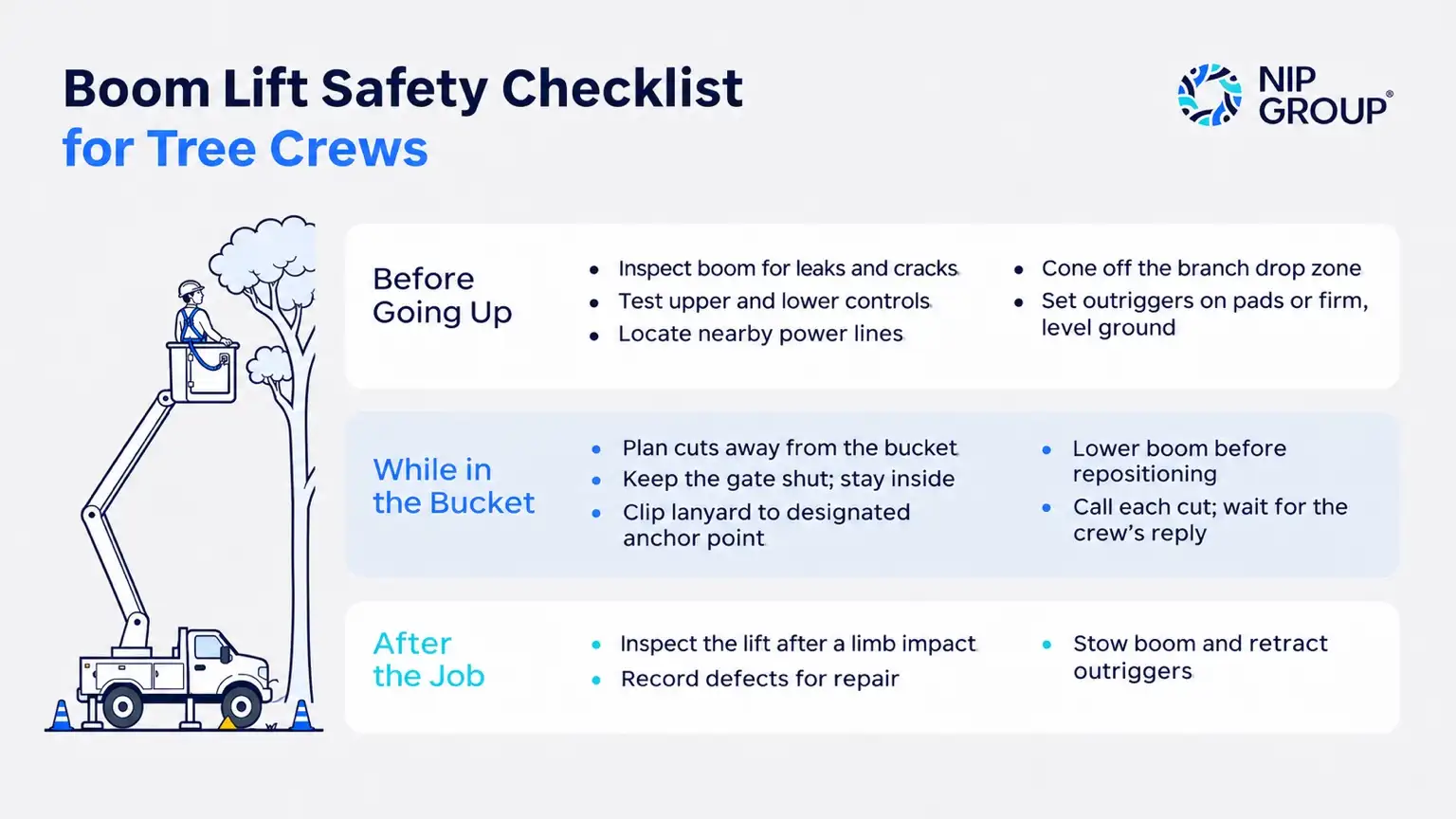
Boom Lift Safety Checklist for Tree Crews
How Can You Build Boom Lift Safety Into Your Everyday Routine?
You can build boom lift safety into daily work by writing your rules down and making sure crews follow them. Many companies miss that written step. A 2024 Journal of Safety Research study reviewed decades of fatal accidents in tree care and landscaping. In 60.2% of them, the employer had no written safety plan. So, your plan should cover:
- Training for new hires: Give new workers boom lift safety training and supervised time in the bucket before they work alone.
- Who can run the lift: OSHA allows only authorized workers at the controls, so list them by name.
- Signed records: Keep dated inspection logs and training sign-offs for every operator.
- Rescue practice: Teach every ground worker to bring the bucket down from the lower controls in an emergency.
Pair Boom Lift Safety With Coverage Built for Tree Work
One bad moment in the bucket can lead to claims under several policies, even when your crew follows every step. TreePro is built for that risk and places no height limits on your crews. Its general liability, workers’ compensation, commercial auto, inland marine and umbrella coverage sit in one program. That way, a single lift incident can be handled in one place.
TreePro is also backed by an insurance company with an A+ rating from A.M. Best. This rating means the company has a strong financial ability to pay claims when you need them paid. Ask your broker to sign you up for TreePro or contact us to learn more about the program.
FAQs
1. How likely is a boom lift to tip over?
A boom lift rarely tips over when it is set up and used the way the maker intends. Tip-overs usually start with a mistake like:
- Loading the bucket past its rated weight limit
- Working on a slope steeper than the maker allows
- Tying heavy limbs off to the bucket or boom
- Running the lift in high winds
2. Can you climb out of a boom lift?
No, you should not climb out of a boom lift while it is in the air. OSHA says workers must stand on the bucket floor and never climb onto its edge. If an operator must move into the tree, they should tie in to the tree before unclipping from the bucket.
3. Do you need to wear a harness when you are in a boom lift?
Yes, you need to wear a harness every time you work from a boom lift. OSHA requires it, and it is your main protection if the bucket jolts. Keep these basics in mind:
- Use a full-body harness that fits snugly
- Choose a short lanyard so you cannot be thrown over the edge
- Check the harness and lanyard for cuts or fraying before each shift
4. What happens if hydraulics fail in a boom lift?
If the hydraulics fail, most boom lifts are designed to hold the boom in place with built-in safety valves. The operator should stay clipped in and calm while a ground worker uses the emergency lowering system at the base.