












Summary
- Many solo contractors carry a workers comp ghost policy without knowing it covers no one.
- Learning its limits shows you when to move to full coverage for your crew.
- This blog explains how ghost policies work and when your business needs full coverage.
Arizona’s governor signed SB 1428, on June 22, 2026, which is a new law on the workers comp ghost policy. If you work alone, you may already be carrying this low-cost policy to prove you have workers’ comp. It gives you a valid certificate, but it pays nothing if anyone gets hurt on the job, including you.
The certificate does not show this limit, so many clients assume your work is fully covered. Arizona’s new law, therefore, makes that limit visible. Starting July 1, 2027, construction contractors with a ghost policy must tell clients about it in writing.
Now, once clients learn you carry a ghost policy, you can expect questions about who works with you and your hiring plans. To answer them clearly, you need to know what your policy covers and where it stops. In this blog, we, therefore, explain how your ghost policy works and when you need full coverage instead.
Must Read: Worker Compensation Insurance And Equipment Coverage: What Every Contractor Needs To Know
What Is a Workers Comp Ghost Policy and How Does It Work?
A workers comp ghost policy is a workers’ compensation policy for business owners who have no employees. Where states allow it, the policy is fully legal, but the catch is that it covers nobody, including you as the owner.
So why would anyone pay for coverage that never pays out? Many clients and general contractors won’t sign a contract without seeing a workers’ comp certificate. So, a ghost policy gives you that certificate at a much lower price. In other words, you are paying for proof of coverage on paper. Getting one follows a simple path:
- You apply with zero payroll: You confirm you have no employees and expect no wages this year.
- You pay a minimum premium: With no payroll to price, you pay the lowest premium your state and trade allow.
- You get your certificate of insurance: This is the proof you show any client who asks for workers’ comp.
- Your records get checked later: At the end of the term, the insurance company audits your books to confirm you never had workers.
Which Businesses Can Use a Workers Comp Ghost Policy?
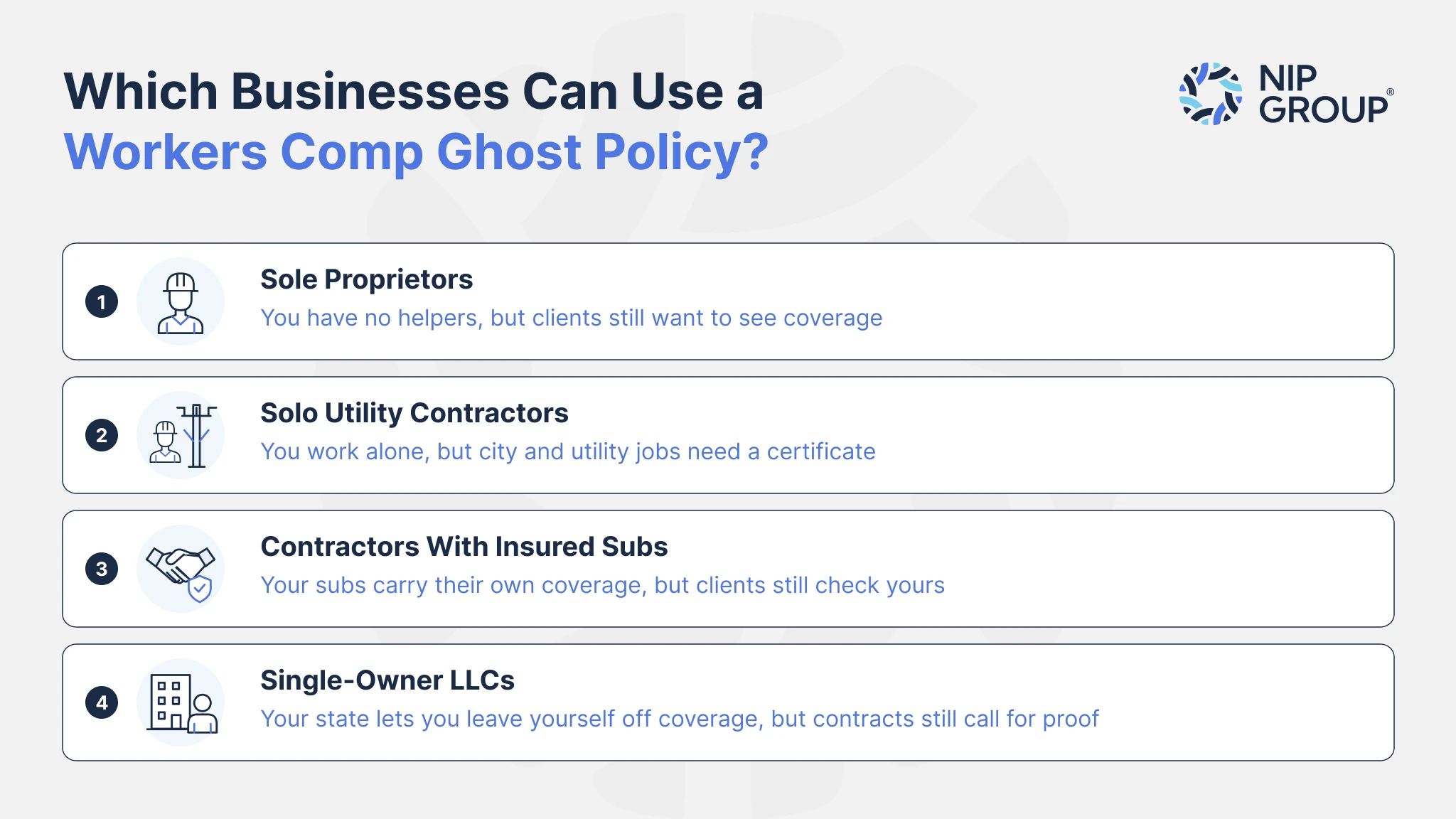
Only one-person trade businesses that need a certificate to win work can use a workers comp ghost policy. Your business structure matters less than who shows up on your jobs. If your business matches one of the setups below, you will likely qualify for a ghost policy.
Sole proprietors who work alone
If you own the business and handle every job without helpers, you have no employees. A ghost policy is built for exactly this setup, because it assumes no one works for you.
Solo contractors who want city or utility contracts
Cities and utility companies usually ask every business on site for a workers’ comp certificate. If you work alone, a ghost policy gives you that certificate at a lower cost. These jobs also set minimums for other coverage, so review the project’s utility contractor insurance requirements before you bid.
Contractors who hire only insured subcontractors
If each sub you bring in carries their own workers’ comp, their pay does not count toward your payroll. Your business still has no workers of its own, so a ghost policy works for you. Keep their certificates on file, since your year-end audit will ask for them.
Single-owner LLCs and corporations
In many states, the owner of an LLC or corporation counts as an employee of their own business. If your state lets you opt yourself out, and no one else works for you, a ghost policy fits.
Must Read: Umbrella or Excess Liability Insurance: Which Is Right for Your Business?
Which Businesses Can Use a Workers Comp Ghost Policy?
What Does a Workers Comp Ghost Policy Not Cover?
A workers comp ghost policy does not cover:
Anyone You Hire, Even for a Few Days
A ghost policy is issued on one condition: you have zero payroll. Hiring even one helper for a weekend job breaks that condition. Your policy was never set up to cover that person, so an injury on the job may not get paid.
Your Own Injuries on the Job
The owner is excluded from a ghost policy. So if you fall from a ladder or hurt your back lifting equipment, the policy pays nothing toward your care.
Your health plan may not help either, since some plans refuse claims for injuries that happen at work. In that case, the hospital bill and the income you lose while recovering are yours to cover.
Work in States That Restrict Ghost Policies
Each state sets its own rules for ghost policies, and some states do not allow them at all. A policy that works for your local jobs may not be accepted once you cross a state line. So, before you bid on a job in another state, ask your broker to check the rules there.
Helpers You Pay as Subcontractors
Paying a helper on a Form 1099 does not automatically make them a subcontractor in your state’s eyes. If that helper carries no workers’ comp of their own, the state may treat them as your employee. Your workers comp ghost policy then gives them no protection.
The year-end audit often takes the same view. Insurance companies usually count payments to uninsured subcontractors as part of your payroll. Since your policy was priced on zero payroll, you owe extra premium on those payments. To avoid this, ask every subcontractor for their own certificate of insurance before the job begins.

Does Your Business Need a Workers’ Comp Ghost Policy or Full Coverage?
If anyone besides you works on your jobs, you need full workers’ comp. A workers comp ghost policy only fits while you are the whole crew. Both give you a certificate of insurance, but they work differently once someone gets hurt or the audit arrives. The table below shows how.
| Ghost policy | Full workers’ comp | |
| Who it’s for | Owners who work alone with no employees | Businesses with at least one worker on the payroll |
| Does it cover your workers? | No, because the policy insures zero payroll | Yes, it pays medical bills and lost wages when a worker gets hurt on the job |
| Does it cover you, the owner? | No, owners are left off the policy | It can, if you choose to include yourself and your state allows it |
| How the premium is set | A flat minimum premium based on your state and trade | Your payroll and the type of work your crew does |
| What the audit checks | That you still had no payroll during the policy term | Your real payroll, so your premium matches the crew you insured |
| When it stops fitting | The day you hire your first worker | It keeps up with your business as you add workers |
What to Do When Your Business Outgrows a Ghost Policy
Once you outgrow your workers’ comp ghost policy, switch to a full workers’ comp policy built on your payroll.
Getting there takes one call to your broker. Tell them roughly what your workers will earn this year and what kind of work they’ll do. Try to time it so the new coverage begins the same day the ghost policy ends. That way, nobody on your crew works a single day without protection.
This is the stage NIP’s WorkCompEdge was designed for. It covers more than 50 types of construction and agricultural work. A few of its features help most while your crew is new:
- Safety training: New hires pick up safer habits early, before small mistakes turn into injury claims.
- Pay-as-you-owe plans: You pay based on the payroll you report, so your bill grows only as your crew does.
- Coverage in more than one state: If a job takes you across state lines, your coverage can go with you.
- Nurse-led claims help: If someone gets hurt, a nurse helps guide their care and recovery.
WorkCompEdge is also backed by A-rated insurance companies. In simple terms, they have the financial strength to pay claims when your workers need them. Ask your broker to sign you up for WorkCompEdge. If you’re planning to hire in the next few months, contact us, and we’ll walk you through your options.
FAQs
1. How much is a ghost policy for workers’ comp?
A ghost policy usually costs your state’s minimum premium for your trade, plus some added fees. Since there is no payroll to price, the cost stays low and fairly fixed. Your final price depends on:
- Your state’s minimum premium rules
- The class code assigned to your trade
- State assessments and policy fees
2. Is a workers comp ghost policy legal in every state?
No, a workers comp ghost policy is not an option in every state. Ohio, North Dakota, Washington, and Wyoming run their own state workers’ comp funds. Private insurance companies cannot sell workers’ comp in those states, so ghost policies are generally unavailable there. If you work in more than one state, your broker can confirm the rules for each.
3. Do I need a ghost policy if I already have general liability insurance?
Yes, you may still need one, because general liability does not count as workers’ comp. General liability pays when your work injures someone else or damages their property. Workers’ comp deals with injuries to the people working for you. Clients usually ask for each certificate separately, so one cannot stand in for the other.
4. Can I cancel a workers comp ghost policy early and get a refund?
You can usually cancel a workers comp ghost policy early, but a refund is unlikely. Insurance companies often treat a minimum premium as fully earned once the policy starts. So, before you cancel:
- Ask your broker how your insurance company handles refunds.
- Notify clients who have your certificate because your contract may require written notice before you cancel any policy listed on it.