









Summary
- Tree care has one of the highest workplace fatality rates, and most incidents follow recognizable and preventable patterns.
- Knowing the right tree cutting safety tips for each phase of the job is what separates a safe crew from a statistic.
- In this guide, we cover site inspection, PPE, felling technique, and power line safety for arborists at every experience level.
TCIA’s August 2025 Accident Briefs documented multiple tree worker deaths in June 2025 alone. A tree worker died from electrocution near a live power line in Ocean Ridge, Florida. Such events were consistent with patterns that repeat year after year in this industry.
According to TCIA and BLS data, tree workers make up less than 0.05 percent of the U.S. workforce but may account for approximately 1.4 percent of all work-related fatalities. The non-fatal injury rate for tree workers is nearly three times that of other industries.
Tree cutting safety tips are the direct, practical response to a risk profile that is among the most dangerous in any occupation. This guide covers the areas where most incidents begin and what your crew can do before, during, and after every job to stay off that list.
What Should You Check Before the Chainsaw Starts
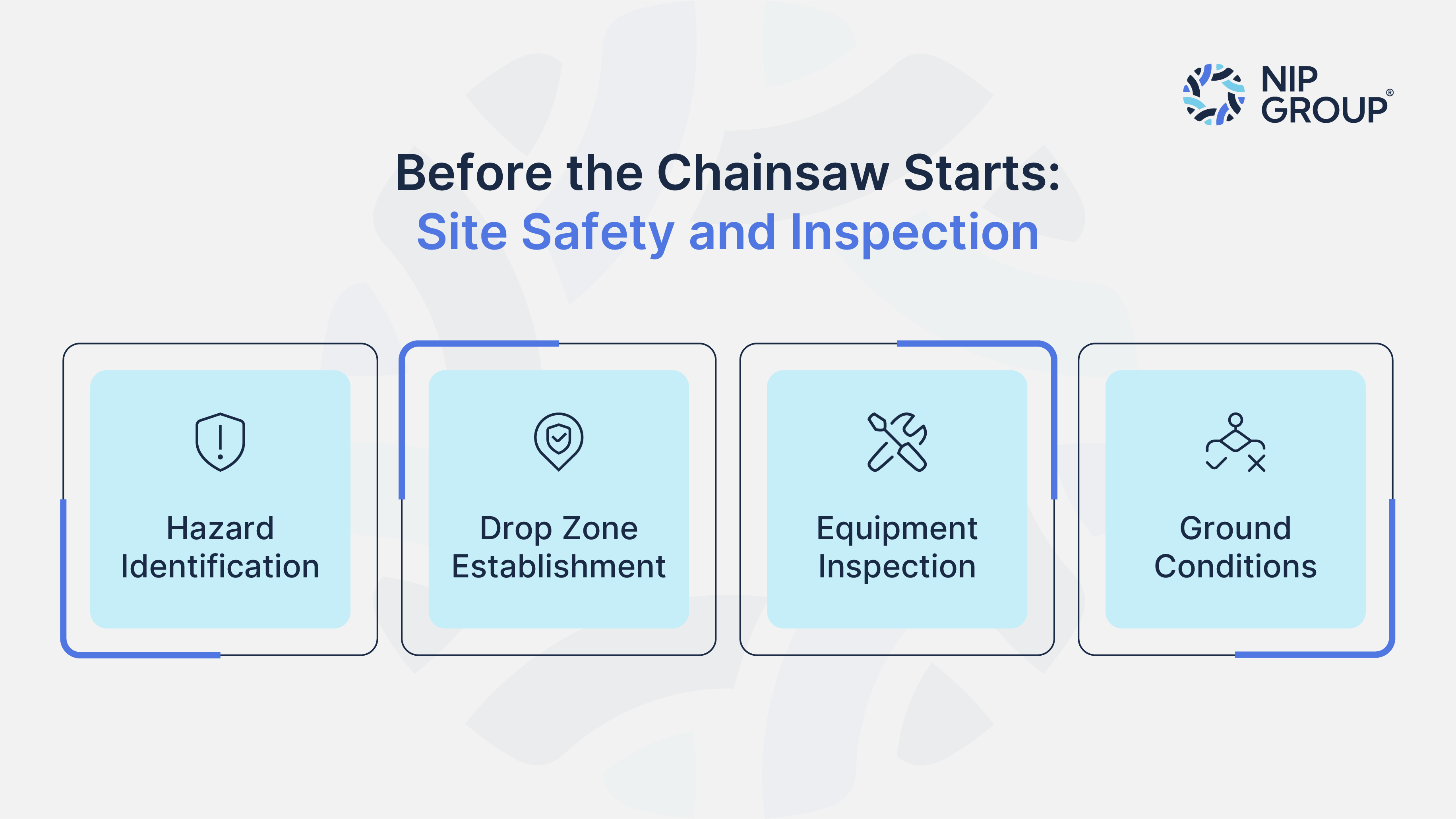
Most tree cutting incidents trace back to decisions made before the first cut. A pre-job tree safety inspection is where safety is either built into the job or quietly overlooked.
What to cover before any work begins:
- Hazard identification: Look for dead or hanging branches, split unions, root damage, and visible decay. This check happens before anyone climbs or positions below the canopy.
- Drop zone establishment: No crew member other than the chainsaw operator should be within 1.5 times the tree’s height during felling. ANSI Z133 is specific on this requirement.
- Equipment inspection: Chainsaws, ropes, rigging hardware, and aerial equipment need to be checked before the job begins. Not during.
- Ground conditions: Slopes, soft soil, and wet surfaces affect equipment positioning and escape route planning. Note them before starting.
For tree safety planning on complex jobs, document the inspection results in writing. That documentation supports your position if an incident generates a claim or an OSHA investigation.
Personal Protective Equipment and Climbing Safety
Tree Trimming Harness and Fall Protection
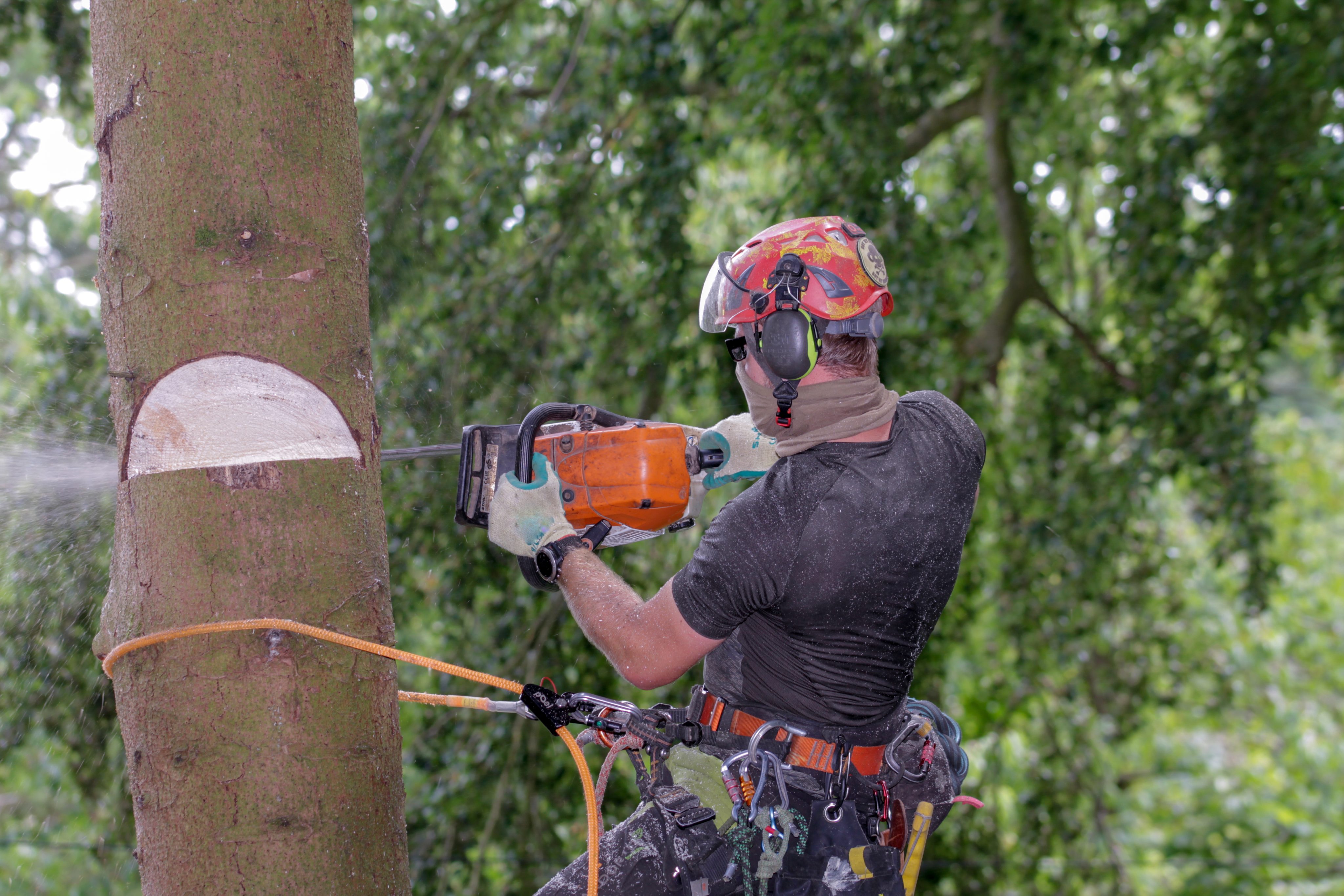
A tree trimming harness must meet ANSI Z133 requirements and be inspected for cuts, UV degradation, and wear at every attachment point before every climb. Any harness that has taken a shock load should be retired immediately, regardless of visible condition.
Tree climbing safety requires that the climber stay connected to the tree through a work positioning system at all times. Overreaching while working, leaning outside the harness connection point to reach a branch, is one of the most consistent patterns in climbing fall incidents. When the branch releases, the climber’s center of gravity shifts outside the anchor. The fall follows.
Must read: Fall Protection for Tree Workers: Four Common Oversights
Utility Worker Fall Safety Equipment in Aerial Lifts
Utility worker fall safety equipment for aerial lift operations has one non-negotiable: the operator must be connected to the basket’s anchor point before the lift leaves the ground. Falls from aerial lifts most often happen when an operator overreaches while not properly connected. OSHA and TCIA fatality investigations document this pattern repeatedly.
Chainsaw PPE
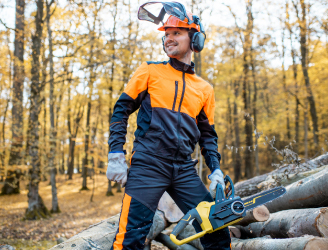
Chainsaw-rated chaps, integrated helmet face shields, hearing protection, and cut-resistant gloves are required for all tree cutting work involving a running chainsaw. Operating without chaps is a violation of ANSI Z133 requirements regardless of experience level or job duration.
Safe Tree Cutting and Felling Techniques
These tree cutting safety tips apply to every felling job regardless of tree size or site complexity:
- Establish a clear escape route before making the first cut. The route should run at a 45-degree angle away from the expected fall direction and be clear of debris.
- Use the three-cut felling method: face notch cut on the fall side, then a back cut that leaves a hinge of appropriate thickness. Hinge wood controls direction of fall.
- Never stand directly behind the tree during or after the back cut. Kickback off the stump is a documented fatal hazard.
- Keep all crew at a minimum distance of 1.5 times the tree height during the entire felling sequence.
- For safety and prevention of tree falls in residential settings, assess lean direction, root plate condition, and any structural defects before cutting.
- When tree cutting near structures or in confined spaces, use sectional dismantling with rigging rather than full-length felling.
- Communicate every step with the ground crew before cutting. A clear signal system keeps workers from entering the drop zone during active work.
Must read: How to Recognize Cold Stress Symptoms on Tree Care Worksites
How Safe Is Your Crew When Working Near Power Lines
Working near energized utility lines is where tree cutting safety tips demand a separate level of preparation. The June 2025 electrocution in Ocean Ridge followed the same pattern as dozens of prior fatalities. A tree worker near a live line, contact made, no path to survival.
The minimum approach distance for unqualified workers is 10 feet from energized lines. Crossing that boundary without the appropriate qualification is the leading cause of electrocution fatalities in tree care.
Before any job near utility infrastructure, contact the utility provider, request line de-energization or insulation, and document that request in writing before any crew member ascends.
TreePro: Coverage for the Work Behind the Tips
Following tree cutting safety tips consistently reduces incidents. It does not eliminate the liability exposure that comes with running a tree care business. An accident, property damage claim, or third-party injury can arrive on a well-planned, well-executed job.
Working in tree care is inherently dangerous. Tree service companies face significant risks and potential liability. The right tree service insurance policy helps manage the legal and financial burden when the unexpected happens.
TreePro is built specifically for the tree care industry and provides:
- Specialized coverage options designed for tree care operations of every scale
- Risk control, claims management, and compliance and safety resources to support your operation
- Crane and boom exposure coverage, plus snow and ice removal, areas many insurance providers in this market overlook entirely
TreePro is a proud member of TCIA, ISA, and UAA.
Talk to your broker about TreePro or contact us directly. Make sure your coverage reflects the risk your crew manages every single day.
FAQs
What is the 5 15 90 rule for tree felling?
The 5 15 90 rule is a tree cutting safety guideline for working near hazard zones. It means
- Stopping work when winds reach 5 mph gusting to 15 mph in high-hazard situations
- Maintaining 90-degree awareness of surrounding hazards during felling
- Applying it within the broader framework of tree safety planning before any cut is made
Application varies by jurisdiction and job context, so checking with your authority having jurisdiction is recommended.
What is the fatality rate for tree workers?
Tree workers make up less than 0.05 percent of the U.S. workforce but may account for approximately 1.4 percent of all work-related fatalities, according to TCIA and BLS data. The non-fatal injury rate is 239 per 10,000 workers, compared to 89 across all industries. Falls and contact with objects or equipment are consistently the two leading fatal incident categories in tree care.
What are the three C’s of pruning?
The three C’s of pruning are dead, diseased, and crossing branches. The three priority removal categories in any standard pruning assessment. They form the foundation of a tree safety inspection before any cutting begins, helping arborists identify the highest-risk branches before determining the full scope of the pruning job.
How do you get comprehensive insurance for arborists?
Getting comprehensive insurance for arborists starts with working with a specialty insurer that understands tree care risk specifically. General contractor policies often exclude aerial operations, crane and boom work, and the completed operations liability that follows a removal job.
TreePro is built for this, covering the full risk profile of tree care businesses, including climbing operations, aerial equipment, and workers’ compensation for high-hazard work. Ask your broker about it.

