






Summary
- Greenhouse technology is advancing faster than most growers’ coverage programs were designed to keep pace with.
- Knowing which systems are changing your risk profile and how is what keeps your coverage from falling behind your operation.
- In this guide, we break down what’s new in 2026, what it means for your business, and what it means for your insurance.
What This Shift Means for Your Operation
The greenhouse technology picture in 2026 is about what’s becoming expected. As more operations adopt connected monitoring systems and automated workflows, competitive baselines are rising across the greenhouse industry trends.
The types of greenhouses that were considered advanced three years ago are increasingly the standard against which buyer requirements and contract terms are set.
Automated environmental controls and smart irrigation tend to deliver the fastest payback through energy and water savings. Robotics and AI-driven analytics require more capital upfront, but reduce the labor dependency. That has made workforce availability one of the most persistent operational challenges in commercial growing.
What New Technology Means for Your Coverage
Here’s what rarely makes it into greenhouse technology coverage discussions: as operations become more sophisticated, the insurance required to protect them changes too.
A greenhouse running connected climate systems, AI-driven pest management, and automated harvesting equipment has a fundamentally different risk profile from one that runs on manual systems.
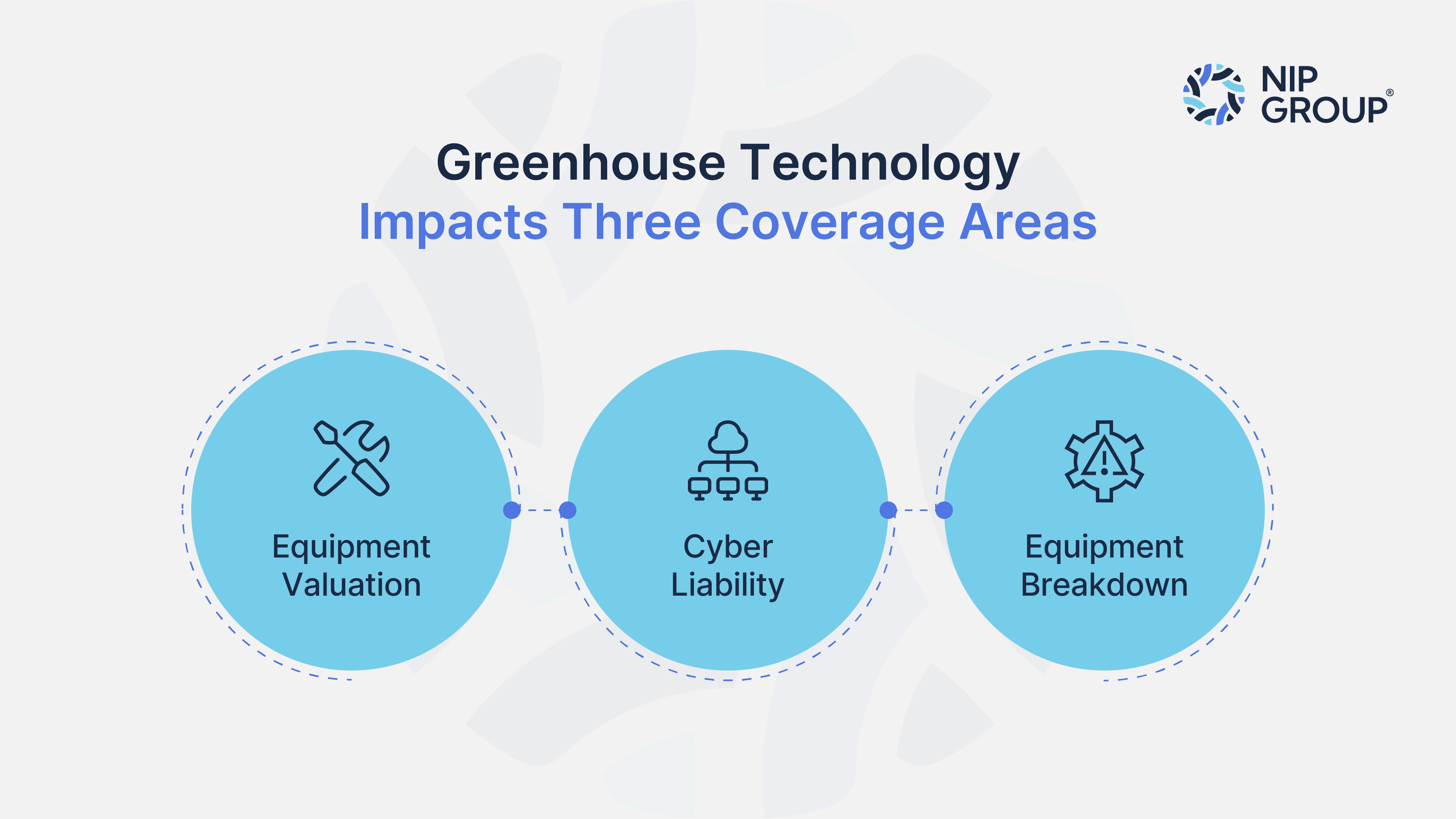
Three coverage areas shift most significantly as operations modernize:
- Equipment valuation. Specialized robotics, sensor arrays, and automation systems need to be covered at replacement cost, not depreciated value. A standard property policy may not distinguish between general greenhouse equipment and a proprietary AI-driven monitoring platform.
- Cyber liability. Connected systems create connected vulnerabilities. A cyber incident compromising your climate control software creates a crop loss event. Coverage that doesn’t account for this dependency is working with an incomplete picture of your actual exposure.
- Equipment breakdown. Automated systems have more failure points than manual ones. Equipment breakdown coverage for the technology running your operation, not just the physical structure, is becoming essential for modern growing businesses.
Must read: Catastrophe Insurance Overview: Benefits, Types, and Who Should Consider It
GrowPro: Coverage Built for the Modern Greenhouse
Greenhouse technology is advancing faster than most coverage programs were designed to keep pace with. A policy written three years ago may not reflect the systems, the valuation, or the cyber exposure of the operation you’re running today.
GrowPro is built specifically for greenhouse growers, nurseries, and garden centers.
It covers equipment breakdown, product liability, umbrella liability, contractors’ pollution liability, and more. All structured around how modern greenhouse businesses actually operate.
Specialized endorsements for growing stock and hydroponics address exposures that standard policies consistently miss. The program is available nationwide with a minimum package premium of $10,000, backed by more than 35 years of green industry expertise.
Talk to your broker about GrowPro. Make sure your greenhouse business insurance reflects what you’re actually running in 2026.
FAQs
What is an example of a greenhouse technology?
A strong example of greenhouse technology in action is AI-powered pest management. Systems like PATS, first deployed in Dutch commercial greenhouses, use computer vision to analyze insect flight patterns and direct small drones to intercept and eliminate pests on impact. It removes targeted pesticide applications entirely and operates continuously without manual oversight.
What services are offered by greenhouse technologies?
Greenhouse technologies cover a broad range of services, including:
- Environmental monitoring and climate control through wireless sensor networks
- Automated irrigation and rainwater harvesting systems
- Robotic planting, spacing, harvesting, and pest management
- LED spectral lighting systems optimized by plant type and growth stage
- AI-driven analytics platforms for yield tracking and decision support
The common thread across all of these is reducing manual labor while improving consistency and crop output.
How is AI being used in greenhouse technology?
AI is being used in greenhouse technology across several areas. Cultivar selection is one. Syngenta’s Tomato Vision facility uses AI alongside DNA sequencing to predict optimal hybrid varieties before physical testing begins. Pest management is another, with computer vision systems identifying insect size, speed, and flight patterns to automate control. AI-driven climate platforms are also making production decisions in real time, based on continuous data from sensor networks throughout the growing environment.
Which is the best insurance for greenhouse businesses?
The best insurance for greenhouse businesses is one purpose-built for horticulture operations, covering the structure, growing stock, equipment, cyber liability, and pollution in a single program. GrowPro fits that description, with specialized endorsements for hydroponic systems, growing stock, and agricultural property that standard commercial policies routinely miss.