













Summary:
- Every commercial policy forces a trade-off between high deductible vs low deductible costs and coverage.
- Understanding how each option works helps you protect your cash flow before a claim happens.
- This guide breaks down what to consider before you make that final decision.
When you buy a commercial insurance policy, you choose more than your coverage limits. You also choose your deductible. That number decides how much you pay each month, and what you owe when a claim happens.
Insurers set deductible options based on the losses they are covering nationwide. 2025 has been a costly year for them. Global insured catastrophe losses reached close to $100 billion in the first half of 2025 alone. Most of that hit the United States. California’s wildfires caused nearly $40 billion of it, according to NAIC.
Losses at that scale change how insurers price risk on every policy they write, including yours. When insurers pay out more in claims, they lean harder on deductibles to manage what they cover. That makes your deductible decision worth extra thought this year.
This decision further shapes what you pay each month and what you owe after a claim. For a small business buying its first policy, that carries real weight. This blog breaks down the logic behind it, so you can pick a deductible built around how your business runs.
Must Read: Worker Compensation Insurance And Equipment Coverage: What Every Contractor Needs To Know
What Does High Deductible vs Low Deductible Mean?
A deductible is the amount you pay out of your own pocket before your insurance starts paying. This applies to almost every business policy you hold, from general liability to commercial auto. You can think of it as your share of the cost, paid first.
High Deductible
A high deductible means your share is larger. You cover more of the claim yourself. In return, your insurer charges you a lower monthly premium, since it takes on less of the early risk.
Low Deductible
A low deductible means your share is smaller. Your coverage kicks in sooner, and you pay less out of pocket per claim. That convenience comes at a cost, since your monthly premium rises to match it.
This is the core of the high deductible vs low deductible decision. One choice lowers what you pay every month. The other lowers what you pay when something goes wrong.
So is high deductible good or bad for your business? It depends on how much cash you can set aside and how much risk you are willing to hold.
Why Are Businesses Rethinking High Deductible vs Low Deductible Choices Right Now?
Businesses are rethinking this choice because commercial insurance rates keep rising. In the fourth quarter of 2025, commercial insurance rates rose 2.9%. A year earlier, that number was 5.6. Growth has slowed, but rates are still climbing every renewal cycle. For a small business, that steady climb pulls money away from payroll, equipment, or rent.
You cannot influence market pricing or catastrophe trends. But your deductible stays fully within your control, no matter what the broader market does. That control is what makes this decision worth revisiting.
A high deductible vs low deductible choice sets how much risk you carry and how much your insurer carries instead. When rates were falling year after year, this trade-off felt less urgent. With premiums climbing again, it carries more weight. That is why businesses are giving it a second look.
Must Read: Commercial Construction Companies: Who Pays for Job Site Damage?
High Deductible vs Low Deductible: Side-by-Side Comparison
The easiest way to understand this trade-off is to see it laid out side by side. Here is how a high deductible vs low deductible policy compares across what matters most to a small business.
| Factor | High Deductible | Low Deductible |
| Monthly premium | Lower | Higher |
| Out-of-pocket cost per claim | Higher | Lower |
| Cash flow in a quiet year | Frees up cash | Ties up more in premium |
| Cash flow after a claim | More strain | Less strain |
| Risk you carry | More stays with you | More shifts to your insurer |
| Best suited for | Strong reserves, clean claims history | Tight cash flow, newer businesses |
A low deductible vs high deductible comparison usually comes down to two questions. First, how much could your business pay out of pocket if a claim hits tomorrow? Second, how much room does your monthly budget have for a higher premium?
If the honest answer to the first question is “not much,” a low deductible protects you. If your budget has little room for a higher premium, a high deductible frees up cash today.
This trade-off also plays out differently depending on the type of coverage you’re buying:
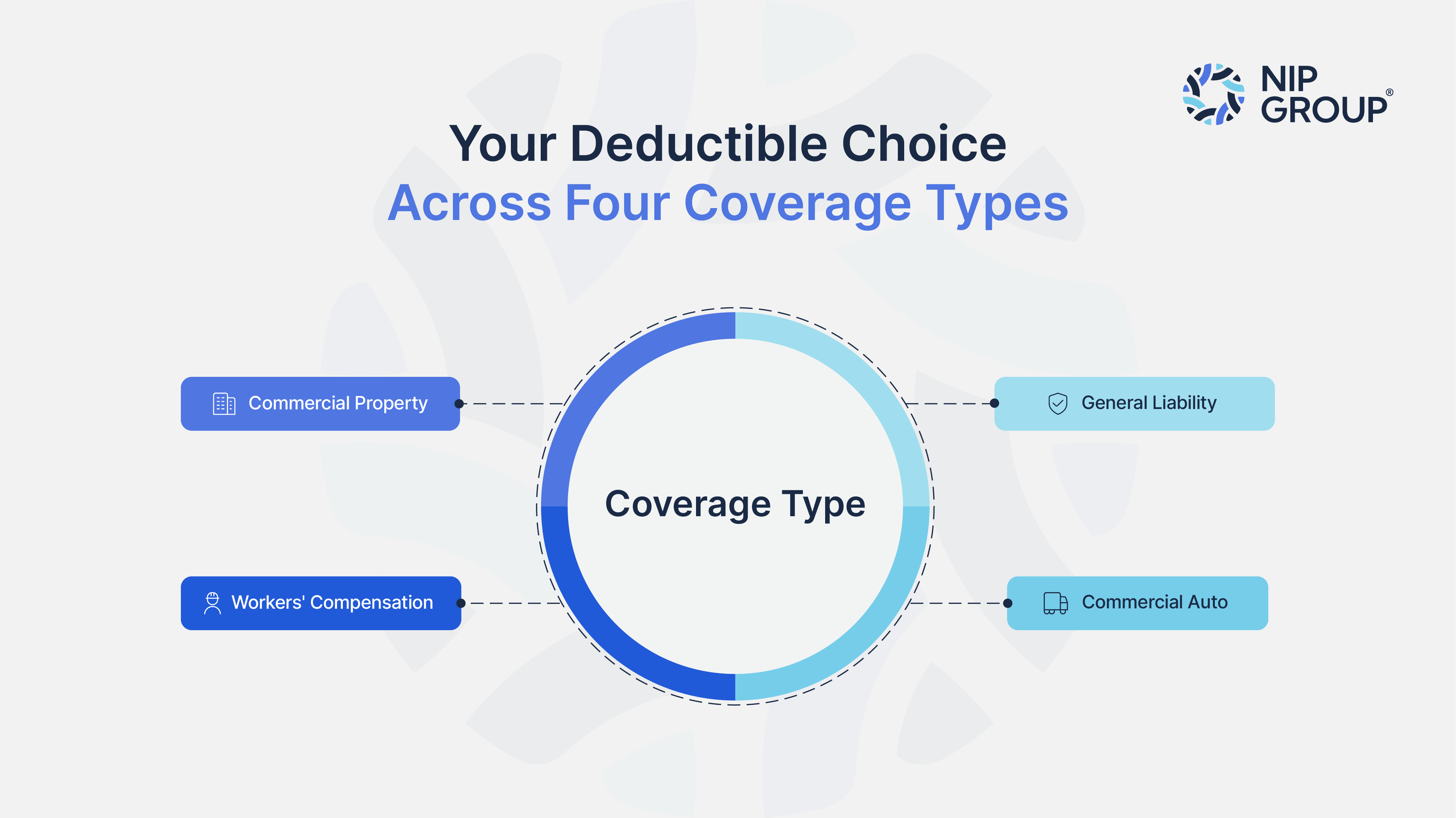
Your Deductible Choice Across Four Coverage Types
-
General liability
This covers injuries and property damage tied to your daily operations. A high deductible lowers your premium here. But a single claim, like a customer injury on your property, can still cost a lot upfront. Think about how often your business deals directly with customers or the public before choosing.
-
Commercial property
Deductibles on this coverage often scale with your property value. A high deductible saves more here, but only if you could rebuild or repair without immediate cash support.
-
Commercial auto
The size of your fleet changes the calculation for commercial auto coverage. More vehicles on the road mean more chances for an accident. For many small fleets, a low deductible is worth the extra premium, since claims tend to come more often.
-
Workers’ compensation
A high deductible here means your business absorbs more of an injury claim’s cost directly. This option works best when your workplace safety record is strong and injuries are rare.
Neither choice is right or wrong on its own. It depends on your business’s finances today, and on the specific coverage line you’re buying it for.
What Should You Review Before Choosing Your Deductible?
Before you pick a deductible, walk through these points with your broker.
-
Cash reserves
Check how much you could pay out of pocket today.
-
Claims history
Look at every claim filed, across all your coverage lines.
-
Premium quotes
Compare costs at more than one deductible level.
-
How it applies
Ask if it resets with each claim, each policy, or once a year.
-
Renewal timing
Revisit the decision at every renewal.
Your business changes each year, and so does your risk tolerance. A high deductible vs low deductible choice is never permanent. It is worth a second look every renewal.

Choose the Deductible That Protects Your Business
Choosing between a high deductible vs low deductible insurance policy is not something to figure out alone. A broker who understands your business can help you weigh premium savings against your actual risk.
NIP Group builds coverage across 25+ industries and 50+ classes, backed by a trusted, national network of brokers. Every policy is backed by A rated XV carriers, meaning strong financial strength to pay claims when they come in. Getting this right protects more than your premium. It protects your ability to keep operating after a claim.
Ask your broker to sign you up with NIP Group. Or, contact us directly to talk through your deductible options with a broker who knows your industry.
FAQs
1. How high of a deductible is too high?
A deductible gets too high once a claim could drain your cash reserves or stall your operations. If covering it means borrowing money or missing payroll, it’s too high for where your business stands today.
2. What happens if I can’t pay my deductible?
If you can’t pay your deductible, your claim stays open until it’s covered. Repairs or payouts may pause in the meantime. However, a few options like these can help:
- Ask your broker about payment plans for the deductible amount
- Set aside a claims reserve ahead of time
3. Does insurance pay 100% after deductible?
Insurance rarely pays 100% after your deductible. Most policies cover costs up to your policy limit. Some claims also involve coinsurance, where you and your insurer split costs beyond the deductible. Check your policy details before assuming full coverage kicks in.
4. Can I negotiate my deductible?
You can negotiate your deductible with your broker at any renewal. Insurers often offer several deductible levels for the same coverage, so you’re not locked into one option. A quick conversation with your broker can uncover a better fit for your budget and risk tolerance.

