







Summary
- Most vegetation management services contractors carry coverage that wasn’t built for their actual exposure.
- Understanding where the real gaps sit, wildfire, pollution, fleet, and compliance, is what changes the outcome.
- In this blog, we break down the insurance needs every utility vegetation management contractor should know.
Vegetation-related transmission outages have averaged roughly 28 per year across the ERO from 2020 to 2025, according to ReliabilityFirst’s August 2025 enforcement analysis.
FAC-003-5, the current NERC standard governing transmission vegetation management, became effective April 1, 2024. That’s not a distant regulatory update. It’s the active standard your work is being evaluated against right now.
Every outage traced to vegetation encroachment puts vegetation management services contractors directly in the conversation. Regulators track it quarterly. Utilities document it. Insurers price around it. The compliance bar has moved, and the insurance needs of utility vegetation management companies have become considerably more specific as a result.
This blog covers what vegetation management services businesses need to know about their coverage and where the gaps most commonly show up.
Why This Work Demands Specialized Coverage
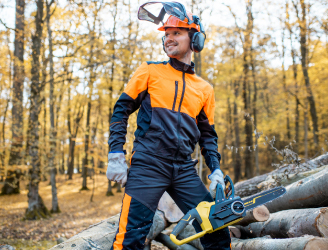
Vegetation management services near utility lines sit at a unique crossroads. It’s tree care risk combined with utility contractor risk, and that combination creates an exposure profile that standard contractor policies simply weren’t built for. Workers operate at height, near energized lines, with heavy equipment, in terrain that changes job to job.
According to FERC, tree contact with transmission lines is a leading cause of electric power outages. It directly contributed to the August 2003 blackout that affected 50 million people across the Northeast and Canada. That history is part of why FAC-003-5 exists and why vegetation clearance work carries the regulatory weight it does today.
That scrutiny flows downstream to the contractors performing the actual clearance work. When a line contact or encroachment occurs, the trail leads to the crew that last worked that corridor. Vegetation management companies carrying a standard general contractor policy often discover, at that point, that their coverage wasn’t written for this exposure at all.
Four Coverage Areas That Actually Matter Here
Wildfire Liability
For vegetation management services operating in fire-prone states, wildfire liability is the most consequential coverage decision on the table. A single spark from equipment near dry vegetation during fire season can generate a claim that blows past standard general liability limits entirely.
Utility vegetation management companies working in California and other high-risk states need wildfire liability coverage specifically written for this exposure. Excess limits up to $25 million are available through programs designed for this industry.
Workers’ Compensation for High-Hazard Crews
Line clearance work near energized infrastructure carries one of the highest injury rates in contracting. Standard workers’ comp classifications often don’t fully capture that hazard profile.
A program written for utility line clearance companies accounts for aerial operations, proximity to live lines, and the specific injury patterns that come with this type of work. Generic classifications understate the risk and often underperform at claim time.
Pollution and Environmental Liability
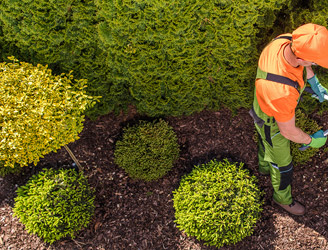
Many vegetation control services use herbicide application as part of integrated vegetation management solutions along rights-of-way. These applications frequently occur near waterways and environmentally sensitive corridors. Pollution liability isn’t included in a standard general liability policy.
For vegetation management companies using chemical applications, this is a gap that can generate serious environmental claims with no dedicated coverage responding to them.
Fleet and Inland Marine Coverage
Line clearance operations run heavy, specialized equipment such as chippers, aerial lift trucks, line trucks, and specialty rigging tools, moving between job sites constantly. Standard commercial auto coverage wasn’t written for this fleet profile.
Composite-rated auto coverage, combined with inland marine protection for equipment in transit, reflects how utility line clearance companies actually operate day to day.
Must Read: How Construction Insurance Coverage Is Tested During High-Risk Projects
Compliance Records Are an Insurance Tool Too
Here’s a connection that rarely gets made explicitly. Your compliance standing under FAC-003-5 is directly relevant to how your insurance responds when something goes wrong.
Vegetation management services contractors working under utility contracts are increasingly required to document clearance work, maintain inspection records, and demonstrate adherence to Minimum Vegetation Clearance Distance requirements. When a claim follows a vegetation-related outage or injury, those records are reviewed first.
A few ways compliance gaps translate directly into insurance problems:
- Missing quarterly inspection documentation weakens your liability position when an encroachment claim is filed
- Herbicide application records that don’t satisfy right-of-way environmental requirements can complicate pollution liability claims significantly
- Crew certification gaps, particularly for work near energized lines, affect how workers’ compensation claims are evaluated and how premiums are priced at renewal
Treating documentation as an insurance asset, not just a compliance box to tick, changes how protected your business actually is when a claim arrives.
Must Read: Industries That Need Power Line Distribution Insurance Most in 2026
Coverage Built for This Industry Specifically
Vegetation management services businesses need coverage that reflects high-hazard tree operations near energized infrastructure, wildfire exposure, chemical application, and specialized heavy fleets. That’s a combination most standard contractor policies weren’t designed to handle.
UtilityPro is built specifically for utility contractors, including utility vegetation management companies and utility line clearance companies.
It covers general liability, workers’ compensation, commercial auto with composite rating, inland marine, wildfire liability protection up to $25 million, pollution coverage, excess liability, and cyber liability. They are structured around how this work actually operates in the field. It’s available nationwide, including in California.
The program is backed by more than 35 years of utility contractor insurance expertise, with risk control services and claims handling built specifically for this industry.
Talk to your broker about UtilityPro, or contact us directly to review your current coverage against what your operations require.
FAQs
- What are three types of vegetation management?
Three common types are mechanical control, chemical control, and biological control. For utility vegetation management companies, mechanical clearance along transmission corridors is the most regulated, governed by FAC-003-5 and subject to quarterly reporting. Chemical application and biological methods are increasingly used as complementary vegetation management solutions, particularly in environmentally sensitive rights-of-way.
- Can seniors get a tree removed for free?
Some local governments and nonprofits offer free or subsidized tree removal for low-income seniors, particularly when a tree poses a safety hazard. Programs vary widely by state and municipality. A local arborist or city public works department is usually the right first call to find out what’s available in a specific area.
- Is it cheaper to trim or cut down a tree?
Trimming is almost always cheaper in the short run. Full removal involves stump grinding, debris disposal, and more labor. That said, repeatedly trimming a tree that’s structurally compromised tends to cost more over time than removing it once. For vegetation clearance near utility lines, the decision isn’t just about cost; proximity to infrastructure often makes removal the safer and more compliant option.
- Which is the best insurance for vegetation management services?
The best insurance for vegetation management services is purpose-built for this work, covering:
- Wildfire liability for operations in fire-prone areas
- Workers’ compensation structured for high-hazard line clearance crews
- Pollution liability for chemical application along rights-of-way
- Specialized fleet and inland marine coverage
UtilityPro covers all of this in a single program, backed by 35+ years of utility contractor expertise and an A+ (Superior) rated carrier. Ask your broker about it.