













Summary
- Most business owners buy a policy and never read it closely before a claim happens.
- Knowing how to read an insurance policy closes that gap before it costs you.
- This blog walks through five practical fixes and where regulators are stepping in to help.
Most business owners buy a policy and never open it again unless something goes wrong. Research published by the University of Michigan Law School backs that up. A national survey found that only 40% of policyholders had read their entire policy in the past year. Just 20% said they fully understood what it covered.
For a small business, skipping that step gets expensive. A denied claim costs more than money. It can stall daily operations while you sort out the dispute. Most disputes trace back to a section nobody read closely at renewal.
This blog covers how to read an insurance policy faster, with five fixes to use before your next renewal.
Must Read: Unlocking the Power of Specialized Knowledge in Insurance
Why Insurance Policies Are Hard to Read in the First Place
Insurance policies are legal contracts first. They are written to hold up in court, instead of reading like a memo. That is why so many business owners struggle with insurance policy information packed into dense, cross-referenced sections, especially when trying to understand complex specialty insurance coverage.
A few things make policies this way:
- Every word has to hold up in court. Insurers choose precise, technical wording over simple language. That wording protects them if a claim gets disputed later.
- Sections point to other sections. A single clause often depends on a definition or exclusion found elsewhere in the policy. That makes any one part hard to read alone.
- Many policies use shared industry templates. Most insurers build their policies from standard forms used across the industry. That is why similar policies often sound alike.
Most states set a minimum readability standard for policies before they reach you. Only four states, Kansas, Mississippi, Utah, and Washington, skip such a law entirely. Even where these rules apply, readable has a narrow, technical meaning.
Regulators often score readability using the Flesch Reading Ease test. One NAIC model sets a minimum score of just 40 for certain policy language, closer to legal writing than everyday conversation. Another sample disclosure scores 61, closer to an eighth-grade reading level. Both meet the law’s minimum score. Only one is easy to read.
Many commercial policies also build on standard forms drafted by an industrywide ratings organization. That is why similar wording shows up across different insurers.
Knowing how to read an insurance policy in the right order turns that legal density into something you can manage.
Must Read: Master the Insurance Review Process
How to Read an Insurance Policy Faster
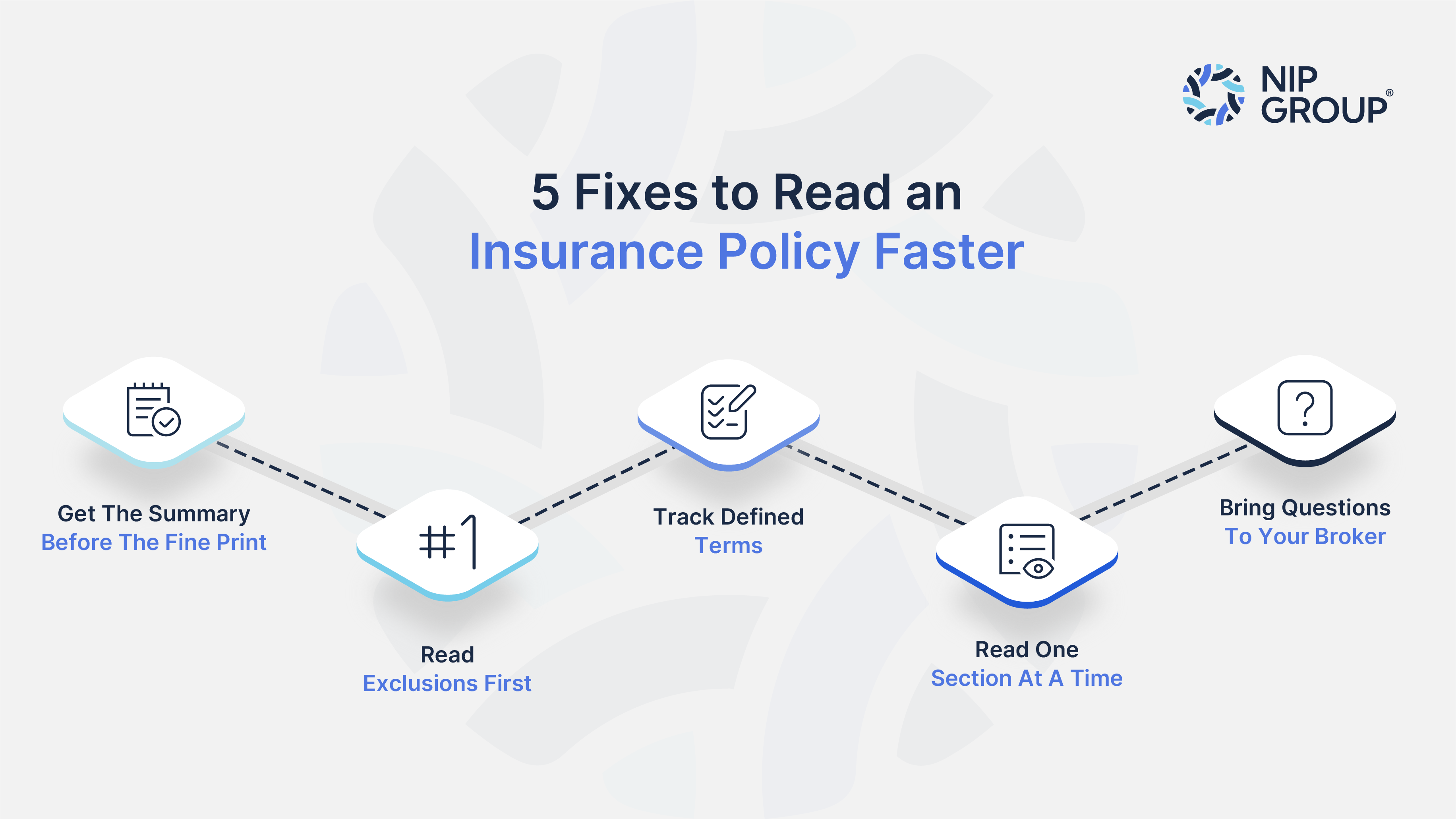
You do not need a law degree to get through your policy. All you need is a system that moves you through the document in order. Read start to finish once, then circle back to key sections. Here is how to read an insurance policy faster, broken into five fixes worth trying at your next renewal.
1. Start With the Declarations Page, Instead of the Fine Print
The declarations page is your policy’s summary. It lists your coverage types, limits, deductibles, and effective dates in one place. Reading this page first gives you a map before you enter the fine print. You will know what to look for when you reach the coverage sections later.
2. Read Exclusions Before You Read Coverage
Most business owners read the insurance coverage section first and skip the exclusions. That order works against you. Exclusions tell you what your policy will not pay for. Reading them early sets realistic expectations before you assume broader protection than you have.
3. Keep a Running List of Defined Terms
Insurance policies define ordinary words in specific ways. Words like occurrence, insured, and property damage often carry a narrower meaning than in everyday use. Keep a simple list as you read. Note each defined term and where it appears. This turns confusing insurance coverage information into something you can reference quickly later.
4. Read One Section at a Time
Trying to read insurance documents cover to cover in one sitting leads to fatigue. Comprehension drops after the first few pages. Break your policy into sections. Read the liability section one day, and property or auto coverage another. Short, focused sessions help the language sink in.
5. Bring Questions to Your Broker Instead of Guessing
Some language will still confuse you after two or three passes. That is normal, and it is what your broker is for. Write down specific questions as you go. A broker can walk you through the exact policy language, saving you time and avoiding speculation.
5 Fixes to Read an Insurance Policy Faster
What Regulators Are Already Doing About This
You are not the only one who finds policies hard to follow. State insurance regulators track this problem, too.
The NAIC‘s Transparency and Readability of Consumer Information Working Group focuses on exactly this issue. Its current charges include building consumer materials on tricky concepts, like deductibles. Many policyholders still do not understand how deductibles work, even after buying coverage that includes one.
The group also monitors state disclosure rules. It helps draft language used in consumer-facing insurance documents across the industry. Their goal is straightforward: make insurance policy information something an average reader can use without outside help.
This does not mean every policy will read easily anytime soon. Regulatory pressure builds slowly, and insurers respond on their own timeline. Learning how to read an insurance policy stays the fastest way to get clarity right now.

Your Broker Is the Final Check on Your Policy
Reading your policy on your own gets you most of the way there. A broker who works in your industry closes the rest of the gap. That matters most around exclusions and defined terms, since those carry real weight in a claim.
NIP Group builds coverage across 25+ industries and 50+ classes, backed by a trusted, national network of brokers. Every policy is backed by A+ rated XV carriers, meaning strong financial strength to pay claims. That combination means the broker explaining your policy already knows the trade you work in.
Ask your broker to sign you up with NIP Group. Or, contact us directly to talk through your coverage with a broker who knows your industry.
FAQs
1. What happens if insurance doesn’t want to settle?
If your insurer will not settle, you still have options. Request a written explanation for the delay, or escalate the claim to a supervisor. You can also file a complaint with your state insurance department if the delay drags on.
2. When not to accept a settlement offer?
Walk away from an offer that does not match your actual, documented losses. Be wary if it arrives very quickly, before the damage is fully assessed. Also watch for offers that leave out costs you may face later, like ongoing repairs. Ask for a written breakdown of the number before signing anything.
3. What are three reasons an insurance claim may be rejected or denied?
Claims get denied for many reasons, but these three come up most often:
- Deadlines for filing or reporting the loss were missed
- Documentation submitted was incomplete or inconsistent
- The loss fell under an exclusion nobody caught early
Reading your policy closely before a loss happens helps you avoid this stage.
4. How long should an insurance company take to settle a claim?
Timelines vary by state and by policy. Many states require insurers to accept or deny a claim within 30 to 45 days of filing. Complex claims can run longer, but your insurer should keep you updated the whole way through.

