









SUMMARY
- Hidden operational risks in janitorial services go beyond slip and fall, and most business owners don’t see them until a claim or contract loss surfaces
- Uninsured or underinsured incidents erode margins, raise premiums, and cost contracts at renewal
- In this blog, we cover the risks that stall growth, why standard policies fall short, and what contract-ready coverage looks like
The global janitorial services market is valued at USD 339.24 billion in 2026 and projected to reach USD 442.38 billion by 2035. More demand means more contracts, more crew, and more sites to cover. The businesses that hold onto that growth are the ones that understand what’s at stake when something goes wrong on a client’s site, and have the coverage to back it up.
The Real Risk Profile of Janitorial Services Businesses
Most people assume janitorial services are low-risk. That assumption costs businesses more than they expect.
Cleaning crews work inside client-owned spaces, often after hours. They’re around high-value assets, sensitive equipment, and strict access rules. OSHA flags chemical hazards, bloodborne pathogens, ergonomic strain, and falls as core hazard classes for the cleaning industry specifically.
The Bureau of Labor Statistics reports a recordable injury incidence rate of 2.5 cases per 100 full-time workers in janitorial operations. That number directly affects how insurers assess and price coverage for cleaning businesses.
Most owners carry insurance that was written for far simpler work than what they actually do every day.
Hidden Risks That Show Up When Business Is Growing
Property Damage in Client Spaces
Commercial janitorial services crews work around flooring, electronics, furniture, and fixed assets that belong to the client. A wrong product on the wrong surface, or a piece of equipment that clips a desk, can cause damage that costs far more than the repair bill suggests.
The real exposure shows up after the incident. Clients don’t just file a damage claim. They terminate contracts, exclude you from future bids, and share the experience with other property managers. Standard general liability policies typically exclude property that’s in the cleaning crew’s care, custody, or control. That coverage gap is where professional janitorial services businesses take the hardest financial hits.
Slip and Fall Liability
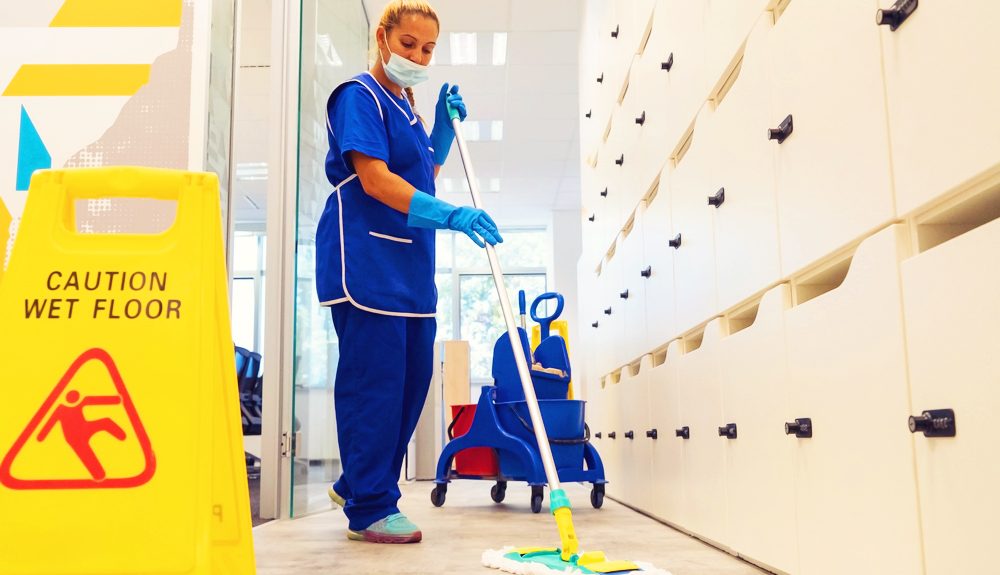
Wet floors come with the job. The claims that follow when signage is skipped or drying time runs short come with it too.
$10.5 billion annually, according to Liberty Mutual’s 2025 Workplace Safety Index. For janitorial cleaning services businesses, the cost of one slip and fall claim rarely stops at the settlement.
Claim history follows you at renewal. Repeated claims make coverage harder to place and more expensive to keep. That pressure shows up directly in your margins and your ability to bid on new work.
Chemical and Pollution Exposure
Disinfectants, degreasers, floor finishes, and strippers are part of every shift. Most crews use them without incident. The problem shows up when a product is misapplied or a space isn’t ventilated properly.
OSHA identifies chemical hazards, occupational asthma, and dermal exposure as real risk categories for cleaning operations. The fallout from a chemical incident can affect workers and the client’s facility at the same time.
Cleaning and janitorial services businesses often assume general liability covers this. Most standard policies exclude pollution-related claims entirely, and that gap is bigger than it looks.
Contractual Liability
This is where most commercial cleaning and janitorial services businesses face the biggest surprise. Commercial cleaning contracts, especially in healthcare, corporate, and retail facilities, routinely require additional insured endorsements, indemnification clauses, and waivers of subrogation.
Standard policies don’t automatically satisfy these requirements. The gap doesn’t show up at signing. It shows up when a claim is filed and the policy language doesn’t match what the contract demands. That mismatch leads to denied coverage, out-of-pocket legal costs, and in many cases, immediate contract termination. The hidden costs of those gaps go further than most businesses realize.
Why Growing Your Janitorial Services Company Increases Exposure
Growth in janitorial services companies doesn’t just add revenue. It adds exposure at every level. Around 48% of commercial cleaning firms report labor shortages and rising costs as key operational challenges. Stretched teams mean faster handoffs, less supervision, and a higher chance of inconsistent service quality across sites.
More locations mean more vehicles on the road, more equipment moving between jobs, and more employees working in environments with different risk profiles. Commercial janitorial cleaning services that grow without adjusting their coverage regularly find themselves underinsured at exactly the point when a claim is most likely to happen.
The businesses that scale without problems treat risk management as part of their growth plan, reviewing coverage before a loss forces the conversation.
Where Standard Insurance Falls Short
Generic policies are built around the assumption that cleaning work is straightforward and low-risk. The coverage reflects that. Key gaps that business janitorial services operations run into regularly include:
- No Care, Custody and Control coverage for client property in the crew’s hands
- No Your Work coverage for damage tied to completed cleaning services
- No Lock and Key Replacement if access credentials are lost or stolen on a secured site
- Pollution liability exclusions that leave chemical incidents uncovered
- GL limits that fall short of what commercial RFPs and facility contracts actually require
Commercial cleaning janitorial services businesses trying to win larger accounts often discover these gaps during the bid process, when a client’s risk team reviews the certificate of insurance and finds the policy doesn’t meet their minimum requirements. By then, the contract opportunity is already gone.
Coverage Built for How Janitorial Work Actually Runs
The risks above aren’t edge cases. They’re built into how office janitorial services and commercial janitorial services businesses operate every day. A slip on a wet floor, a chemical issue on a client’s surface, a contract that demands higher limits. These situations come up regularly, and the question is whether your coverage is ready when they do.
MaintenancePro is NIP Group’s specialty program built for janitorial, maintenance, and commercial cleaning operations. It covers general liability, workers’ compensation, commercial auto, inland marine, crime, contractors pollution liability, employment practices liability, cyber liability, and umbrella coverage up to $25 million, structured around the exposures that standard policies consistently miss.
To understand how MaintenancePro applies to your operation, contact us directly to review your coverage and find the gaps before a client does.
Ask your broker to sign you up for MaintenancePro.
FAQs
- What is Care, Custody and Control coverage in janitorial insurance?
Care, Custody and Control (CCC) is an endorsement added to a general liability policy. Standard GL excludes damage to property that’s physically in your crew’s possession during work. CCC closes that gap. If a crew member damages a client’s flooring, furniture, or electronics on the job, the claim is covered. Without it, those costs come out of pocket and often trigger contract disputes alongside the repair bill.
- What happens if a janitorial employee is injured on a client’s site?
Your workers’ compensation insurance is the primary coverage, not the client’s policy. Here is what typically follows:
- The employee reports the injury to their supervisor right away
- They receive medical care and file a workers’ comp claim
- The claim covers medical expenses and lost wages regardless of fault
If the client’s negligence contributed to the injury, such as a hazardous condition they failed to address, third-party liability claims may also come into play. Cleaning businesses without proper workers’ comp face serious financial and legal exposure when this happens.
- Why do janitorial businesses lose contracts over insurance gaps?
Commercial clients review insurance certificates closely before signing. Common disqualifiers include:
- GL limits below what the contract or RFP requires
- Missing additional insured endorsements
- No subcontractor liability coverage
- No crime or employee dishonesty coverage
Any one of these gaps can remove you from consideration before a conversation even starts. For a closer look at what gets most cleaning businesses disqualified, this breakdown of the top five janitorial risks covers each one directly.
- What risks come with scaling a janitorial services company?
Growth adds revenue and exposure at the same time. The risks that come with scaling include:
- Labor shortages that stretch supervision thin across multiple sites
- More vehicles and equipment in transit, which increases auto and inland marine claims
- Larger contracts in healthcare or corporate facilities that require higher coverage limits than basic policies carry
The coverage that worked for five contracts often doesn’t hold up for fifteen. Most businesses find that gap during a claim or a competitive bid review, which is the worst time to find it.