







Though the arboriculture industry has grown and evolved significantly in almost every regard, tree care work remains one of the more dangerous occupations. With a non-fatal injury rate nearly three times the all-industry average, tree service workers and their employers face serious risks in their everyday activities. Professional liability insurance is little more than a starting point to protect tree care business owners and their employees. With all the opportunities and risks, arborists and other tree care pros — and the brokers who help insure them — need access to specialized monoline policies that address and cover their specific insurance needs.
The Physical Demands of Tree Care Professionals
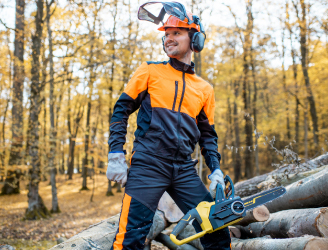
It’s no surprise tree care is physically demanding, though some people might underestimate just how taxing and risky this work can be. Tree service workers are much more likely to get injured on the job than workers in most other occupations.
According to a study that examined 17 years of landscaping professionals’ workers’ compensation claims, the most common cause of worker injury was getting struck by an object or equipment. Other common injuries include exposure to harmful substances, slips, falls, and overexertion. Tree care operations can also expose workers to other dangers, including external threats like down power lines and heavy equipment, like booms and wood chippers. Though some of these injuries are fatal or severely disabling, even those that are less severe can significantly impact employees and employers.
Lesser injuries can still have severe consequences
Though the physical risks of tree care work are usually associated with falls and falling trees or branches, many injuries can occur unexpectedly, like when workers are loading or unloading work vehicles. For example, an employee who injures their hand unhooking a trailer could file a workers’ compensation claim and miss several months of work. In fact, 22% of serious claims involved a truck, trailer, or tailgate, making the seemingly simple task of loading and unloading one of the riskier activities for tree service workers.
External threats can further strain tree care pros
Arborists also work in a variety of different environments, many of which present new or additional risks to an already hazardous occupation. Arborists must work in nearly all weather conditions, in freezing temperatures and under the sweltering sun. They also work in urban, suburban, and rural landscapes, contending with uneven terrain and heavy vehicular and pedestrian traffic. These are only a handful of the complex scenarios tree service workers might find themselves in, which should be sufficient evidence to convince you just how crucial it is to insure against these many risks.
The Costs and Risks to Business Owners
Outside of property damage, workers’ compensation claims are among the most common in the arboriculture and landscaping industries. Risk management is an important part of every business, but it’s especially relevant for businesses whose work includes more frequent, more diverse perils.
Without tree care insurance designed to cover these perils, the costs and risks to business owners can, at the very least, hinder growth, and at its worst, upend the business completely. One of the chief concerns of the tree care industry today is a labor shortage. In Lawn & Landscape’s 2023 State of the Industry Report, quality labor shortage ranked number one in issues concerning businesses, followed by high workers’ compensation costs at number four.
The shortage of workers presents a unique dilemma for tree service businesses. On the one hand, the industry’s continued growth is a positive; on the other, the obvious paucity of skilled workers may create new challenges for these businesses. In 2019, the National Association of Landscape Professionals embarked on a mission to attract at least 100,000 people to the industry by 2025. If and when they do achieve this goal, a new challenge will arise — managing a workforce with less experience.
Statistics show that young and newly-hired workers tend to suffer from workplace injuries more frequently than workers who have been on the job longer. The influx of new and inexperienced tree service workers can increase tree care companies’ risk profile, potentially leading to more liability claims, workers’ compensation claims, lawsuits, and more.
Hiring and onboarding new workers is a risk most tree care companies will have to take if they want to continue to grow. However, leaving coverage gaps due to subpar business liability insurance or workers’ comp is not. For arborists and other tree care companies seeking peace of mind and the protection of their business and employees, the need for specialized insurance is arguably more important than ever.
Protecting Business Owners Through Specialized Mononline Coverage
Professional liability insurance and commercial workers’ comp insurance serve as a critical shield that protects the well-being of both a business and its employees. Insurance for arborists must consider the physically demanding nature of regularly working in potentially hazardous conditions and the proper tree services coverage should address these risks.
A business is only as good as its employees, and a comprehensive workers’ compensation policy benefits both business owners and the people who work for them. With specialized workers’ compensation insurance for arborists, employees have the support they need, and employers can focus on growing their business knowing their employees are taken care of in case of the unexpected.
Highlights of NIP Group’s Products to Protect Tree Care Professionals
NIP Group continues to innovate and roll out customized risk management solutions to further protect the interests of business owners and their employees in the agricultural and construction industries. NIP Group’s Edge Series of insurance products offers specialized monoline policies that address key risks of high-hazard industries, such as tree care services.
Too often, brokers and businesses settle for package policies that include generic professional liability coverage and basic workers’ compensation. That’s why NIP Group introduced the Edge Series, serving over 50 monoline specialty policies from greenhouse growers to utility contractors. The Edge Series provides brokers and businesses with flexible, tailored coverage that allows you to choose the appropriate risk management solutions for your business risks. These monoline policies are the perfect complement to the TreePro program, giving you yet another opportunity to customize insurance coverage to fit the specific needs of individual tree care businesses.
Conclusion
If you’re an insurance broker, your clients depend on you to understand their risk management needs, and to find them the most comprehensive coverage on the market. If you’re a business owner looking for tailored insurance coverage for your tree services company, you already know basic business liability insurance won’t provide the coverage you need to protect you from everyday occupational risks.
Proper safety protocols, training, and on-the-job awareness are the best tools for preventing accidents, injuries, and consequently, workers’ compensation claims. Unfortunately, even with the most stringent precautions in place, accidents and injuries can still occur. In these situations, only specialized liability and workers’ comp insurance designed for arborists is sufficient to offer the peace of mind your business, clients, and employees deserve.
Visit the TreePro web page to learn more, submit your accounts, or speak with an expert.
Sources
https://www.mdpi.com/1999-4907/13/9/1518
https://www.dir.ca.gov/dosh/dosh_publications/Tree-Work-Safety-Guide.pdf
https://www.bls.gov/web/osh/summ1_00.htm
https://www.tdi.texas.gov/pubs/videoresource/fstreetrim.pdf
https://www.osha.gov/tree-care/hazards-solutions
https://blogs.cdc.gov/niosh-science-blog/2021/08/10/landscaping-wc/
https://cdn.gie.net/fileuploads/document/2023/10/10/2024_soi_full_report_rfs.pdf