








“For brokers and arborists, understanding the distinctions between utility line clearance and standard tree care is critical — not just for crew safety, but because scope creep can fundamentally change how underwriters view and price risk.”
– Tim Greifenkamp, CPCU, TreePro Program Manager
The subtle differences between residential tree care and higher-risk line clearance can result in coverage gaps, exclusions, non-renewals, and denied claims. According to the Occupational Safety and Health Administration, line clearing refers to tree care work within 10 feet of an energized power line. Standard tree care, on the other hand, typically refers to operations that include tree removal, maintenance, and pruning or trimming more than 10 feet away from power lines. For brokers and arborists, understanding the distinctions between utility line clearance vs. tree care is critical — not just for crew safety, but because scope creep like crossing that 10-foot boundary fundamentally changes how underwriters view and price risk.
How Underwriters Evaluate Tree Care Risks
Tree care insurance coverage is notoriously difficult to underwrite and place, particularly for contractors that take on more specialized work such as utility line clearance. For underwriters, tree work utility exposure can vary significantly between residential work and dedicated line clearing operations. However, under the National Council on Compensation Insurance (NCCI) and certain state organizations — such as the New Jersey Compensation Rating & Inspection Bureau (NJCRIB) — standard class codes may not distinguish between utility arborists vs. tree trimmers. Because these codes sometimes fail to address the nuances of tree care risks, underwriters often add surcharges, attach strict exclusions, push the accounts to surplus markets, or deny coverage outright.
How Brokers Can Guide Residential Tree Care Companies
As a broker, you can showcase your expertise and grow your tree care portfolio by guiding clients whose work might cross into utility line-clearing exposures. Helping companies identify the differences between standard residential pruning and higher-risk line-clearing operations can identify the correct exposures and insurance needs earlier in the process. Brokers can also add value by educating clients about OSHA qualifications and training standards and offering tips to streamline underwriting and simplify auditing. These can include knowing about approach distances and jobsite safety practices, as well as submitting employee certifications, separating payroll records, and keeping subcontractor COIs on file.
Understanding Tree Care OSHA Compliance for Line Clearing Operations
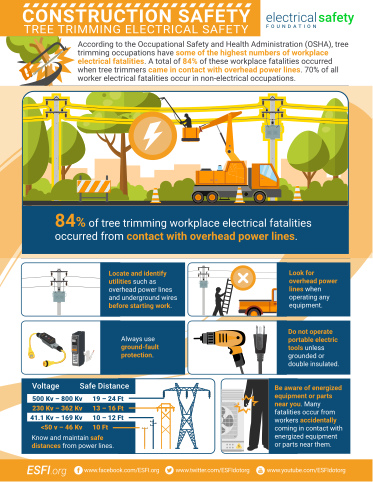
OSHA’s eTool provides helpful guidance for utility line-clearing operations, including worker qualification levels and power line tree-trimming safety standards under 29 CFR 1910, such as:
- Minimum Approach Distances: Keep approach distances to a minimum of 10 feet for lines 50 kV and below; add four inches of approach distance for every additional 10 kV above 50 kV. These minimums apply for all workers except those who have specialized training.
- Insulated Protective Equipment: Use insulated equipment (e.g., line hose, barriers, and live-line tools) rated to the appropriate voltage.
- Personal Protective Equipment (PPE): Require workers to use PPE, such as safety glasses, hard hats, and any other equipment that can protect against specific hazards identified in a tree service risk assessment or tailgate briefing.
- Fall Protection Equipment: Ensure workers operating at or above 4 feet use fall arrest systems and/or work positioning equipment (depending on their level of training). Fall protection equipment should meet minimum design requirements under 29 CFR Part 1926 Subpart M and be inspected before each use.
- Medical Services and First Aid: Employees must be trained in CPR and first aid (newer 269-qualified employees can work but must be CPR and first aid trained within 3 months of hire). For certain types of work, outlined in 269, crews may require at least two people; when working alone, implement safe work practices to minimize injury risks.
- Hazard Assessments and Job Briefings: Conduct hazard assessments to identify potential safety hazards. Then, incorporate design changes, safety practices, and other controls to address or eliminate risks. Before beginning work, use job briefings to communicate potential hazards and, if new hazards are identified, stop work and conduct a new hazard assessment and job briefing.
- Use of Aerial Lifts: Test all aerial lift equipment before each use. Only trained employees can operate aerial lift equipment. Minimum approach distances apply to aerial lift equipment unless the insulated portion of the lift is operated by a qualified employee.
Case Study: Why Operational Scope and Full Disclosure Matter
Following a dispute over a worker injury with a policyholder, West Bend Insurance Company in June 2026 requested a federal court clear it of any financial responsibility, on the grounds that no coverage applied under any of the tree care coverages the insured carried. The disagreement began in 2023 after a Trees R Us employee says he suffered an injury working a job in Florida. In addition to stating that no coverage applied under the insured’s policies at the time of the incident, West Bend noted a bodily injury exclusion in the policy related line clearing and disconnection of power. The complaint also alleges Trees R Us materially misrepresented the scope of its operations during application and renewal. According to West Bend, Trees R Us operations were limited to Illinois, Wisconsin, and Indiana, though the company performed work in other parts of the United States, including Florida.
This case highlights the importance of fully disclosing the extent of a tree care company’s operations, drawing a clear line between tree trimming and utility line clearing, and carrying specialized high-hazard tree care insurance.
Turn to the Experts in Tree Care Insurance
Protecting tree care clients who work near power lines requires more than standard knowledge and off-the-shelf coverage. For brokers, finding a partner that understands the nuances of high-hazard operations can help, both with educational resources and the tailored insurance coverage clients need. NIP Group’s TreePro program provides specialized, all-lines insurance specifically designed for tree service professionals, directly addressing the rigid exclusions and gray areas that are all too common among standard carriers.
Ready to deliver the tailored protection your tree care clients need?
Learn more or submit your accounts online today.
Tree Care Pre-Submission Checklist