









Workers’ comp for tree service professionals is notoriously difficult to place, creating a major challenge that may lead to missed opportunities and increased liability exposure. As an insurance broker, your tree care clients depend on you to help them find the best coverage options at competitive prices. To do that, brokers need to understand industry-specific risks, compare monoline workers’ comp versus package policy options, and look for specialized programs that provide the tailored coverages tree service businesses need.
Why Is Workers’ Comp for Tree Care So Hard to Place?
Tree care workers’ compensation rates are among the most expensive commercial insurance coverages, but many traditional insurers won’t even write these policies. Since arborist workers’ compensation covers a wide range of risks in an already dangerous industry, specialized insurance programs are often the best, or only, option. These programs bring a deeper understanding of arboriculture and the unique challenges tree service contractors face, including high-risk class codes, labor shortages and payroll variability.
High-Risk Class Codes
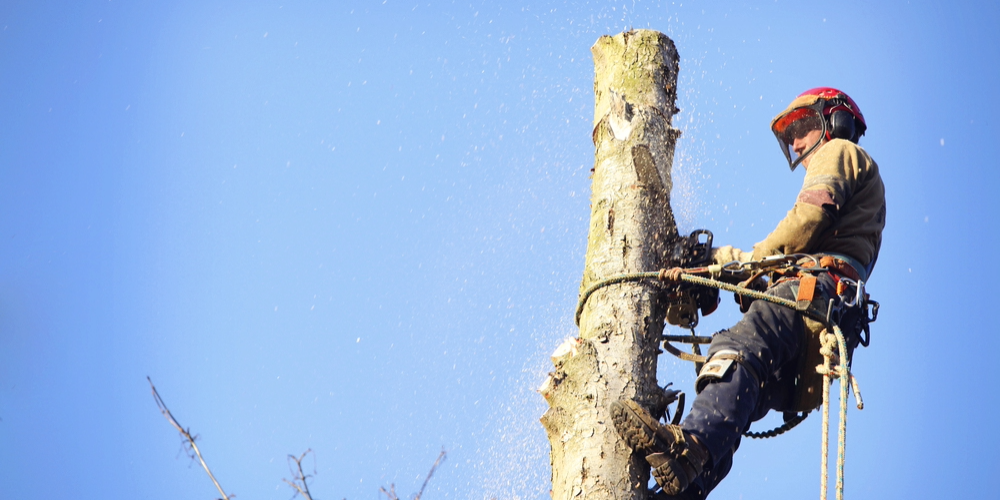
Arborist workers’ compensation insurance usually falls under unforgiving class codes. With a fatality rate of 110 per 100,000 — roughly 30 times the all-industry average — tree trimming is one of the most dangerous types of work. This combination of injury frequency and severity often causes standard insurers to summarily decline tree removal workers’ compensation coverage.
Employee turnover
Tree care work comes with high turnover rates, with as many as 40% leaving the job within the first three months. And since younger employees and those with less experience are more likely to get injured on the job, continually hiring new workers may make it more difficult and more expensive to place workers’ comp policies.
Payroll variability
Unpredictable payrolls are another complication that discourages many standard insurers from writing tree care workers’ comp policies. With extreme variability due to weather, labor shortages, and difficult working conditions, many tree care companies struggle to accurately forecast and track their payrolls throughout the year.
When Monoline Workers’ Comp Makes More Sense Than Package Placements
While packaging monoline coverage with a broader commercial policy typically offers some cost savings, there are certain situations where a monoline policy may be the better option.
1) If the business experienced recent losses
Businesses with a history of workers’ comp claims may be denied a package policy because of those losses. Even if they’re able to secure a package policy, their experience modification rate will apply to the entire policy, raising premiums across the board. Instead, it may make more sense to unbundle the workers’ comp to limit surcharges exclusively to the workers’ comp line.
2) If the business offers specialized or higher-risk services
Higher-risk businesses or those that offer certain specialized services may be ineligible for package policies due to workers’ comp risks. For hard-to-place workers’ comp, monoline policies tend to offer more tailored underwriting that’s better suited for more technical risks like those under tree service workers’ comp.
3) If the coverage is comparable but the cost is lower
In some cases, splitting off monoline workers’ comp can reduce overall premiums. At the very least, it provides price transparency for businesses that want to know the true cost of each coverage.
4) If it’s the only option
For businesses that carry higher risks — whether they’re newer and lack a safety record, have a poor claims history, or operate in a high-risk industry — a monoline workers’ comp policy on the residual market may be the only option.
5) If higher coverage limits are needed
Under a package policy, workers’ comp benefits may be capped at a specific number that doesn’t necessarily provide adequate protection for the business. With a monoline policy, businesses may be able to opt for a higher coverage limit than what’s offered through a package policy.
6) If state mandates require a local policy
Certain states have specific workers’ comp requirements that might make monoline coverage the only option. For example, monopolistic states (Ohio, North Dakota, Washington, Wyoming) require most companies to purchase workers’ comp through a state fund. In New York State, contractors must carry New York workers’ comp coverage, while Florida requires out-of-state contractors to have a Florida endorsement, a Florida workers’ comp policy, or reciprocity for temporary work.
How To Place Tree Care Insurance: Choose Specialty Providers
Placing workers’ comp for tree care companies often requires you to move away from standard carriers and turn to specialty markets. Providers that operate in these markets — like NIP Group — bring deeper industry expertise and the flexibility to underwrite complex, high-risk exposures like tree care. By choosing specialized coverages under industry-specific programs like TreePro, you can help your tree care clients recognize the unique risks of arborists and take proactive steps to protect themselves.
Give Your Clients Access to Better Tree Coverage by Design
NIP Group’s TreePro insurance program brings more than 35 years of tree care industry experience, along with the comprehensive coverages designed to protect tree service businesses of all sizes. With hard-to-place tree care clients, it’s important to explore your options, from specialized package policies to monoline coverages that suit exact business needs. And with NIP Group’s dedicated program managers, you’ll get the support of a committed safety partner and the customized coverages for your tree service clients.
Learn more about TreePro’s eligible tree service insurance risks and submit your accounts today.