













Summary
- Most small business owners misunderstand how do insurance deductibles work until a claim arrives.
- A deductible sets what you pay first, and your insurer covers the rest.
- This guide walks through deductible types and how they affect your premium.
If you ask ten small business owners what their deductible means, most will only have a rough idea. That gap catches up with them the moment a claim comes in. A deductible is one of the most misunderstood parts of any policy. Most owners assume one number covers everything. However, a single policy can carry several deductibles, each tied to a different type of claim.
That is what makes a deductible one of the most expensive parts of a policy to misunderstand. The South Carolina Department of Insurance publishes a consumer guide on deductibles for exactly this reason. So if you have ever wondered how do insurance deductibles work, you are not alone.
This guide breaks down what a deductible means and how it plays out during a claim. You will also see how to choose the right amount for your business.
Must Read: Filing Insurance Claims for Businesses After an Incident: Important Steps
What Does Insurance Deductible Mean?
It is the amount you pay out of pocket before your insurer covers a claim. That amount is fixed in your policy before you ever file one, so there are no doubts when a loss happens.
A quick example makes this concrete. Say your commercial property carries a $2,000 deductible, and a storm causes $10,000 in damage. You pay the first $2,000 toward repairs, and your insurer covers the remaining $8,000.
That split is the core of how do insurance deductibles work across nearly every commercial line, from property to auto.
Business owners searching “what are deductibles” are usually trying to understand this exact split. Once the math is clear, the term becomes a fixed, predictable number you can plan around.
How Do Insurance Deductibles Work From Loss to Payout?
This is where the concept turns into real dollars. Once a loss happens, your deductible follows a set path before any payment reaches you.
- A covered loss occurs, such as storm damage or theft
- You report the claim and provide documentation, like photos or invoices
- Your insurer reviews the claim and confirms the deductible on your policy
- The deductible is subtracted from the verified loss amount.
- Your insurer pays what remains, up to your coverage limit.
That sequence explains how do insurance deductibles work for most commercial claims. A few situations shift how it plays out.
Start with the small losses first. If a claim comes in under your deductible, your insurer pays nothing at all. Say your deductible is $2,500 and the damage totals $1,800. You cover that cost yourself, and the claim never touches your policy.
The math changes again with repeat claims. Commercial deductibles typically apply per occurrence, not per year. Your deductible resets with every new incident. Two separate storms in the same season mean paying for it twice, once for each event.
Liability claims follow a different path entirely. With property damage, your insurer subtracts the deductible before cutting your check. A liability claim works in reverse. Your insurer usually pays the third party in full first, then bills you for the deductible afterwards. It cannot subtract a deductible from a payment made to someone else’s business.
These three situations share one lesson. The deductible on your policy is rarely the full story of what a claim will cost you. A liability claim, in particular, can arrive as a bill weeks after the incident is already closed.

Structures for Insurance Deductibles Explained Behind Every Commercial Policy
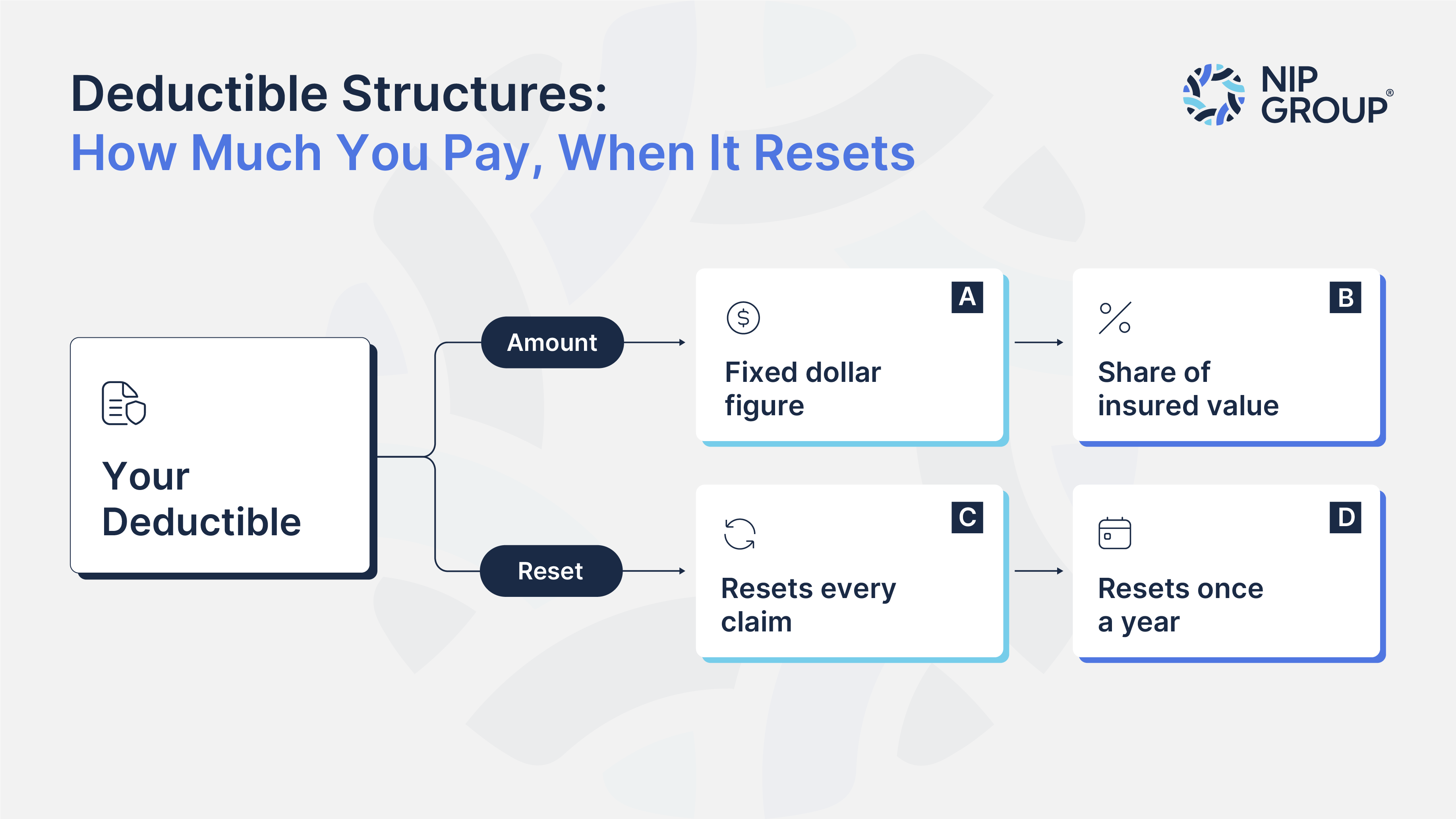
It simply comes down to two structures: how much you pay, and when that payment resets.
Flat vs. Percentage: How Much You Pay
- A flat deductible is a fixed dollar figure, such as $1,000 or $2,500, set when you buy the policy.
- It stays the same no matter how large or small the claim turns out to be.
- A percentage deductible is calculated as a share of your total insured value, rather than the claim amount.
That last point trips up many business owners. Say your building is insured for $500,000 with a 2% wind deductible. That deductible works out to $10,000, regardless of whether the actual storm damage comes to $15,000 or $150,000. Percentage deductibles show up most often in property coverage for coastal or wind-prone regions, where storm risk runs high.
Must Read: Beyond Basic Coverage: How Umbrella Liability Insurance Works
Per-Claim vs. Annual: When the Deductible Resets
- A per-claim deductible applies every time you file, no matter how many claims you have in a year.
- An annual, or aggregate, deductible resets once per policy period.
- After you hit that total, your insurer covers eligible losses in full for the rest of the term.
Workers’ compensation and commercial auto typically run on a per-claim basis. Each injury or accident gets treated as its own event. Some general liability and umbrella policies use an aggregate structure instead. That structure caps your total out-of-pocket exposure across every claim in the year.
These structures don’t usually stay the same across your full insurance program. Knowing how do insurance deductibles work across each policy helps you prepare for renewal conversations with your broker.
Deductible Structures: How Much You Pay, When It Resets
How to Choose the Right Deductible for Your Business
Getting the concept right on paper is one thing, but picking the deductible for your policy is another. A few practical questions shape how do insurance deductibles work for your specific setup.
- How much cash can your business set aside for a surprise loss?
- How often has your business filed claims in the past three years?
- Which lines carry the highest risk for your type of work?
If your answer to the first question feels uncomfortable, a lower deductible protects your cash flow. If your business rarely files claims, a higher deductible often makes more financial sense. There is no single right answer here. Every business answers how do insurance deductibles work a little differently. The right choice depends on your risk tolerance and what your business can absorb.
This is exactly where working with a broker pays off. A broker who understands how do insurance deductibles work across commercial lines can model real numbers for your business. They can also flag when a deductible chosen years ago no longer fits how your business runs today.
NIP Group builds specialty insurance programs for small businesses across dozens of industries. Each program is backed by A and A+ rated carriers. An A+ rating means a carrier has a superior financial ability to pay claims. That rating matters as much as the deductible you choose. It determines whether your insurer can deliver when a real loss happens. Ask your broker to sign you up for NIP Group’s specialty programs. Or, contact us directly to make sure your coverage fits your business.
FAQs
1. Is it better to have a $1,000 deductible or $2,000?
Neither amount is automatically better. A $1,000 deductible costs less out of pocket if you file a claim, but usually comes with a higher premium. A $2,000 deductible lowers your premium but raises what you pay when a loss happens. Run the math on both before deciding.
2. Does insurance pay 100% after you meet your deductible?
No, not usually, as your deductible covers only the first part of a claim.
- Your coverage limit caps the total payout.
- Coinsurance or exclusions can also reduce what your insurer pays.
Meeting your deductible starts the payout, not a full check.
3. What is the disadvantage of having a higher deductible?
A higher deductible leaves you with a bigger bill the moment you file a claim, since you pay that amount before your insurer contributes a cent. If your business doesn’t have $2,500 or more set aside, that single expense can strain an already tight month.
4. Will insurance cover everything after a deductible?
No, meeting your deductible clears one barrier to coverage, but two things can still limit your payout.
- Damage or losses your policy excludes entirely
- Claim amounts that exceed your coverage limit
Read your policy’s exclusions list closely so you know what stays uncovered even after the deductible is met.

