








Summary
- A patch over a moving crack fails, and the client calls you back.
- Finding what moved before you quote keeps repairs intact and protects your business.
- This blog walks through common pool concrete repair mistakes and the coverage that backs you.
According to IBISWorld’s March 2026 report, U.S. pool construction will bring in an estimated $24.8 billion this year. With fewer new homes going up, pool builders are doing more of their work at existing homes.
For many contractors, that means repairing pools that are decades old. In most cases, whoever built the pool moved on years ago and took the paperwork with them. You walk up to a cracked shell or deck with no pour dates and no soil report. So, the contractor has to figure out the cause before quoting a fix. If they guess wrong, the patch cracks again, and the client expects them to redo the job.
In this blog, we cover where pool concrete repair can go wrong and how contractors can protect their business.
Must Read: What Are the Swimming Pool Insurance Requirements for Contractors?
Why Does Pool Concrete Repair Fail So Often?
Pool repairs fail because the patch covers the crack while the force behind it keeps working. The crack is only the visible sign of a problem somewhere underneath. Until you find that problem, any material you apply is working against it.
That problem usually comes from one of two places:
- Movement that hasn’t stopped: If the soil is still settling, or groundwater keeps pressing on the shell, the concrete hasn’t finished moving. Patch it now, and you’ll likely see that crack again within a season or two.
- Two structures treated as one: From the surface, the shell and deck look like one piece. Underneath, each one sits on its own base. They shift by different amounts as the soil and seasons change. Lock them together with a rigid patch, and a new crack will form right where they meet.
Whichever one you’re dealing with, diagnosis comes first. Figure out which structure moved, and why, before you open a single bag of mix.
Where Do Contractors Go Wrong With Pool Concrete Repair?
Pool repair mistakes start before any work begins, when the contractor misreads the cause of the damage.
1. Patching Cracks Without Finding What Moved
The most frequent mistake is patching a crack before you’ve checked whether it’s structural. There are two types of pool cracks, and both call for different fixes:
- Shrinkage cracks: They are fine hairlines that show up as the concrete dries out. They tend to stay put, so a simple patch usually does the job.
- Structural cracks: These are deeper breaks that run into the shell. So, you should watch for water loss, or one edge sitting a little higher than the other.
A structural crack tells you something underneath is moving. Most of the time, the soil has settled, or groundwater is pressing on the shell from outside. No surface patch can hold that back, so sooner or later the crack opens up again.
Water leaking through it can then wash out the deck base, and the client may file a damage claim. Claims like these are why pool business insurance matters on repair jobs.
2. Skipping Drainage and Moisture Checks
Contractors often price a deck job based on what they see and skip over where the water goes. If the deck tips toward the pool or its base has washed out, water ends up under the slab.
In colder states, that water freezes each winter, lifting the slab and cracking your patch.
So check the drainage before you quote any pool deck repair. Run a hose across the deck and watch where the water collects. If drainage is the problem, add the drainage fix to your quote.
Must Read: What a Strong Swimming Pool Construction Business Plan Looks Like in 2026
3. Ignoring the Joint Between the Coping and the Deck
Plenty of contractors patch a deck crack without checking the joint where the deck meets the coping. On older pools, that expansion joint is often missing or dried out.
The coping rests on the pool’s bond beam, but the deck sits on its own base. When summer heat hits, the deck grows slightly. A healthy joint absorbs that growth. Without one, the deck shoves against the coping on every hot afternoon. Eventually, the coping cracks, and water seeps behind the tile.
That’s why a concrete pool deck repair that skips the joint usually fails along the same line. Dig out the old joint material first. Then refill the gap with a flexible sealant made for pool decks.
4. Letting Slurry and Debris Into the Pool or Drains
Slurry, the gray runoff from grinding concrete, can damage a client’s pool and drains if you don’t contain it.
- In the pool: It turns the water cloudy and can clog the filter or grind down the pump.
- In storm drains: Runoff that reaches the street can break local stormwater rules and land you a fine.
So cover the pool and block off nearby drains before you make the first cut. A new pump or a city fine can easily cost more than the repair you were hired for.
5. Choosing the Wrong Repair Material
Pick your material after the diagnosis, because each one suits a different kind of crack. If a shell crack is still leaking, reach for hydraulic cement, which sets fast even with water seeping through. Once a structural crack has stopped moving, epoxy injection is the better fit. It bonds the two sides back into one solid piece.
Decks need one more check. Your patch has to match the texture around it, because a smooth spot turns slick the moment it gets wet. Commercial clients often write this into their bids, and homeowners expect it even if they never ask. And if a guest slips on your patch, the claim comes back to you.
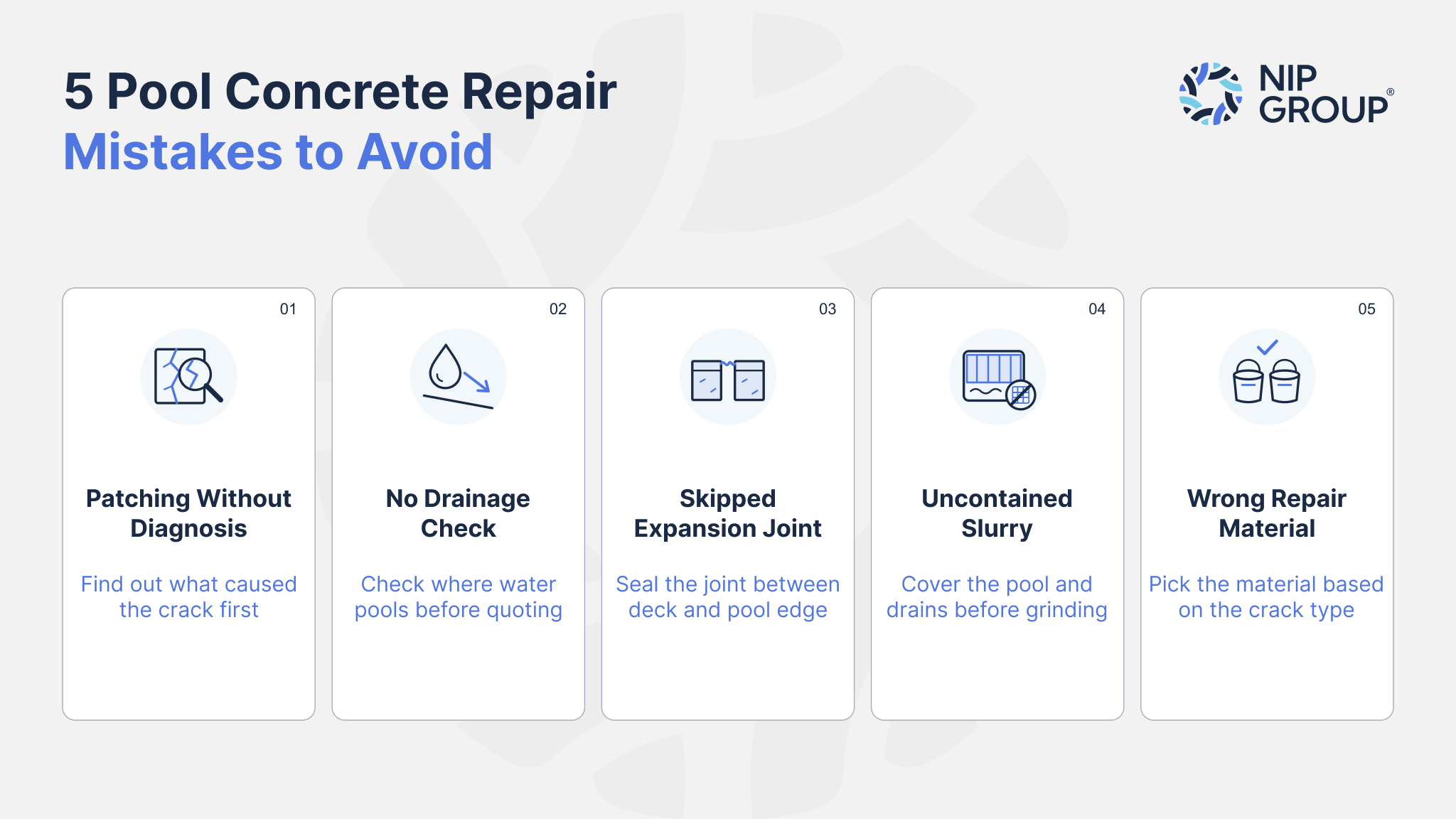
5 Pool Concrete Repair Mistakes to Avoid
What Should a Pool Concrete Repair Diagnosis Include Before You Quote?
A good pool concrete repair diagnosis puts what you found in writing before any work starts. If a client later blames you for a crack that was already there, that record answers for you.
Build these steps into every quote:
- Photos and a crack map: Shoot each crack with a tape measure in the frame, then mark where it sits on a rough site sketch.
- Width and level notes: Jot down whether it’s a hairline or something wider, and whether one edge sits higher than the other.
- Slope and moisture readings: Log the moisture reading and which way water runs off the slab.
- Joint condition: Is the coping joint there at all? If it is, check whether it’s pulling away.
- A clear scope of work: Put in writing what you’re fixing and, just as plainly, what you’re not.
- A change-order clause: Leave yourself room to reprice if you open things up and find hidden damage.
That paperwork pays off on the sales side, too. Property managers and HOAs hiring pool deck repair services trust the contractor who can show this work.
What Happens When a Pool Concrete Repair Fails After You Leave?
When a pool concrete repair fails after you leave, the client’s first call is usually to you. How serious that call gets depends on how long the failure went unnoticed.
If the crack reopens within a few weeks, it usually means a simple callback. If it sits longer, water seeps through and starts washing out the base beneath the deck. Once that base shifts, a section can lift, leaving an edge that trips a guest. That is when the client’s call turns into a claim.
Your general liability policy usually covers the injuries and property damage that follow. It typically won’t pay to redo the faulty repair, so that cost stays with you. And because these claims surface after the job closes, you also need completed operations coverage.
PoolPro is built with that exposure in mind and brings your core coverages under one program:
- General liability: For injury and property damage claims tied to your finished work.
- Workers’ compensation: For crew injuries on the job site.
- Commercial auto: For the trucks that carry your crew between jobs.
- Commercial property and inland marine: For your shop and the tools you haul.
Behind PoolPro is an insurance company rated A+ (Superior) by A.M. Best. That means it has superior financial capacity to pay claims, including those that arrive months after a job. Ask your broker to sign you up for PoolPro. Or, you can also contact us directly to talk through the coverage your pool repair work needs.
FAQs
1. What is the concrete that pool builders use for pools?
Most concrete pools are built from shotcrete, which is concrete sprayed over a steel rebar frame. Crews apply it with one of two spraying methods, gunite or wet-mix shotcrete:
- Dry-mix (gunite): The mix travels dry, and water is added at the nozzle
- Wet-mix (what most pool builders mean by shotcrete): The concrete is already mixed when it arrives, then pumped and sprayed
2. Which cement is usually used for a swimming pool repair?
Most swimming pools use Portland cement, the same everyday cement found in most concrete. The smooth plaster coat on the inside is usually white Portland cement mixed with marble dust. And if the soil around the pool is high in sulfates, builders may switch to a sulfate-resistant cement instead.
3. Do you need a license to do concrete work for pools?
Whether you need a license depends on where you work. Many states license pool or concrete contractors, and some cities or counties add their own requirements. Some states require one only above a set job value. Check with your state licensing board and local building department before you bid.
4. Should you offer a warranty on pool repair work?
Yes, offering a warranty on repair work can set you apart from other bidders. Be specific about what it covers:
- Included: The quality of your work and the materials you supplied
- Excluded: Soil movement or drainage issues outside the job