









Summary
- Insurance companies let software price your quotes and check your claims before a person does.
- Good records and an underwriter who knows your trade help the software get it right.
- This blog shows how AI for insurance affects your quotes and claims, plus new risks.
In November 2026, state insurance regulators met at the National Association of Insurance Commissioners (NAIC) Fall National Meeting. One item on their agenda was a new AI Systems Evaluation Tool that around twelve states have been testing since March 2026. Once adopted, it will help regulators check how insurance companies build and manage their AI systems.
This is also because AI for insurance shapes the coverage your business buys. Before an underwriter looks at your file, the software may have already set the price on your quote. It may also flag your claim photos for a closer look. So, those two decisions shape what you pay for coverage and how quickly a claim check reaches you. Regulators, therefore, want a clearer view of how these systems reach those decisions.
So, in this blog, we walk through how AI is changing your coverage, from the first quote to the final claim payment.
Must Read: High Deductible vs. Low Deductible: The Logic Behind Your Choice
What Does AI for Insurance Mean for Your Small Business?
For your small business, AI for insurance means software often takes the first look at your application or claim. Artificial intelligence in insurance learns from thousands of past policies and claims, then compares your business with similar ones. From there, it predicts how likely you are to file a claim. That prediction then shapes your price and policy terms.
The catch for trade businesses is that the software reads common businesses best, since it has seen so many. Much of your risk comes from the job itself. A tree crew, for example, cuts limbs near power lines, while a pool crew handles strong chemicals. If your application does not spell that out, the software may place you in the wrong category. That can lead to two problems:
- A quote that misses your real risk: A tree service priced like a landscaper may get a rate that does not fit its work.
- Coverage that falls short: A pool contractor treated like a general contractor may end up without protection for the jobs its crew handles.
Clear and complete details from day one help these tools see your business the way it runs.
How Is AI for Insurance Changing Underwriting, Claims, and Risk?
AI is speeding up every stage of your insurance, from the quote you receive to the claim you file. That speed also asks something new of you: making sure the data reflects how your business works.
Underwriting: How Fast Can You Get a Quote Now?
AI is cutting the time it takes to get a quote. Once you apply, the software gathers your loss history and public records before an underwriter even looks. That is why a quote that used to take a week can show up in a day or two.
And that pace is set to climb. Fortune Business Insights projects AI use in underwriting will grow 41.6% a year through 2034, the fastest of any area.
The more a quote depends on software, the more its blind spots can cost you. A model built on broad data may not understand how a tree crew plans a crane lift. It might read that job as reckless and charge you more than you should pay. That is where specialty insurance earns its keep. An underwriter who knows your trade can see the planning behind the lift and fix what the software got wrong. At its best, AI for insurance handles the paperwork, and the underwriter makes the final call.
Claims: How Quickly Will Your Claim Be Settled?
AI for insurance gets you answers on claims faster, starting with the photos you send. Software can study pictures of a damaged truck and estimate the repair cost before an adjuster visits. NAIC surveys show auto and home insurance companies using AI for this work, along with fraud checks.
Those fraud checks compare your claim with thousands of others and flag anything that looks unusual. So if your photos are blurry or your records are thin, even an honest claim can stall. Clear photos and complete records from day one keep your claim moving.
Once your claim is open, AI also keeps you updated. Chatbots answer simple questions at any hour, and automated texts tell you when your claim status changes. This use of AI in customer communications in the insurance industry saves you from chasing updates by phone. These updates work well for small, routine claims. A large loss needs more than a text, so ask for a named adjuster who explains each decision.
Risk: What Sets Your Price These Days?
AI helps insurance companies set your price based on how your business runs today. With insurance analytics and AI, a company can look at your vehicle tracking data and inspection reports side by side. What those records show can raise or lower your premium.
If the tracking data shows your drivers often speed or brake hard, your auto premium can go up. Careful habits show up in the data too. When you keep a written safety program and pass inspections, the software reads your business as a lower risk.
For a well-run business, this is the biggest benefit of AI for insurance. Safety habits that once went unnoticed can now earn you a lower price.
Must Read: Errors and Omissions Insurance Explained: What It Covers and Who Needs It
What New Risks Is AI Creating for Your Business Coverage?
As AI for insurance spreads, it brings two new risks to your coverage. One comes from how insurance companies use AI, and the other comes from how you use it.
On the insurance side, Fortune Business Insights expects the AI in insurance market to reach $154.39 billion by 2034. With that growth, more decisions about your policy will run through software, which raises two concerns:
- Outside data you never supplied: Some tools pull third-party records about your business, and an outdated one can raise your quote.
- Reasons you cannot see: A model may weigh factors no one explains to you, which makes errors harder to catch.
Regulators have, therefore, started to respond. The NAIC Model Bulletin, adopted in December 2023, says AI-supported decisions must still follow insurance laws.
The second risk starts with your own tools. Many owners now use AI to draft estimates or write ads, and either one can lead to a claim:
- A faulty estimate. If an AI tool miscalculates a bid, your client may hold you responsible for the cost.
- A copied image or phrase. An AI-written ad can borrow someone else’s work and trigger a copyright claim.
Some general liability policies exclude losses like these. For instance, HSB launched AI liability coverage for smaller businesses to pay for them. If AI is part of your daily work, ask your broker how your current policy treats it.

How Can You Prepare for AI-Driven Underwriting and Claims?
The best way to prepare is to control what these systems learn about your business. That work starts with your application.
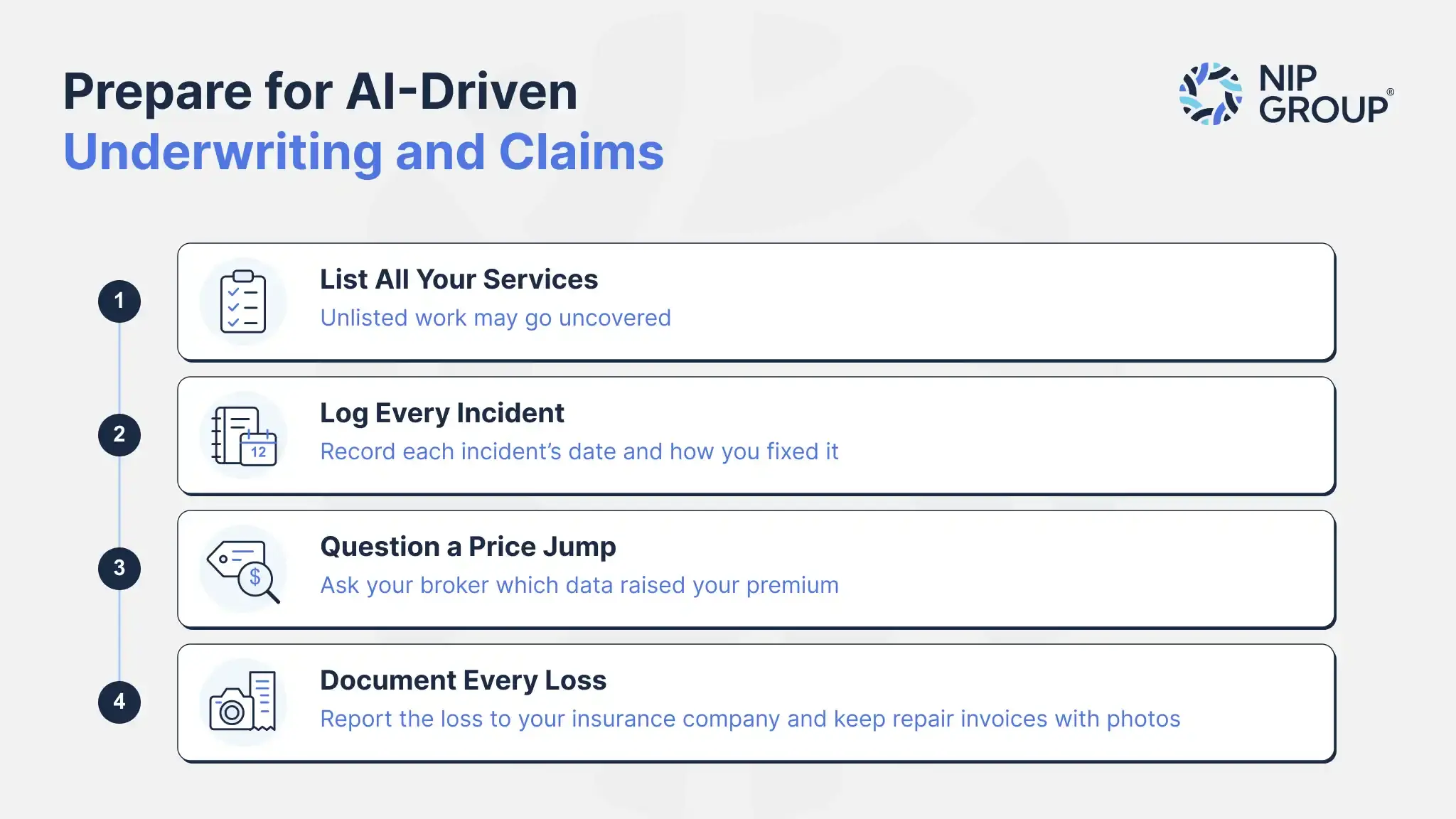
- Check your application first: AI tools sort your business into a category based on the work your application describes. If it lists you as a landscaper and your crew also removes trees, that tree work may go uncovered. Before the application goes out, review it with your broker to make sure every service you offer is listed.
- Keep a dated incident log: Once your application is in, the software looks closely at your claims history. A short, dated note on each incident and how you fixed it shows the underwriter how you handle problems.
- Question a quote that does not add up: Sometimes your premium rises even though nothing about your work has changed. When that happens, ask your broker which data led to the increase. If a record about your business is wrong, you can ask to have it corrected before you sign.
- Build a full file after a loss: When something goes wrong on a job, report the loss to your insurance company as soon as you can. Keep repair invoices with your photos, since a complete file gives the software fewer reasons to delay payment.
Prepare for AI-Driven Underwriting and Claims
Why Your Trade Still Needs Underwriters Who Know It
Your trade still needs underwriters who know it because AI for insurance can only read the data it is given. It cannot see how carefully your crew plans a risky job. Seeing that takes human judgment, which has shaped NIP Group’s work with high-hazard industries since 1987. Each program has a dedicated team with in-house underwriting authority, so people who understand your work make decisions on your policy.
Those programs cover more than 25 industries and 50 classes, from tree care to excavation. Coverage options vary by program and include general liability, commercial auto, workers’ compensation, specialty property, umbrella liability, and contractor’s equipment. Behind them are insurance companies rated A+ (Superior) by A.M. Best. That rating means these companies are highly capable of paying your claims.
Ask your broker to sign you up for a NIP Group program built for your industry. Or contact us if you want to talk through your options first.
FAQs
1. Can AI deny my business insurance claim?
AI can play a part in a denial. It may flag your claim or suggest a lower payout, and some insurance companies use it to guide their decisions. Every denial must still follow your state’s insurance laws. If your claim is turned down, ask for the reason in writing and for a person to review it.
2. Who oversees how insurance companies use AI?
Your state insurance department oversees it. Each state writes its own rules, and more states now follow AI guidance from the NAIC. If a decision about your policy seems unfair, you can file a complaint with your state’s department.
3. What information can AI pull about my business?
AI can pull more than you might expect. Depending on your state and your insurance company, these tools may look at:
- Aerial or satellite photos of your buildings and yard
- Your credit-based insurance score, if your state allows it
- Your website and online listings, which show the services you offer
4. Will AI replace my insurance broker?
AI is not likely to replace your broker. It can speed up tasks like comparing quotes. Your broker reads the fine print for exclusions that could leave your work uncovered. If an insurance company misjudges your risk, your broker pushes back for you.