












Summary
- Janitorial businesses without green cleaning certification are losing access to a growing share of premium contracts.
- Knowing what certification actually involves and how it changes your risk profile is what makes the investment worthwhile.
- In this guide, we break down why certification matters now and what it means for your coverage going forward.
ISSA’s Cleaning Management Institute has certified more than 300,000 cleaning and maintenance professionals worldwide since 1964, with green cleaning credentials among its most sought after offerings. That number reflects a genuine shift in this industry.
According to Technavio’s January 2026 market analysis, more than 80% of new commercial cleaning contracts in mature markets now require certified green products as standard contract terms, not as an upsell.
Green cleaning certification has moved from a competitive advantage to an expectation. For janitorial businesses still operating without one, that shift carries real consequences for the contracts you can bid on and the exposure you carry while doing the work.
This guide covers what green cleaning certification involves, why it matters more than it used to, and what it means for your coverage.
What Green Cleaning Certification Actually Means
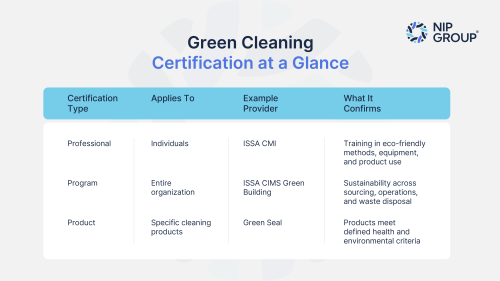
There is an important distinction worth making clearly. A green cleaning certification can apply to an individual professional, a cleaning program, or a product, and each one means something different.
Professional certifications, like those offered through ISSA’s CMI, confirm that an individual has completed structured training in environmentally responsible cleaning methods, equipment use, and product selection.
Program level certifications, like ISSA’s CIMS Green Building standard, assess an entire organization’s commitment to sustainability across every part of its operations, from product sourcing to waste disposal. Product certifications, such as Green Seal, verify that specific cleaning products meet defined health, environmental, and performance criteria.
According to ISSA’s January 2025 guidance, a credible certification process typically includes a thorough evaluation that confirms products, processes, and policies align with sustainable goals, with an emphasis on reduced chemical use, resource conservation, and lower environmental impact.
Understanding which type of certification your business needs and which one a specific client requires is the first step before pursuing any of them.
Why Certification Matters More Than It Used To
The case for green cleaning certification has grown considerably stronger in recent years, for reasons that go beyond environmental responsibility on its own.
Client demand is shifting fast. Major commercial clients are now writing certification requirements directly into vendor contracts. In March 2025, JLL launched a Sustainable Workplace Initiative requiring all contracted janitorial providers to use certified environmental products and report quarterly on water usage and waste diversion. Amazon followed in April 2025 with its own facility cleaning standards mandate for contracted vendors.
Properties pursuing or maintaining LEED-Certified status need cleaning vendors whose practices align with green building standards. A janitorial business without certification is effectively shut out of bidding on a growing segment of premium commercial properties.
Clients also pay more for certified services. According to FieldPulse’s industry analysis, cleaning services that have adopted green practices regularly charge meaningfully higher rates than competitors still using conventional products and methods, and clients accept those rates because the certification functions as a trust signal. Certified practices also prioritize low toxicity products, which directly benefits occupant health in schools, healthcare facilities, and offices where chemical sensitivity is a real concern.
For a business deciding whether green cleaning certification is worth the investment, the market is largely making that decision already. The contracts available without it are shrinking, and the ones that require it are protected by janitorial service insurance that reflects the products you are actually using on the job.
Must read: Commercial Cleaning Quote That Wins the Job
How a Green Cleaning Program Changes Your Risk Profile
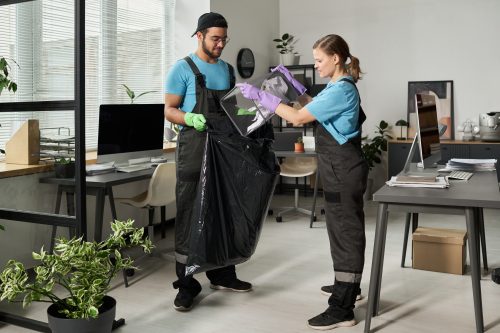
Cleaning workers throwing garbage in trash bag during cleaning in office
Here is what does not get discussed enough when businesses pursue green cleaning certification. Adopting a new green cleaning program is not just a procurement decision. It is an operational shift that changes your exposure in ways your existing coverage may not anticipate.
New cleaning chemistries and green cleaning products certification standards bring new exposure patterns. Different surfactant interactions, different surface compatibility issues, and different professional judgment claims arise when a sustainable product underperforms a conventional one on a specific job.
A client whose marble flooring is damaged because a green certified product was not compatible with that surface does not care that the product was certified. They care that something was used on their property and it caused damage. That is a claim regardless of how environmentally responsible the product was.
If you are working through how to choose eco-friendly cleaning products for client work, surface compatibility testing and documentation matter as much as the certification label itself. Insurance written before your green transition may not reflect this evolving product mix.
MaintenancePro: Built for an Evolving Product Mix
Green cleaning certification is increasingly the price of entry for premium commercial contracts. Getting there means changing your products, training your team, and in many cases rethinking processes you have run the same way for years.
Janitorial service insurance needs to keep pace with that change. MaintenancePro’s general liability coverage is built around janitorial chemical use specifically, including the evolving product mix reshaping this industry as more businesses pursue green clean practices and certified programs.
The program covers general liability, workers’ compensation, auto liability, property, crime coverage, and cyber liability, all structured around how janitorial businesses operate today, not how they operated before sustainability became standard.
The carrier behind MaintenancePro holds an A+ (Superior) rating from A.M. Best, backed by more than 35 years of janitorial industry expertise.
Talk to your broker about MaintenancePro or contact us directly. Make sure your janitorial coverage reflects the products and practices your business uses today.
FAQs
What is green cleaning certification?
Green cleaning certification is a designation that confirms a professional, program, or product meets defined environmental and health standards. It can apply to an individual who has completed training, a facility that has adopted sustainable practices organization wide, or a specific product verified through a body like Green Seal.
How do you get a cleaning certificate?
Getting a cleaning certificate typically starts with selecting a recognized provider, such as ISSA’s Cleaning Management Institute or the International Janitorial Cleaning Services Association. The process usually includes:
- Completing structured coursework on cleaning methods and product use
- Passing an evaluation or exam covering safety and sustainability standards
- Maintaining the credential through continuing education or periodic recertification
Program and product certifications follow a similar path but apply at the organizational or product level rather than to an individual.
Do I need a license to clean houses in Oregon?
Oregon does not require a statewide professional license specifically for residential house cleaning businesses. That said, you will likely need a general business license at the city or county level, and certain services involving specific chemicals or equipment may carry additional local requirements. Checking with your local jurisdiction before starting is the safest approach.
Which is the best insurance for green janitorial services?
The best insurance for green janitorial services covers the specific exposures that come with newer cleaning chemistries, not just standard janitorial risk. That means general liability built around chemical use, surface compatibility claims, and workers’ compensation for staff working with evolving product lines. MaintenancePro is structured around exactly this, backed by an A+ (Superior) rated carrier and decades of janitorial industry expertise. Ask your broker about it.