










Summary
- A work mistake can cost your client money even when no one gets hurt.
- The right coverage pays these claims along with the cost of defending your business.
- This blog explains what errors and omissions insurance covers and which trades need it.
Errors and omissions insurance pays for claims when a mistake in your work costs a client money. In most of these claims, nothing breaks, and no one gets hurt. So, many contractors assume their general liability policy covers them.
That assumption, however, is getting riskier. Insurance companies now spend more on software that checks each claim against the policy wording. Grand View Research valued the U.S. market for this software at about $4 billion in 2025. It further expects 13.9% growth each year through 2033.
So if your policy covers only injuries and property damage, a claim over a work mistake may not be paid. Many contractors learn this only when a client demands payment. In this blog, we explain what this coverage includes and which trade businesses need it.
Must Read: High Deductible vs. Low Deductible: The Logic Behind Your Choice
What Is Errors and Omissions Insurance?
Errors and omissions insurance is liability coverage built around the quality of your work. In simple terms, it pays your legal defense and settlement costs when a client claims your mistake cost them money. These claims can come up even when nobody is hurt, and nothing is damaged.
When brokers talk about insurance errors and omissions, they usually mean this same protection. It is also called professional liability, or workmanship coverage when it comes built into a general liability policy.
A pool service job shows how this kind of claim can arise. Say a commercial pool you maintain fails a county health inspection because of a setting you missed. The owner has to close the pool for a week and loses that income. Because the closure traces back to your work, the owner can turn to your business for the lost revenue.
Why Doesn’t General Liability Cover Every Mistake?
Most work mistakes fall outside general liability because the policy was written for accidents. It pays when someone gets hurt or when another person’s property is damaged. A work mistake usually does neither.
What general liability is built to cover
- Bodily injury: A client or passerby gets hurt on your job.
- Property damage: Your crew or equipment harms something another person owns.
What it tends to leave out
- Faulty workmanship: The cost of fixing or redoing work your crew got wrong.
- Financial loss: Lost income or extra costs your client faces after the mistake.
- Bad advice: Losses tied to a product or method you recommended.
The policy’s own exclusions explain these limits. Most standard general liability insurance policies exclude damage to your own work and claims tied to professional services. If a client says your mistake cost them money, either exclusion can leave that claim unpaid.
Some general liability products add workmanship coverage to pay for these claims. Your broker can tell you whether your policy includes it.
Must Read: Worker Compensation Insurance And Equipment Coverage: What Every Contractor Needs To Know
What Does Errors and Omissions Insurance Cover?
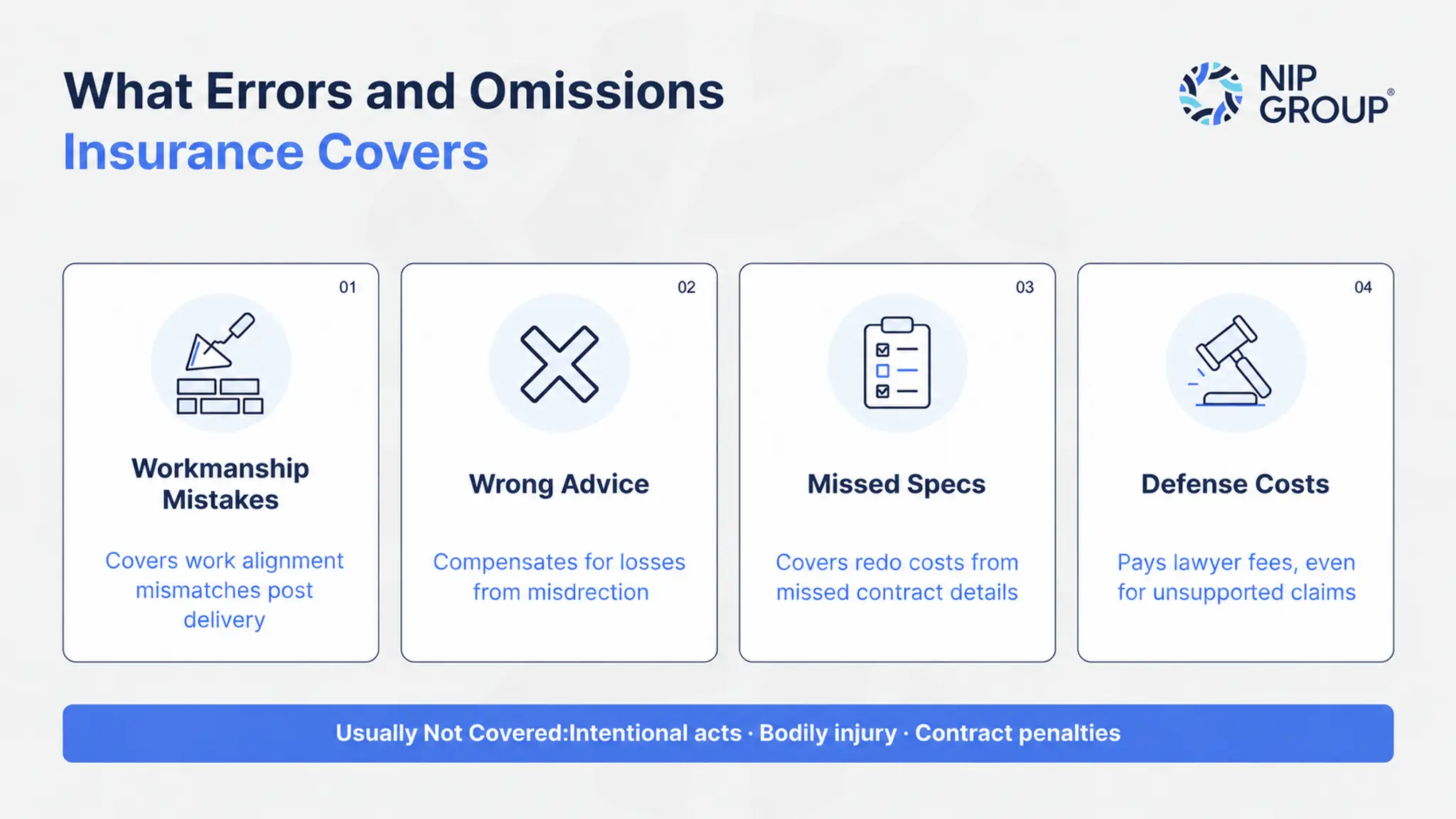
For trade businesses, E&O coverage usually responds to these four kinds of problems on the job:
Workmanship Mistakes
This is the claim most contractors think of first. Say your crew installs a paver patio for a restaurant’s outdoor seating area. A few months later, the base you prepared settles and the pavers start to shift. The owner has to close the patio for repairs and expects your business to pay for the redo. Workmanship coverage can help with that cost.
Wrong Advice or Recommendations
Clients lean on your experience when they decide what to buy. So when a recommendation goes wrong, the criticism tends to come back to you. Suppose the pump you suggested is too small for a commercial pool.
The owner may then ask you to pay for new equipment and lost days. Since the loss started with your recommendation, E&O coverage can help pay this claim.
Missed Specs or Scope Items
Commercial contracts list the exact materials and depths each job requires. If your crew misses one of those details, the work may fail inspection or need to be redone. Your client will likely send you the bill for the redo and the lost time. E&O coverage can help pay that claim because the loss came from a mistake in your work.
Defense Costs
Some claims have no merit at all, but you still have to answer them, and lawyer fees start adding up from the first letter. Most E&O policies help pay for your defense, so one dispute does not drain your cash.
What It Usually Leaves Out
E&O coverage usually excludes these claims.
- Intentional acts: Mistakes made on purpose or with clear disregard for safety rules.
- Bodily injury: These claims belong under general liability or workers’ compensation.
- Contract penalties: Late-finish fees you agreed to in a contract, unless your policy says otherwise.
Design work needs a separate look. If your work includes stamped design plans or engineering, ask your broker about a standalone professional liability policy. Workmanship coverage inside a general liability policy is not designed for that level of design work.
What Errors and Omissions Insurance Covers
Which Trade Businesses Need Errors and Omissions Insurance?
If clients rely on your advice or expect you to follow their plans, your business likely needs errors and omissions insurance. In each trade below, a small error can become a bill your client expects you to cover.
- Landscapers and lawn care companies: If your irrigation layout waters the wrong zones, the client may expect you to pay for the redo.
- Pool contractors: A wrong chemical setting can fail an inspection and close a commercial pool, costing the owner income.
- Tree care companies: Clients keep or remove trees based on your advice, so a wrong call can come back to you.
- Excavation and paving contractors: A grade that misses the plan can force a tear-out, and the client may expect you to pay.
- Utility contractors: One misplaced line can delay an entire project, and those delay costs often land on your business.
- Greenhouse and nursery growers: A mislabeled plant order can cost your buyer a full growing season of sales.
- Janitorial and maintenance companies: The wrong cleaner on a specialty floor can ruin its finish and leave you facing the refinishing bill.
Some commercial clients also require proof of E&O coverage before work starts. Without it, you may lose the job.
What Affects the Price of Errors and Omissions Insurance?
It depends on how much risk your work carries. Your broker will look at a few details about your business to set your price.
- Your trade: Work based on plans or design advice carries more risk, so it usually costs more to cover.
- Revenue: More revenue often means more jobs and more chances for a claim.
- Claims history: Claims filed over your past work can raise your price at renewal.
- Limits and deductible: A higher limit raises your premium, while a higher deductible can lower it.
How you buy the coverage matters too. When your general liability policy already includes workmanship coverage, you have one policy to manage instead of two.

Get Workmanship Coverage Built Into Your General Liability
The easiest way to cover work mistakes is to choose a general liability policy that already includes them. LiabilityEdge is built that way. It is NIP’s stand-alone general liability policy for growers and trade contractors, with Workmanship Errors and Omissions Coverage included. If a client accuses your work of causing a loss, your policy is ready to respond.
It includes protection for employment practices, cyber claims, limited pollution, and wildfire liability. The policy is also backed by insurance companies rated A+ XV. This means they have a solid financial ability to pay claims and rank among the largest in size. LiabilityEdge covers more than 50 trade and grower classes and is available in most states.
Ask your broker to sign you up for LiabilityEdge. Or, contact us to find out how LiabilityEdge fits your trade and your contracts.
FAQs
1. Do consultants need E&O insurance?
Yes, most consultants need E&O insurance because clients pay them for advice. If that advice leads to a loss, the client may hold you responsible. The same risk applies in the trades. An irrigation consultant or a landscape designer can face this type of claim.
2. What is another name for errors and omissions insurance?
Another name for errors and omissions insurance is professional liability insurance. You may also see it under these names:
- E&O insurance: It’s the short name most brokers and clients use.
- Malpractice insurance: This is common for doctors and lawyers.
- Professional indemnity insurance: This term is used more often outside the U.S.
3. Does E&O insurance cover mistakes my employees make?
Yes, E&O insurance generally covers mistakes your employees make on the job. Subcontractors should carry their own coverage, so ask them for proof before they start.
4. Is E&O insurance required by law?
For most trade businesses, this insurance is not required by law. Some licensed professions must carry it, such as real estate agents in certain states. For contractors, the requirement usually comes from client contracts instead. Read bid documents closely before you sign.